Server-side tracking collects marketing events on a server you control instead of in the visitor's browser, and that server forwards them on to platforms such as Google Ads, GA4 and Meta. The browser makes one request to your own domain rather than a separate request to every vendor, so collection no longer depends on what each visitor's browser and extensions allow. It does not remove the need for consent, and it cannot recover an event a visitor never agreed to send.
Why it matters for agencies
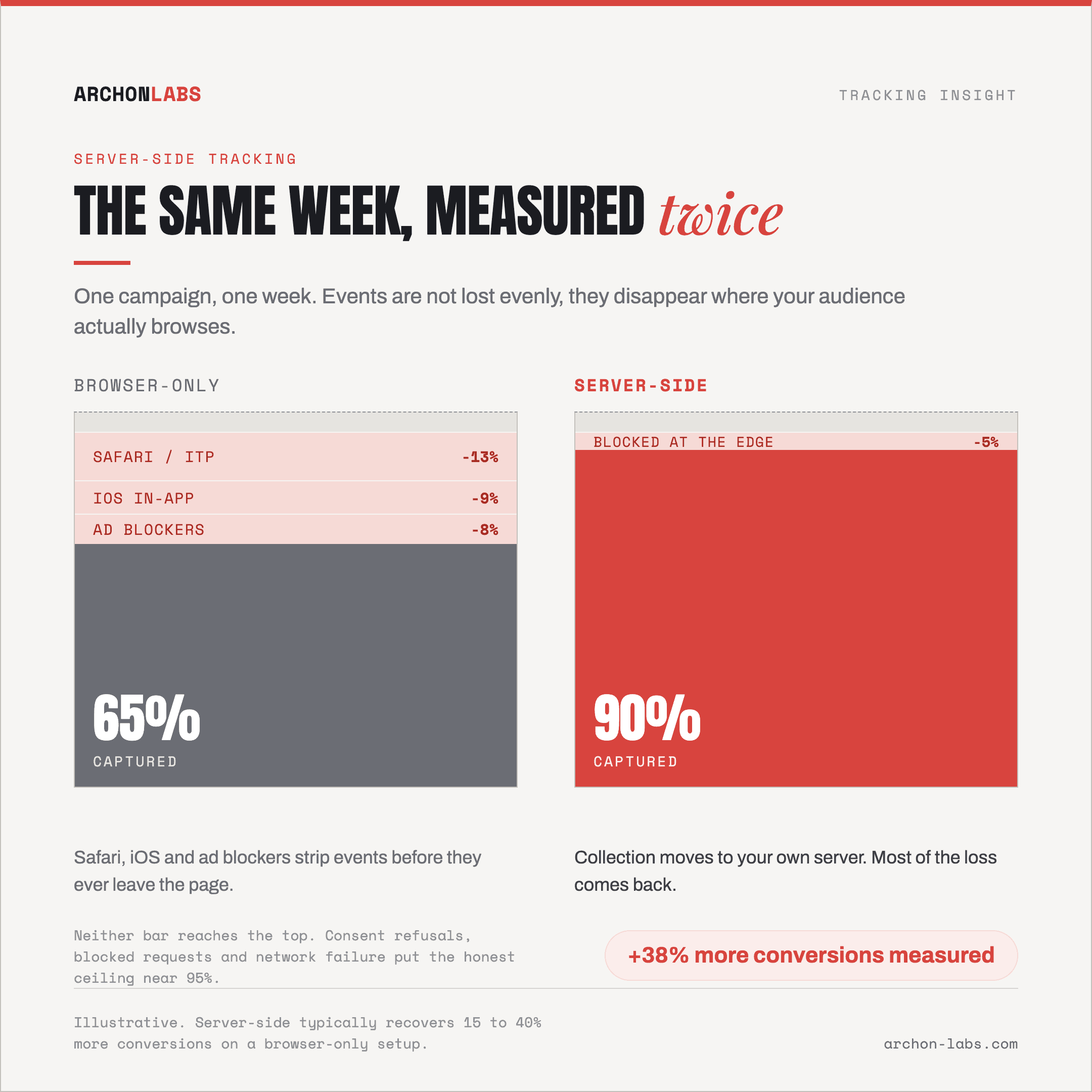
The effect shows up in two places an agency cares about: the numbers you report to the client, and the numbers the bidding algorithms actually see. Events lost in the browser are not lost evenly. They disappear most on Safari and iOS traffic and on visitors running an ad blocker, so a campaign can read as weaker than it is purely because of what its audience browses with. Moving collection server-side typically recovers 15 to 40% more conversions on a setup that was browser-only, which changes both what you can prove and what the platform has to optimize against.
What teams get wrong
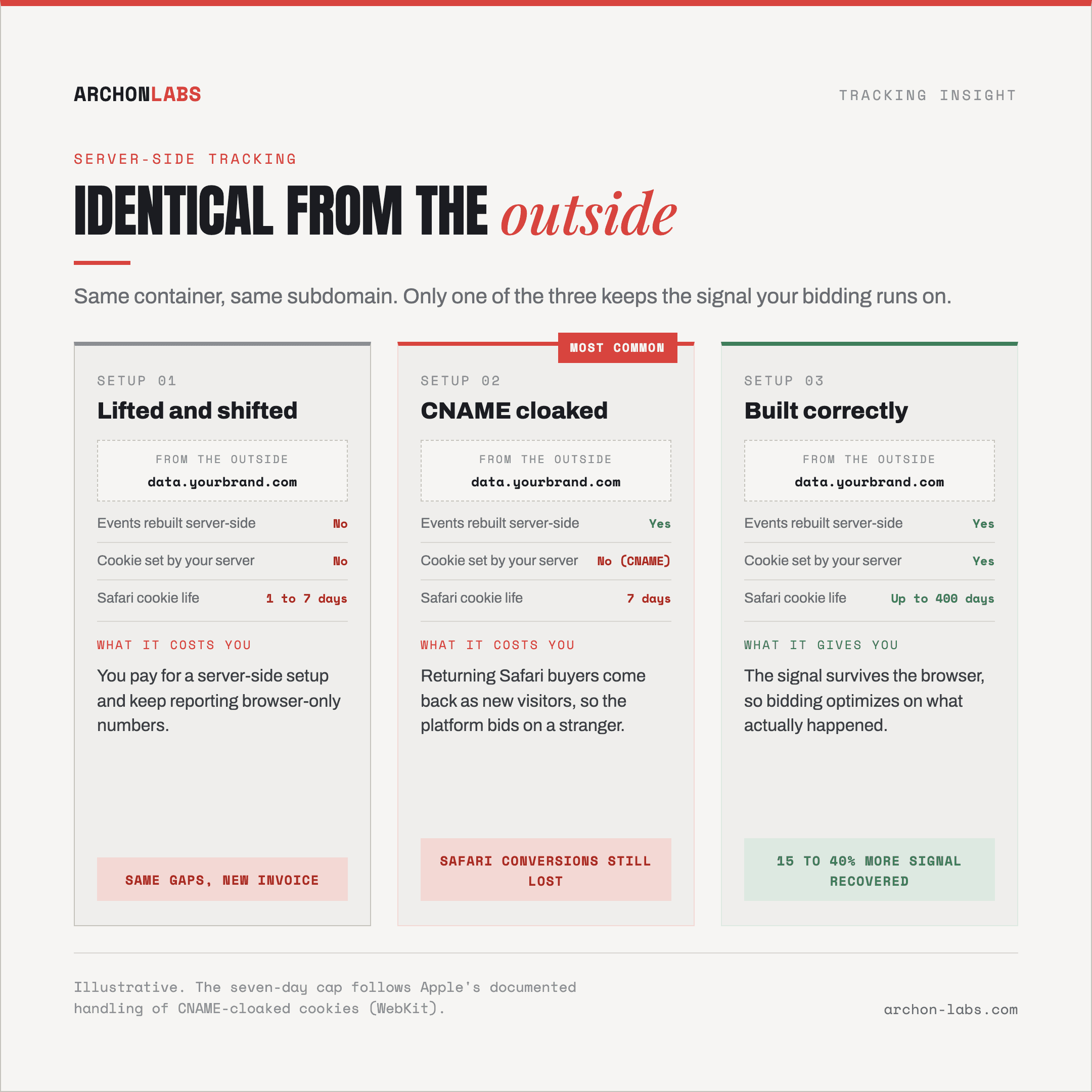
The most common mistake is treating server-side as a switch rather than a rebuild. A container running on your own subdomain proves nothing by itself. If the events arriving at it are the same incomplete browser events, the problem has moved rather than been solved. The second mistake is expecting completeness. Consent refusals, blocked requests and ordinary network failure still remove a share of events, so the honest ceiling is roughly 95%, and a vendor promising more is selling a number rather than a setup.
The third is quieter and costs the most. Teams assume that first-party means Safari treats the cookie as first-party. It does not always: Apple's Intelligent Tracking Prevention caps cookies set in a response from a subdomain that resolves through a CNAME to a different domain at seven days, which is documented in WebKit's own post on CNAME cloaking. At Archon Labs that is the failure we find most often on setups that were otherwise built correctly and were still quietly losing Safari conversions.