The symptom
Server-side tracking gets pitched to you constantly, and the pitch always sounds the same: expensive, technical, and vague about what you actually get back. You have a client roster to run, and "recover some conversions" is a hard thing to put a number on before you have spent the money. So it sits on the maybe pile.
Maybe you already went ahead. You spun up a container in Stape or Taggrs, wired GA4 through it, and the dashboards look roughly the same as before. From where you sit the box is ticked and the payback is invisible. It is a fair reaction, and it is usually the wrong conclusion.
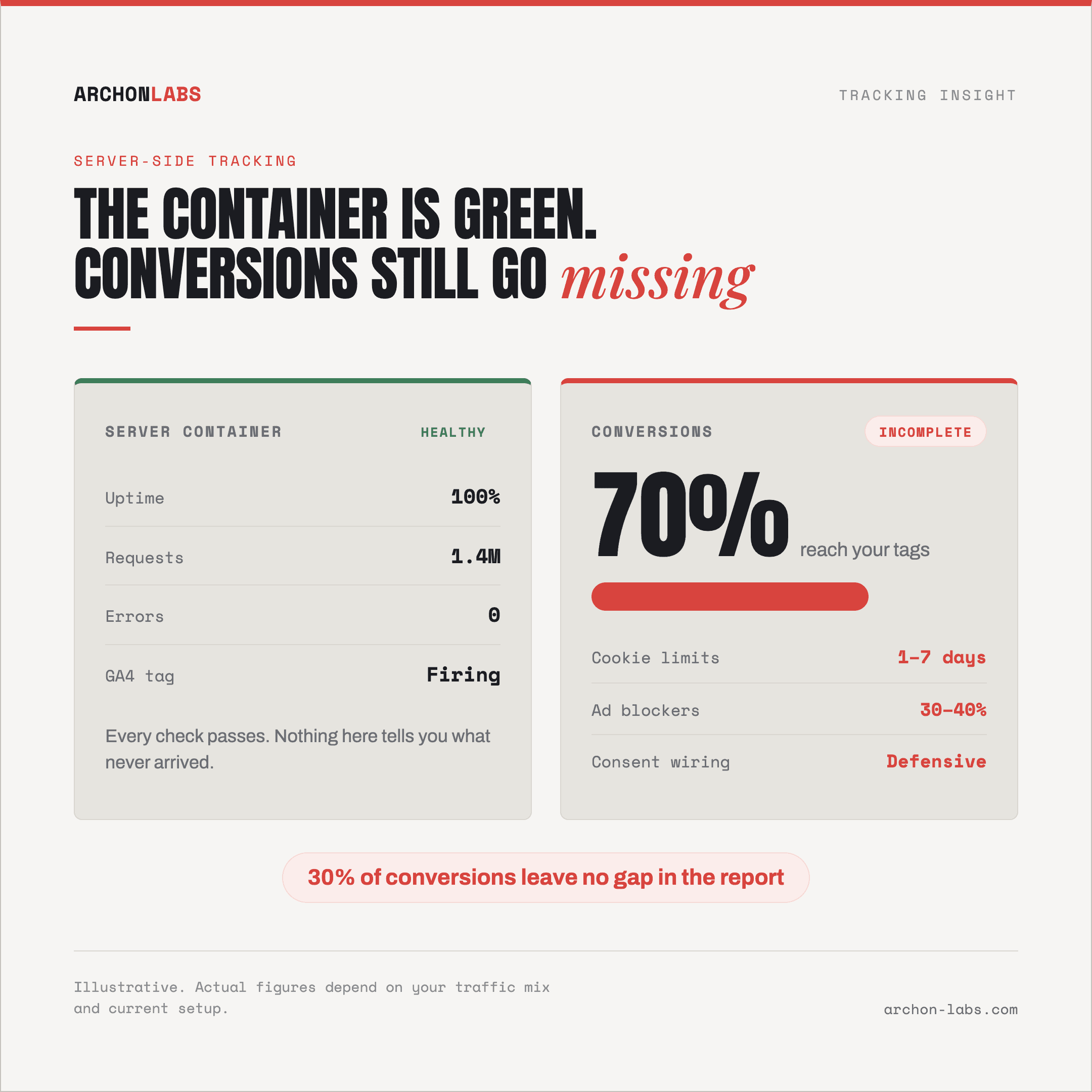
The honest problem is that you cannot see what you are not collecting. A conversion that never reached your tags leaves no gap in the report, no red number, nothing to point at. The loss is real, it is just quiet, which makes "is this worth it" almost impossible to answer from the dashboard alone.
Why it happens
Server-side tracking feels like it does not pay back for two separate reasons, and it helps to keep them apart.
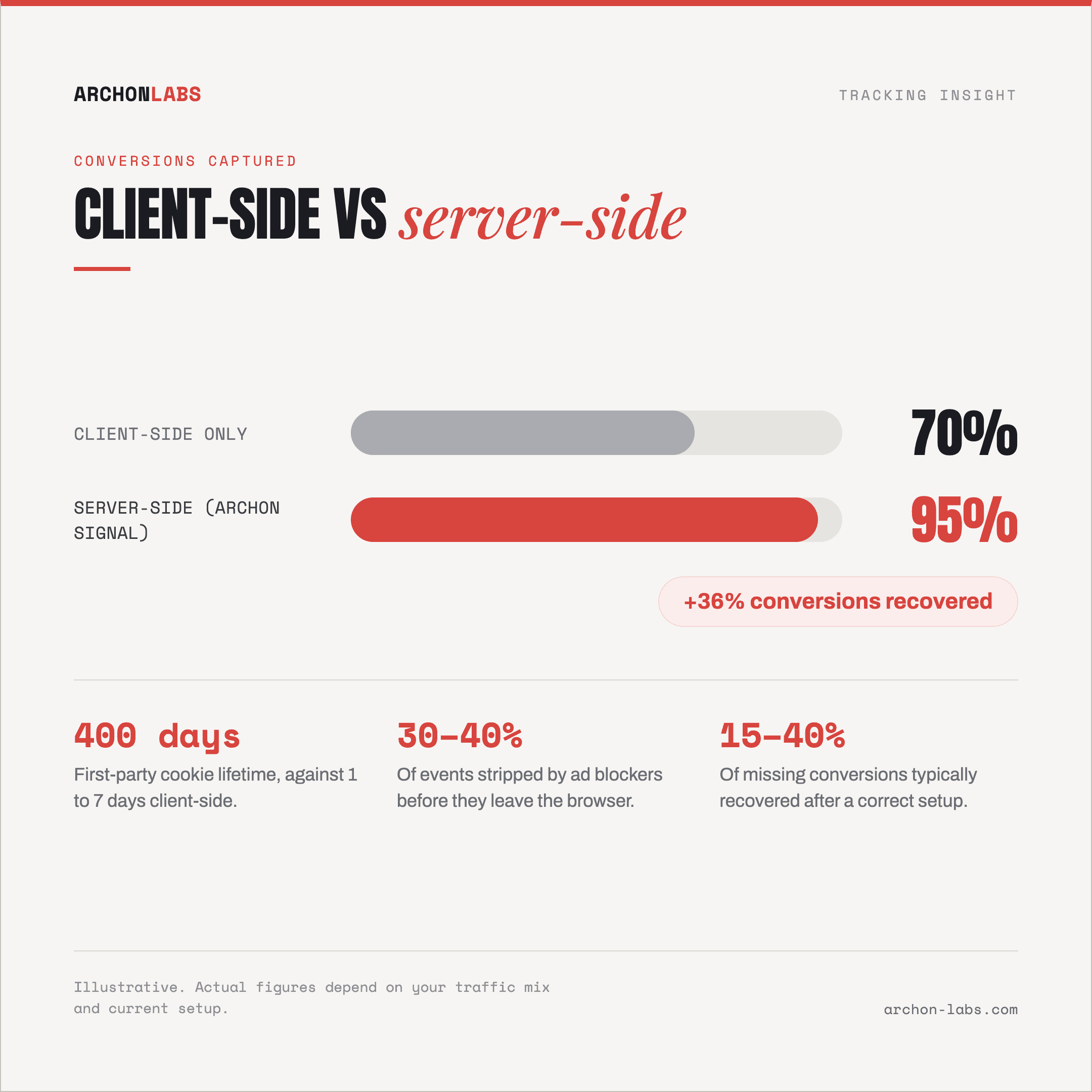
The first is that the loss is a sum of small leaks, never one obvious break. Safari and iOS clear third-party cookies in one to seven days, so returning visitors get counted as new and late conversions never tie back to the campaign that earned them, while a first-party cookie set server-side can last up to 400 days. Ad blockers strip 30 to 40% of tracking events before they even leave the browser. A consent banner wired defensively drops conversions you are actually allowed to measure. Each of these is small and defensible on its own. Added up, a typical account has 15 to 30% of its conversions consistently uncaptured, and the algorithm spending the budget is optimising on that holed picture without anyone noticing. We broke down exactly where those conversions go before they reach GA4 if you want the mechanics.
The second reason is the one that catches agencies who already made the investment: having the tool is not the same as having it configured right. A container that exists is not automatically a container that is adblocker-proof, Safari-proof, and consent-correct. UTM parameters and click IDs have to be protected, first-party cookies have to actually be set first-party, and events have to be validated against what the platforms receive. Skip that work and the setup looks live while quietly recovering a fraction of what it should. That is why two server-side setups on the same account can differ by a wide margin in what they actually bring back.
What good looks like
Worth it is not a property of server-side tracking in the abstract. It is worth it when there is real loss to recover, and the size of that loss is what decides the payback. So the first move is not to buy anything, it is to measure what a given account is actually losing.
Once you know there is signal to recover, the fix is conceptual and it stays at the business level. Move collection onto your own domain so ad blockers and cookie limits stop deciding what you get to measure. Feed the platforms a fuller, validated stream so they optimise on real outcomes instead of a thinned sample. And verify before you switch, running the new path in parallel with the existing setup so nothing goes live until every conversion is checked against the old numbers. This is the job Archon Signal does: recover the signal the browser was dropping, without touching your campaigns.
Done properly, a server-side setup typically recovers 15 to 40% of the conversions that were going missing. For one performance agency we worked with, that meant 38% of client traffic affected by tracking prevention brought back into measurement, a 26% average uplift in measured conversions, and 14 hours saved per project versus handling it in-house. The recovered signal is not a one-off bump either, it keeps arriving run after run, which is what lets the platforms keep learning on real outcomes.
Frequently asked
We already run Stape, why would we need you?
Because a running container and a correctly configured one are different things. Most of the setups we improve already have server-side infrastructure in place, and the value is in the consent wiring, the click ID protection, and the validation, not in the tool itself. If your setup has never been checked against what the platforms actually receive, there is usually recoverable signal sitting on the table.
How do we know it is worth it before spending anything?
You measure the loss first. That is the whole point of the audit: it maps how much a specific account is losing to cookie limits, ad blockers, and consent before any work starts. If there is little to recover, we will tell you, and server-side is not worth it for that account. Worth it is a conclusion you reach from data, not a promise you take on faith.
Will this change our campaigns or budgets?
No. None of this touches bidding, budgets, or creative. It changes the data underneath the campaigns, which is usually where the real performance is hiding. Your team keeps running the account exactly as they do now.
Is a server-side setup still compliant?
Yes, when consent is wired in correctly. Server-side collection runs alongside Consent Mode v2, so measurement respects consent rather than working around it. Recovery and compliance are two sides of the same setup, not a trade-off you have to make.
How fast do we see recovered conversions?
A typical client account is live one to two weeks after the audit. Recovered signal starts arriving as soon as the new path is verified and the platforms begin receiving the fuller event stream, and because it keeps arriving, the value builds rather than fading after launch.
Server-side tracking is worth it exactly when there is real loss to recover, and the only way to know is to look. Request a free tracking audit and we will measure what a client account is actually losing before you spend a thing.