The symptom
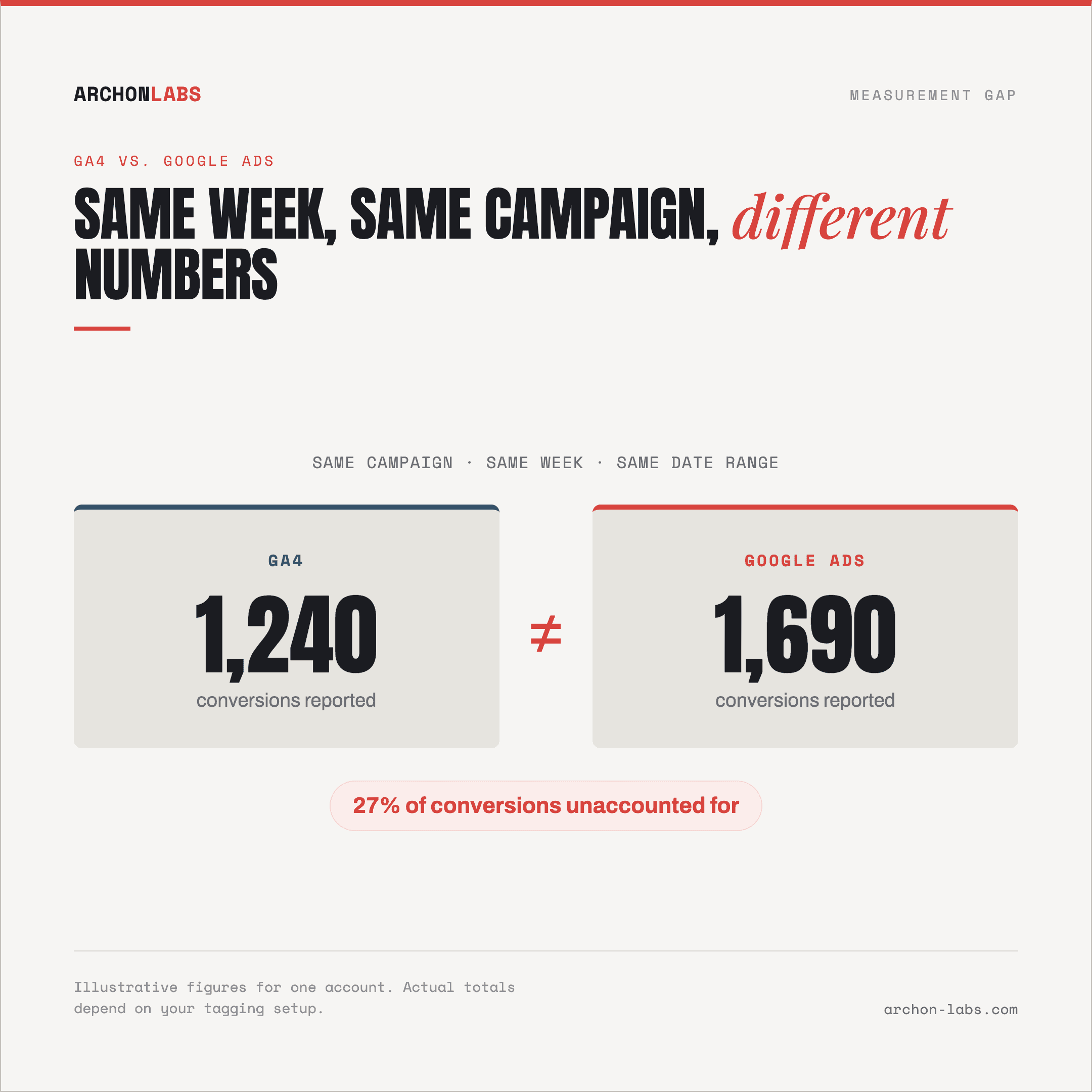
You open GA4 and Google Ads for the same week, filter to the same date range, and the conversion counts do not agree. Ads claims more, GA4 shows fewer, and the client wants to know which number is real. At Archon Labs we hear this from agencies every week, and the honest answer is that both numbers are incomplete, they are just incomplete in different ways.
It is easy to wave away as a reporting quirk. It is not. The gap is real conversions that happened and never made it into your analytics, which means the algorithm spending the client's budget is optimising on a picture with holes in it. In a quarterly review that is the difference between a channel looking flat and looking like it is working, and you rarely get to redo the story once the client has heard the wrong version.
The reflex is to reconcile the two numbers by hand, stretch an attribution window, or trust whichever platform reports the friendlier figure. None of that recovers a conversion that was never collected. If the event did not reach your tags in the first place, there is nothing in the warehouse to reconcile, and the report ends up confidently wrong rather than usefully incomplete.
Why it happens
There is rarely a single cause you can point at. The loss is the sum of a few leaks that each look small on their own and add up to something that is not. That is exactly why it stays hidden, because nothing is obviously broken.
Browser restrictions. Safari and iOS clear third-party cookies in one to seven days. A returning visitor gets counted as new, and a conversion that lands after the cookie is gone is never tied back to the campaign that earned it. A first-party cookie set server-side can live up to 400 days, so the same journey stays connected.
Ad blockers. Common blockers strip 30 to 40% of tracking events before they ever leave the browser. No request, no event, no conversion. The visit still happened, you simply never saw it, and no amount of dashboard tuning gets it back.
Consent, wired defensively. A banner set up to be safe rather than correct drops conversions you are actually allowed to measure, because it blocks tags before Consent Mode has a chance to do its job.
Half-wired tags. Enhanced conversions and server events that are configured but never validated send thin data, so the platform optimises on less than it thinks it has.
Put together, this is why a typical account has 15 to 30% of its conversions consistently uncaptured. Each leak is defensible in isolation. The total is what quietly moves the numbers the client makes decisions on.
What good looks like
The fix is to stop depending on the browser to carry your measurement, and move collection onto your own domain, server-side. When events are sent first-party to a container you control, ad blockers and cookie limits stop deciding what you get to measure. This is the job Archon Signal does, a server-side setup that recovers the signal the browser was dropping. The detail is on the Archon Signal page.
At a business level it is three steps, and none of them touch your campaigns.
Collect first-party. Events go to a container on your own subdomain instead of a blockable third-party script.
Enrich and validate. First-party identifiers are hashed client-side and passed server-side for enhanced conversions, so the platforms receive a fuller, compliant stream.
Verify, then switch. The server-side path runs in parallel with the existing setup, and every conversion is validated against the old numbers before anything goes live. Nothing goes live unverified.
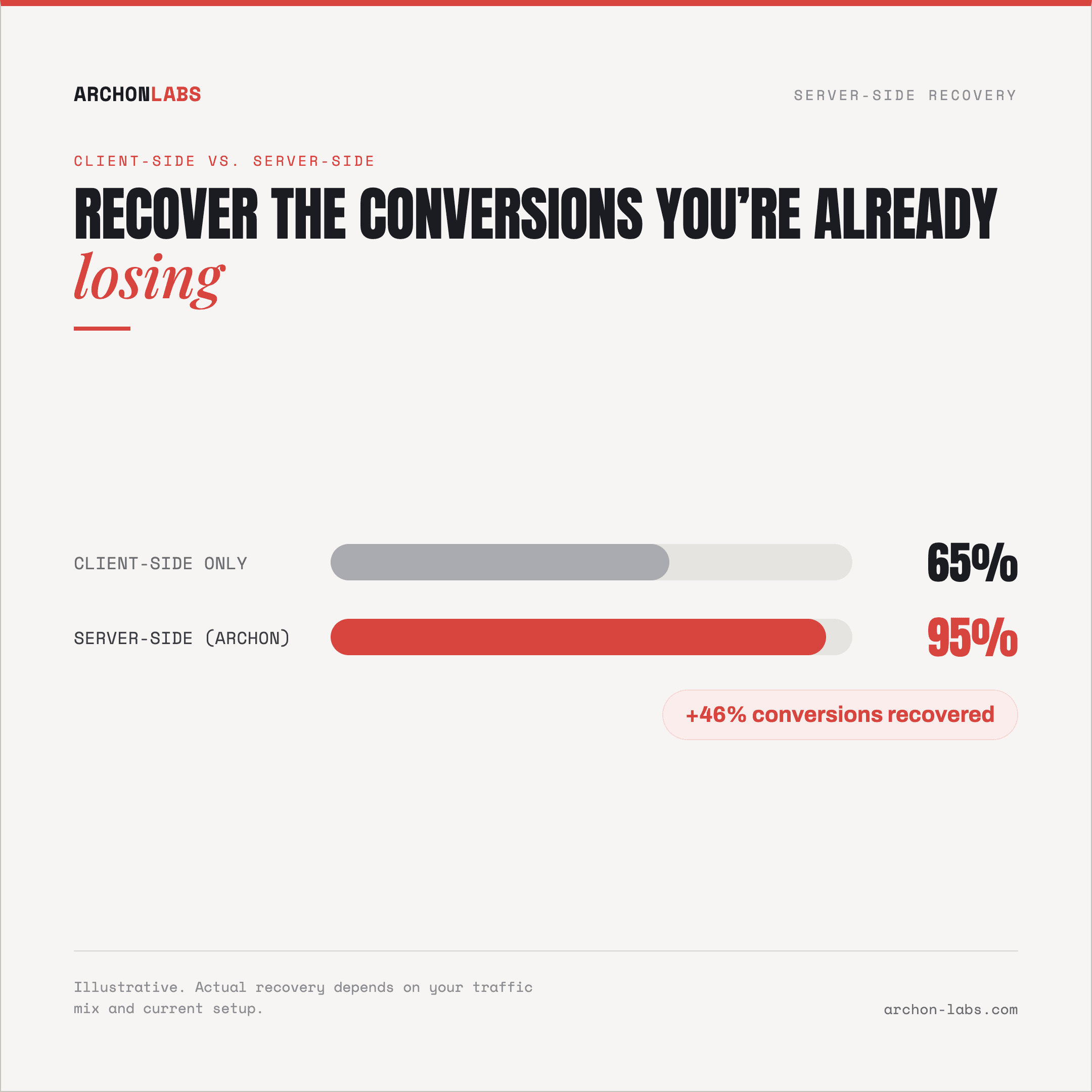
Done this way, a server-side setup typically recovers 15 to 40% of the conversions that were going missing, and the recovered signal flows straight into the platforms so they optimise on the fuller stream rather than the leaky one.
The point is not a one-off bump on a dashboard. Once collection is first-party and validated, the recovered signal keeps arriving run after run, which is what lets the platforms learn on real outcomes instead of a thinned sample of them. That durability is the difference between a fix and a workaround.
Frequently asked
We already run Stape. Are we covered?
Not necessarily. Having a server-side container is not the same as having it configured right. Most of the setups we improve already have one running, and the value is in the configuration, the consent wiring and the validation, not in the tool itself.
Will this change our campaigns?
No. None of this touches your bidding, budgets or creative. It changes the data underneath the campaigns, which is usually where the real performance is hiding.
Is a server-side setup still compliant?
Yes, when consent is wired in correctly. Server-side collection runs alongside Consent Mode v2, so measurement respects consent. Recovery and compliance are two sides of the same setup, not a trade-off.
How fast do we see the recovered conversions?
A typical client account is live one to two weeks after the audit. Recovered signal shows up as soon as the server-side path is verified and the platforms start receiving the fuller event stream.
If you are not sure how much a client account is losing, the fastest way to find out is to have someone look. Request a free tracking audit and we will map where the conversions are going missing.