Consent Mode v2 is Google's mechanism for passing a visitor's consent choices to Google tags, using four separate signals: one for advertising storage, one for analytics storage, one for sending user data to Google for advertising, and one for personalized advertising. Tags read those signals and adjust what they collect and send, so a refusal changes how a tag behaves instead of being ignored. It is not a cookie banner and does not collect consent, it only carries the choice a banner recorded.
Why it matters for agencies
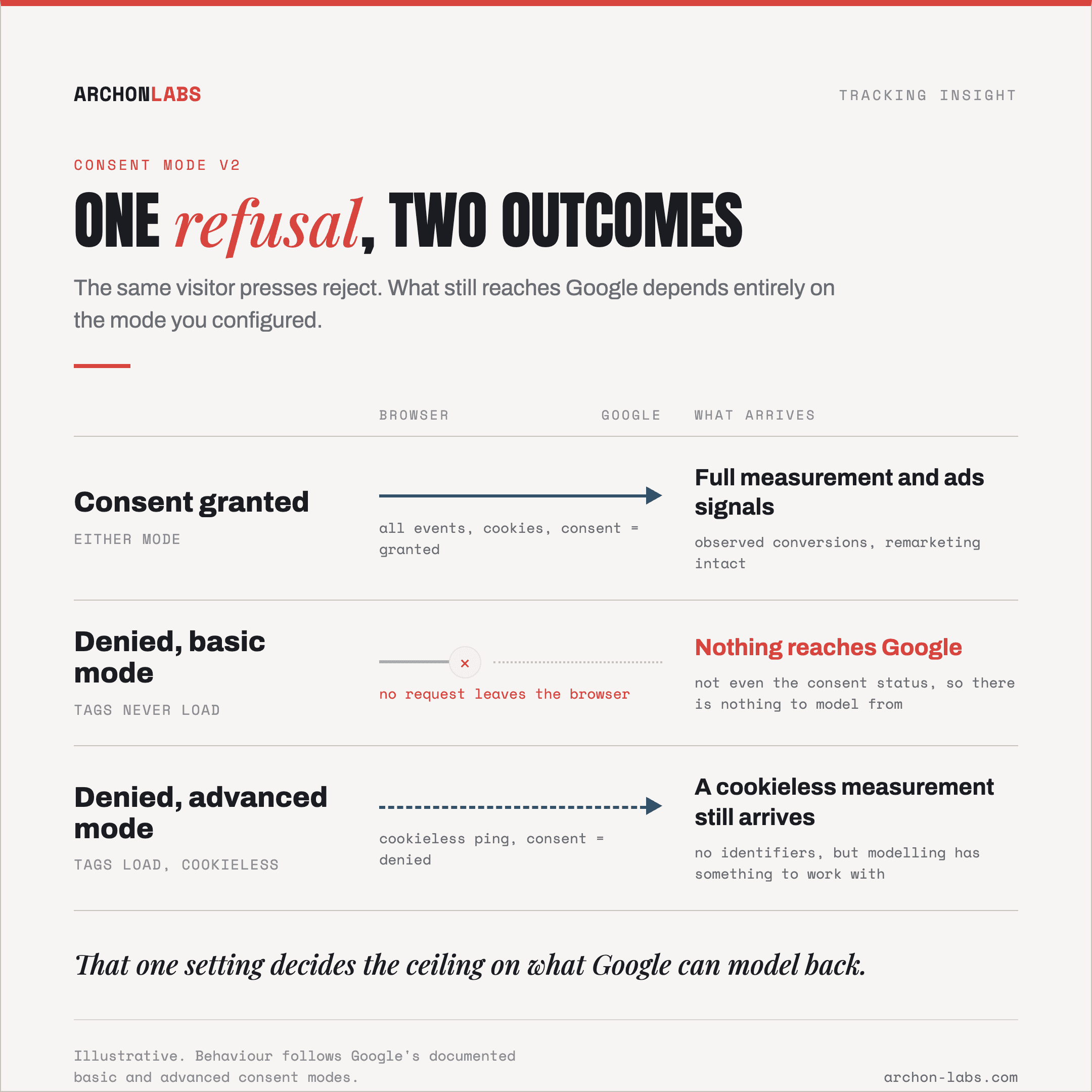
For an agency this sits directly under the numbers a client sees. Google's EU user consent policy covers the European Economic Area, the UK and Switzerland, and Google is blunt about what happens without the signals: "Google won't be able to verify user consent choices and this may lead to loss in data", across measurement, ad personalization and remarketing. The second consequence is quieter. Consent Mode v2 also decides how much is still measured after a refusal. In advanced mode a denied visitor still sends a cookieless measurement, in basic mode nothing reaches Google at all, not even the consent status. That one choice sets the ceiling on what Google can model back.
What teams get wrong
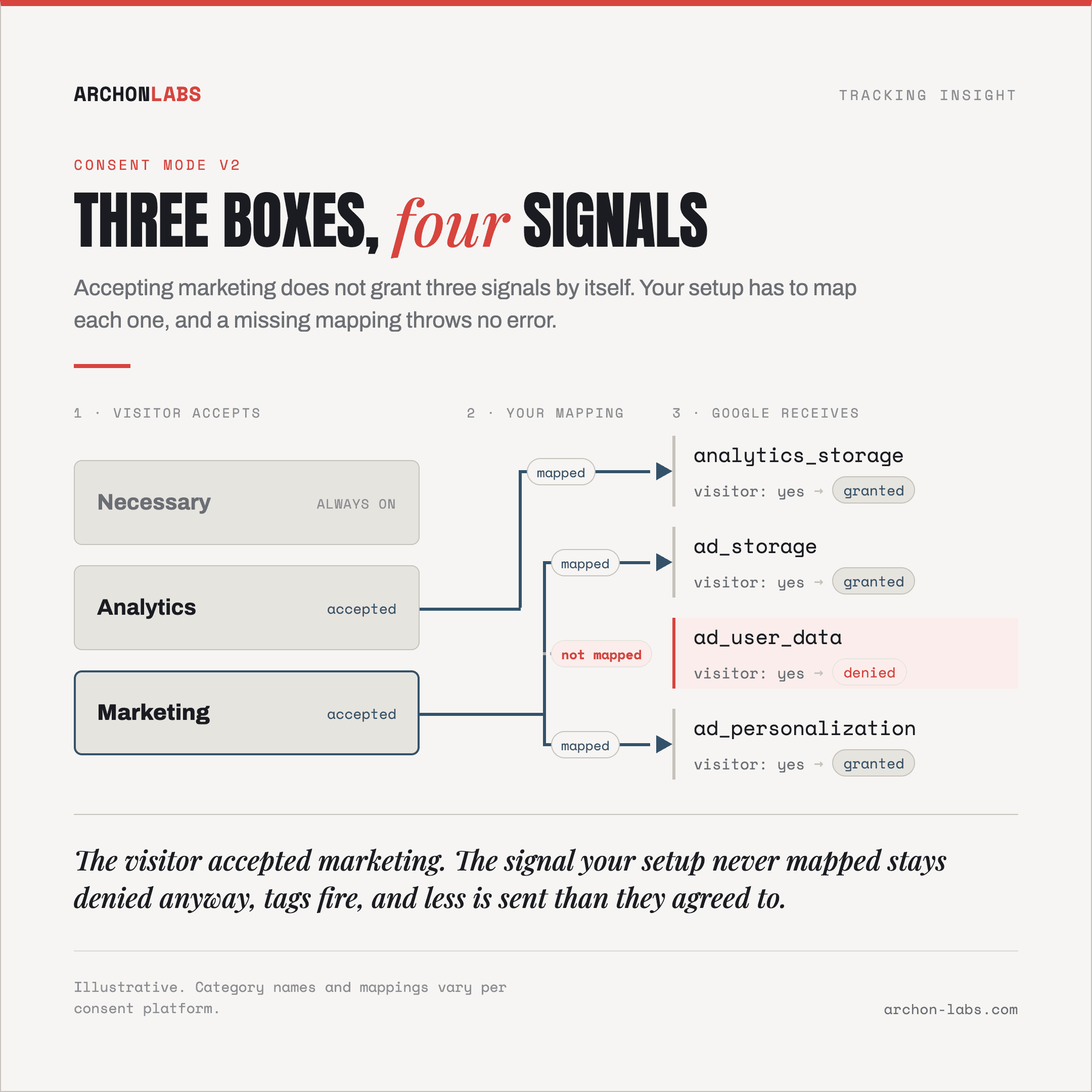
The most common mistake is treating the banner as the implementation. A certified consent platform proves a banner renders, not that the four signals reach Google correctly, and Google does not require one: its documentation allows a custom consent solution just as readily. The expensive version of this is a mapping problem. Most banners offer three categories, necessary, analytics and marketing, while Google reads four signals, so the marketing category has to answer for advertising storage, user data sent to Google for advertising, and personalized advertising. Leave one of those denied while the visitor pressed accept and nothing errors: tags fire, the banner looks right, and less is sent than the visitor agreed to.
Two more are worth naming. Defaults can be scoped per region, so denying everything for all traffic worldwide is a decision somebody made, not a rule. And modelling does not quietly repair the rest: Google sets a threshold of 700 ad clicks over a 7 day period per country and domain grouping, so small markets get nothing modelled back. At Archon Labs the mapping error is the one we find most on setups that passed every compliance check.