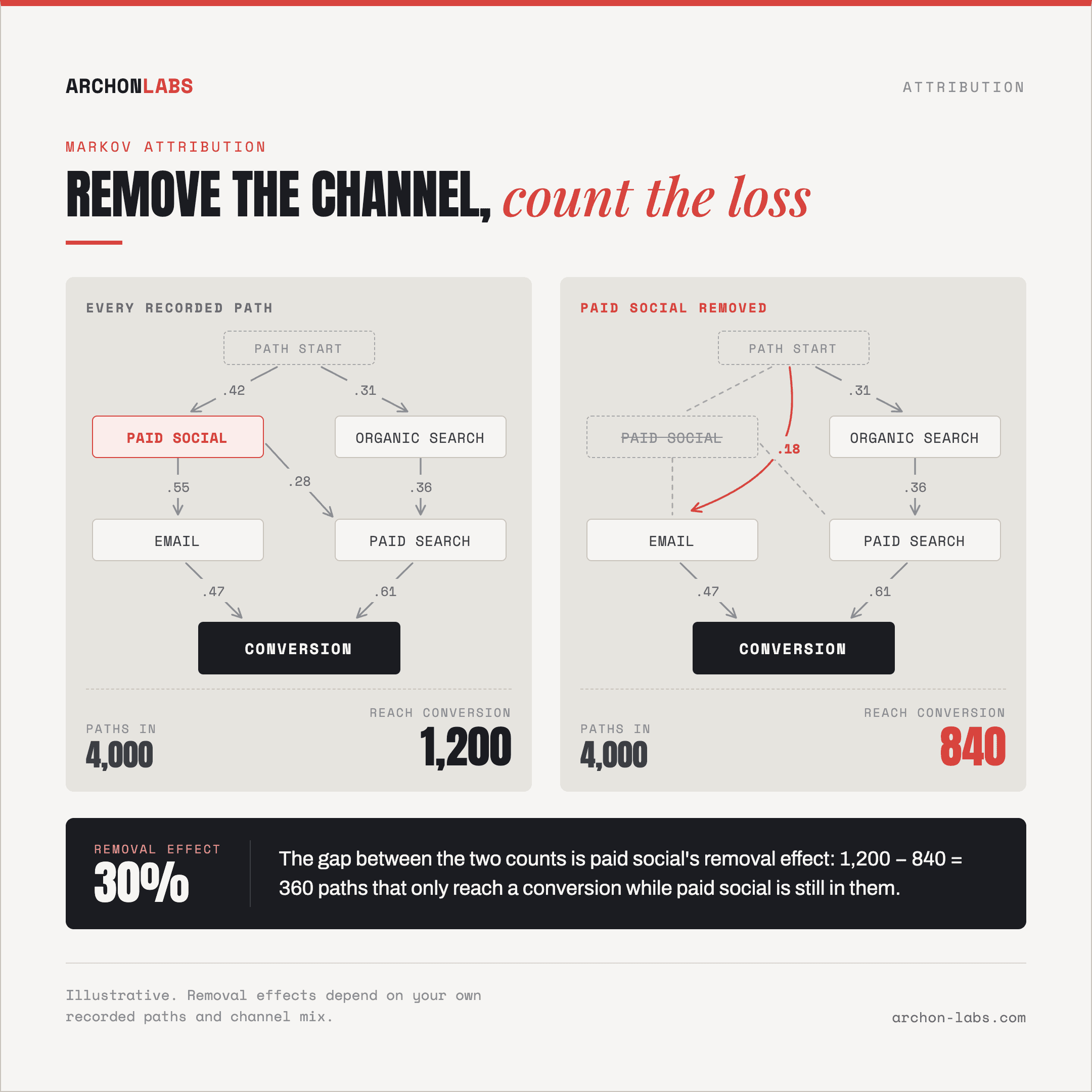
Markov attribution is a data-driven method for crediting marketing channels in a multi-touch customer journey, built by modelling visitor paths as a Markov chain, a graph connecting channels by the probability of moving from one to the next. Credit for each channel is its removal effect, the drop in conversion probability the model calculates when that channel is removed from the graph and every path is recalculated without it. The graph comes from an account's own recorded paths, so it needs a large, varied set of multi-touch journeys to produce a stable answer.
Why it matters for agencies
When a client asks which channel earns credit for a sale, a Markov attribution run answers with a number that has a mechanism behind it. Take paid social out of every recorded path and count how many fewer of those paths still reach a conversion, and that difference becomes paid social's removal effect and its share of the credit. That is a different answer than a last click report, because it comes from the account's own recorded journeys rather than a rule chosen in advance. What moves in the dashboard is the story a channel tells: a channel that rarely closes a sale alone but consistently sits early in converting paths can outscore a channel that closes plenty of sales by itself.
What teams get wrong
The most common mistake is treating a platform's own "data-driven attribution" as if it already is a Markov chain model. Google's own documentation describes data-driven attribution only as crediting based on an account's past conversion data, never naming Markov chains or any specific mechanism, so calling the two the same thing is an assumption dressed up as fact. A Markov attribution run built on raw path data and a platform's built-in data-driven model can produce different splits for the same conversions, and Archon Labs treats them as two separate methods until a platform documents otherwise.
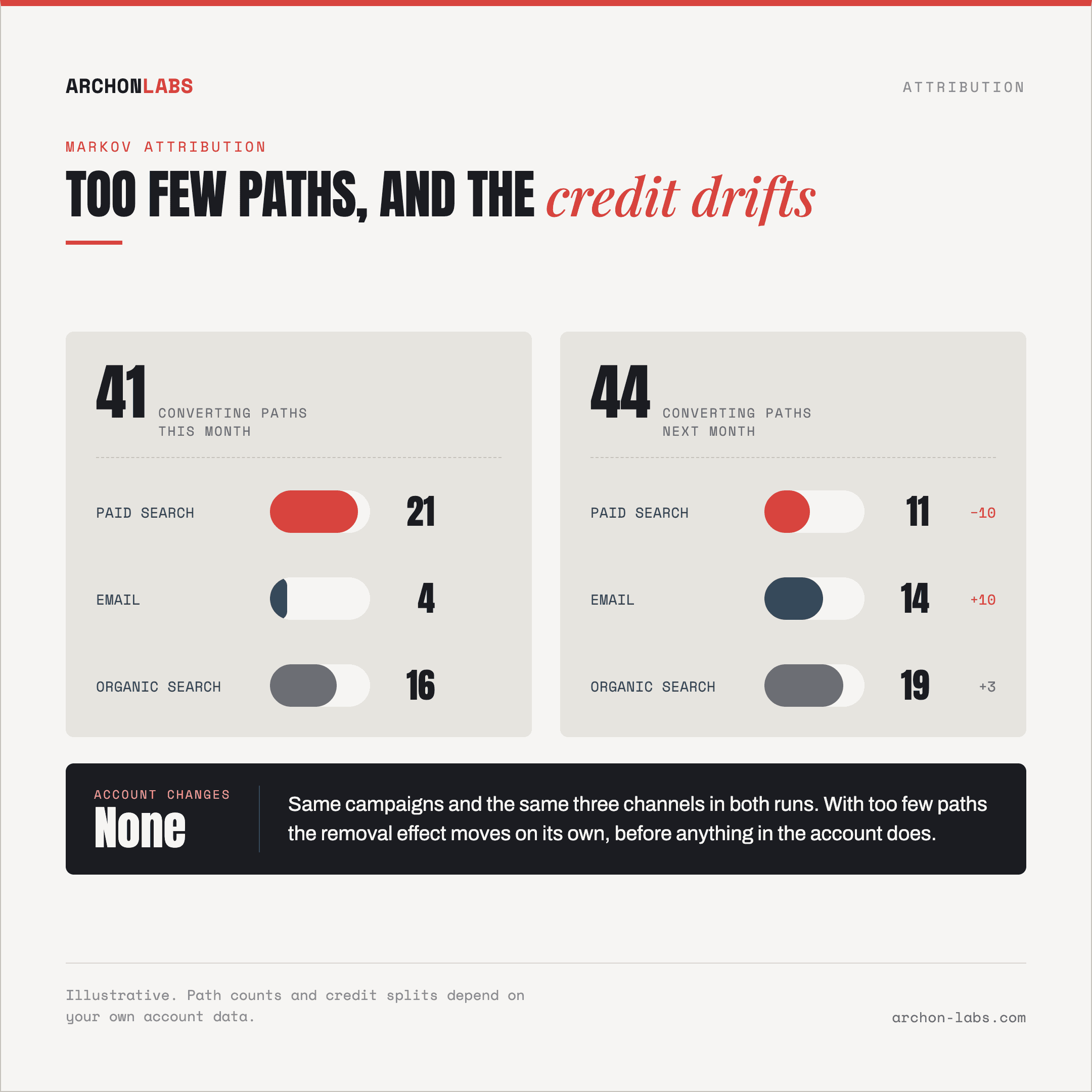
The second mistake is running the model on too few converting paths to trust the result. A transition graph built from a handful of multi-touch journeys produces removal effects that swing from one export to the next for reasons unrelated to the campaigns, and a monthly re-run can hand a channel a different score than last month's did. The model needs path variety, not just volume, so an account where every journey runs through the same three channels in the same order gets no more insight than a simpler heuristic.