A data warehouse is a central system that holds copies of data taken out of the tools that produced it, organised for analysis and reporting rather than for running those tools. It keeps current and historical records from several sources in one place, so website events, ad spend and CRM revenue can be queried together and compared over time. It is a storage and query layer, so it reflects the quality of whatever is loaded into it rather than improving it.
Why it matters for agencies
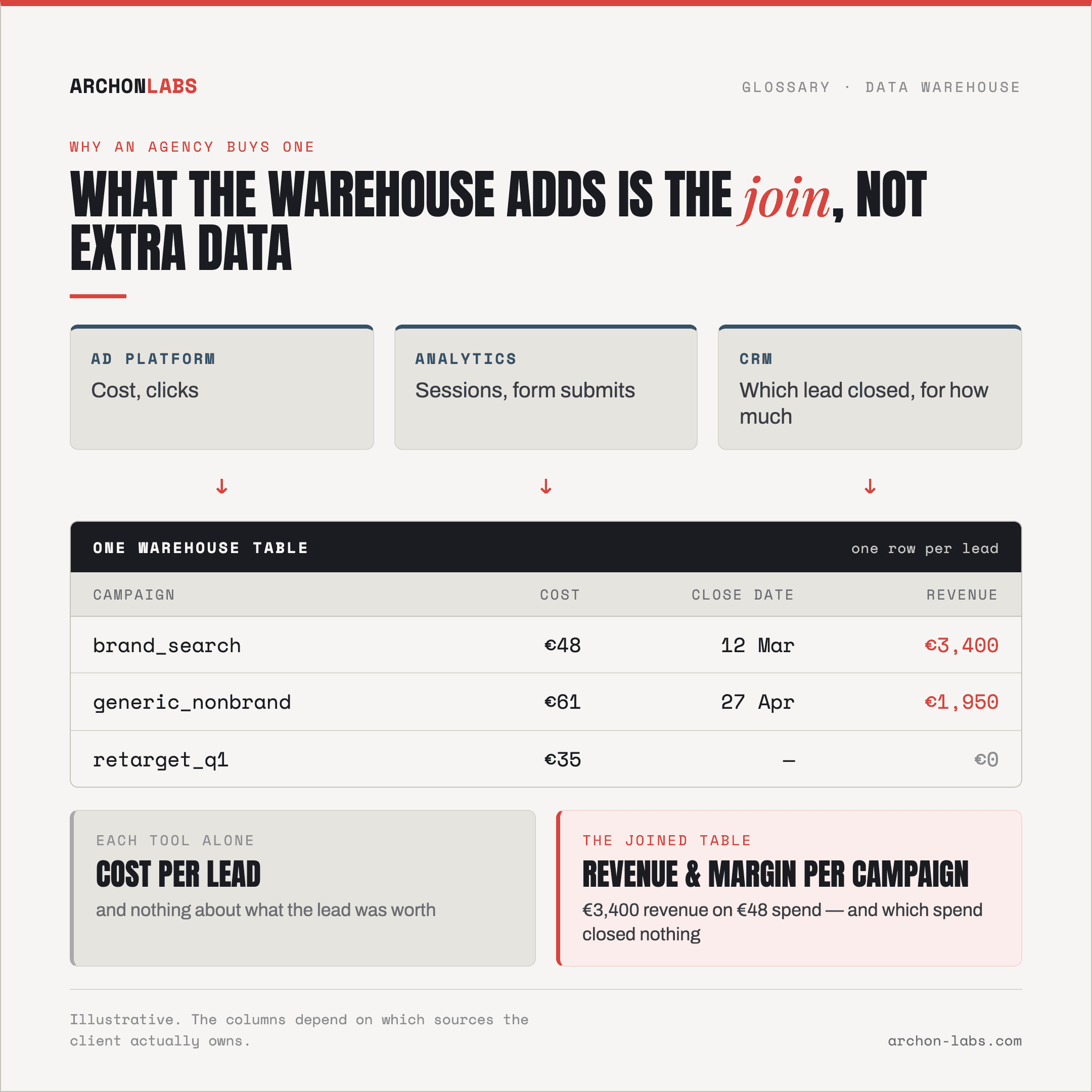
For an agency, a warehouse is the layer where the numbers a client actually cares about can meet. An ad platform reports on its own clicks, analytics reports on the website, the CRM knows which lead closed and for how much, and no single interface can join the three, so cost, lead quality and revenue only become one answer once they sit in one place. History works the same way: a standard Google Analytics property keeps user-level and event data for at most 14 months and then deletes it, while a table in a warehouse the client owns keeps accumulating. That is what turns margin per channel, or this quarter against two years ago, from a research project into a query.
What teams get wrong
A warehouse gets bought as a single source of truth and quietly becomes several, because raw events do not arrive carrying the metrics people argue about. Google notes that its interface applies its own session-level attribution and that this cannot be reproduced from the exported data, and it lists session counting, metric scope and time zones as the usual reasons two people reach two different totals. So whoever writes the query decides what counts as a session, which channel gets the conversion, and where the day starts. That rarely gets written down, so the client hears one number from the dashboard and another from an analyst, and the argument the warehouse was meant to end reappears in SQL.
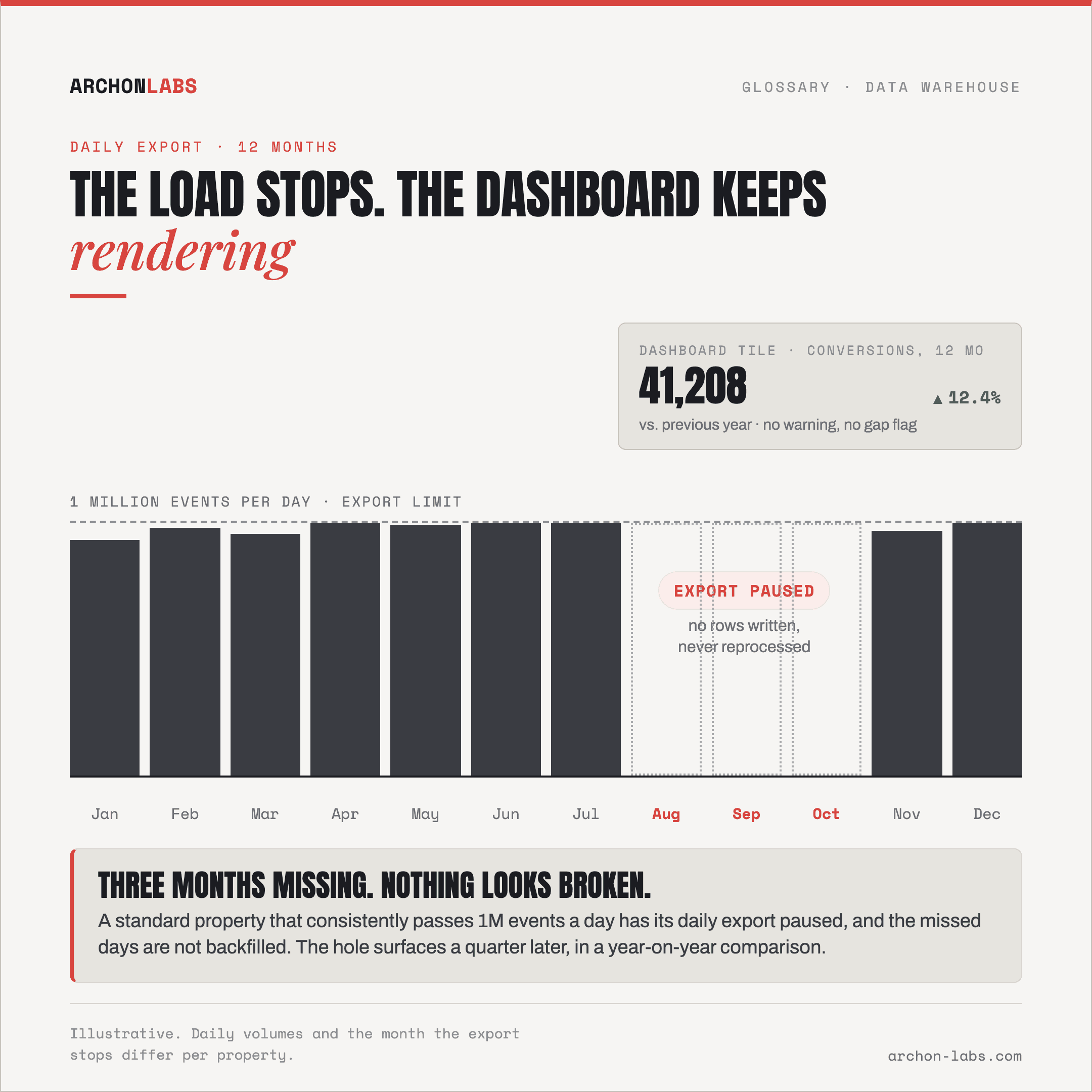
The second mistake is treating the load as permanent infrastructure. A standard property that consistently exceeds 1 million events a day has its daily export paused, and the days it missed are not reprocessed, so the hole is there for good while the dashboard on top keeps rendering as though nothing happened. Archon Labs finds gaps like that in warehouses nobody had reason to doubt, usually a quarter later in a year-on-year comparison.
In depth: When has your agency outgrown GA4? · Archon Pixel