The symptom
It usually starts with a number you cannot defend. A client asks why the figure in your monthly deck does not match what their own analyst pulled out of GA4 last Tuesday, and you end up explaining sampling to a finance director. Nothing is broken. You just cannot prove the number is right, which in that room amounts to the same thing.
Then the pattern repeats across the account. An exploration that was fine last year now carries the data quality warning. The pages report shows an (other) row where the long tail of product URLs used to be. Someone asks for a proper year on year comparison and the raw data is simply gone. Reporting gets slower, more caveated and less convincing every quarter, and nobody can point at the moment it changed.
At Archon Labs we hear the same sentence from agency leads most months: the data is probably fine, we just cannot show it. That is what outgrowing a tool feels like from the inside. Not an outage, a slow loss of confidence in your own numbers. And it lands on your biggest, most profitable accounts first, because those are the ones generating enough volume to reach the limits.

Why does GA4 stop being enough?
Because the limits are structural, not accidental. GA4 is a reporting product with a generous free tier, and that tier is defined by published ceilings. None of them are secret. They are just easy to ignore until an account grows into them, and they tend to arrive in a specific order.
Sampling hits exactly where you do the thinking. Standard reports are pre-aggregated and stable. Explorations, which is where real analysis happens, run against a quota. Analytics Help puts the event level query limit at 10 million events for a standard property, and up to 1 billion for Analytics 360. Past that, your exploration is built on a sample and scaled back up. Directionally right, precisely wrong, and precision is exactly what a client challenge asks for.
Retention deletes the history your comparisons need. Event level data on a standard property is kept for 2 or 14 months, and 14 is the highest setting you are allowed to choose, where Analytics 360 reaches 50. The catch is where it bites. Per Google's data retention documentation, retention affects explorations and funnel reports but not the standard aggregated reports. So the canned trend line still shows you two years, and the moment you want to interrogate it, the raw material is gone.
Cardinality quietly hides the tail. When a report table exceeds its row limit, GA4 sorts the rows by volume and collapses everything past the limit into a single (other) row. The example in Analytics Help's page on the (other) row is the Pages and screens table at a 100k row limit, and it notes that any dimension with more than 500 values should be treated as high cardinality. For a client with a deep catalogue, or any setup passing identifiers into custom dimensions, the tail that holds the actual insight is precisely what gets swallowed.
Even the escape hatch has a ceiling. The standard answer to all of the above is the free BigQuery export, and it is a genuinely good move. It is also capped. Google's Analytics 360 comparison lists the daily export limit for a standard property at 1 million events, against billions of events for Analytics 360. Streaming export is uncapped, so the practical workaround for a high volume client is to pay for streaming and rebuild the daily tables yourself.
There is a fifth problem sitting underneath the other four, and it matters more than any of them. Every ceiling above describes what GA4 does with data after it arrives. None of them touch what never arrived at all. If browser side collection is already losing conversions, exporting to BigQuery hands you a complete copy of an incomplete dataset, which feels like progress and changes nothing. That gap has its own diagnosis in why conversions never reach GA4. Moving to a warehouse and fixing collection are two separate jobs, and doing the first without the second just relocates the problem.
What good looks like
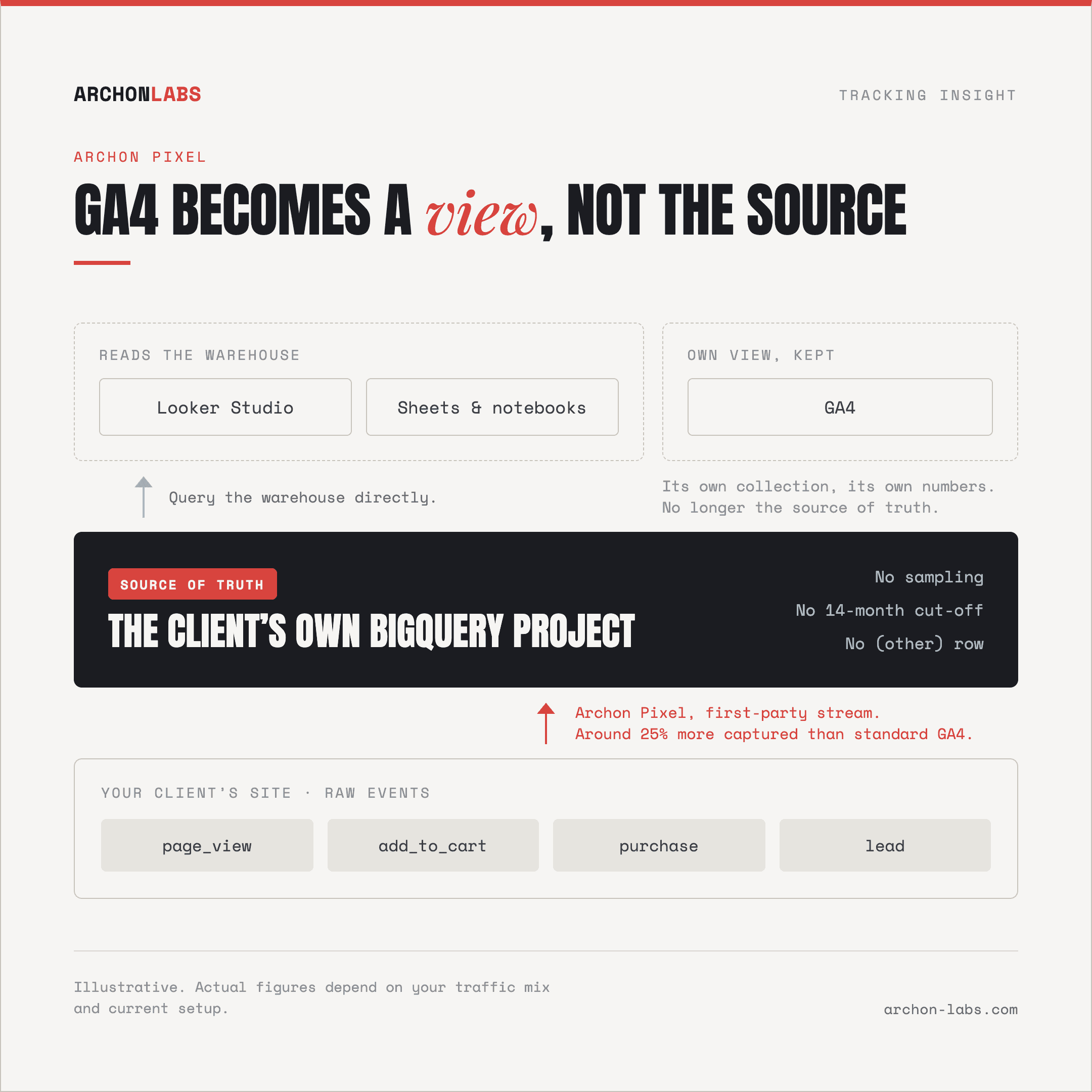
The answer is not another dashboard. It is that the raw events land somewhere your client owns, complete and unsampled, and that every report anyone builds reads from that one place. Once that is true, the ceilings above stop being your problem, because they are limits on a reporting layer you no longer depend on for the truth.
That is the job Archon Pixel does. It is a first-party analytics pixel that streams events straight into your client's own BigQuery project, with no sampling, no retention window quietly deleting last year, and no (other) row hiding the tail. On a typical account it captures around 25% more than a standard GA4 setup, because it collects first-party instead of depending on what a browser lets a third-party script keep. The mechanics behind that are in first-party cookies and the 400-day difference.
Three things change at the business level, and none of them touch your campaigns.
One definition per metric. A conversion is defined once, in code, and every deck and dashboard reads that definition. The version where the number depends on who built the report goes away.
History you actually keep. Raw events stay in the warehouse for as long as the client wants them, so a year on year comparison becomes a query instead of an apology.
No ceiling as the client grows. The volume that used to trigger sampling and (other) rows becomes ordinary. Your best accounts stop being the hardest ones to report on.
Note what does not change. Most clients keep GA4, because people like the interface and the free tier still does useful work. It simply stops being the source of truth and becomes one view onto data that lives somewhere better. That is a far easier conversation than proposing you rip out their analytics.
Frequently asked
Is this a GA4 replacement?
No, and treating it as one is the wrong frame. GA4 stays for exploratory work and for the people who already know their way around it. What changes is which system your reporting trusts. When the two disagree, the warehouse wins, because every number in it can be traced back to the event that produced it.
We already linked the free BigQuery export. Is that not the same thing?
It is a real step and worth keeping, but it inherits GA4's collection gaps and its identity stitching, and on a standard property it carries the 1 million event daily cap. The export gives you GA4's version of events in a warehouse. It does not give you a more complete version of events. Having the tool is not the same as having it right.
How do we know an account has actually crossed the line?
Four checks, in order. Does the data quality icon show up on the explorations you rely on? Does any report you send a client contain an (other) row? Have you wanted a comparison older than 14 months in the past year? Does the client clear a million events on a busy day? One yes is worth watching. Two is a decision.
Will our analysts need to learn SQL?
Some of them, eventually, and it is the most useful thing they will learn this year. In practice the reporting layer stays where it is, because anything that reads BigQuery keeps working, including Looker Studio, Sheets and the notebooks your analysts already use. What moves into code is the metric definitions, not the day to day work.
If you want to know which of your accounts have already crossed that line, request a free tracking audit and we will show you where GA4's limits are already shaping the numbers you hand to clients.