The symptom
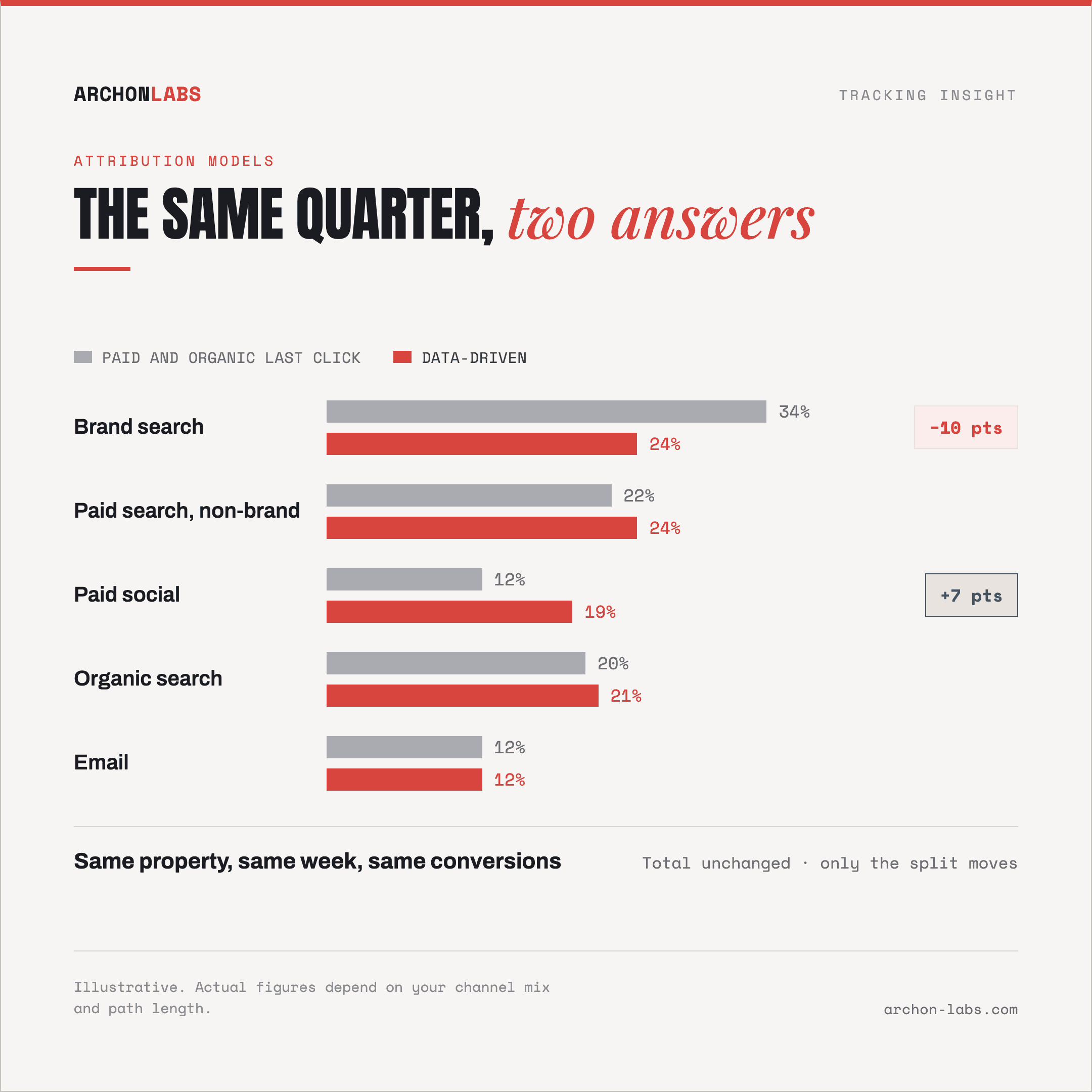
A client asks a simple question. Which channel drove the growth last quarter? You open the model comparison in GA4 and the answer changes while you watch it. Under paid and organic last click, brand search looks like the hero. Under data-driven, the channels in the middle of the path take a chunk of that credit back. Same property, same week, same conversions.
Then it happens between systems. Google Ads credits itself with more than GA4 will give it, and the client wants one figure to sit next to a budget decision. "It depends on the model" is not one.
And the report will not tell you how much of that spread is an accounting rule and how much is a gap in what got recorded.
Why it happens
There are fewer models left than most guides admit
Most of what still ranks for an attribution model comparison describes six models with a diagram for each, and that corpus is out of date on its central claim. GA4 has three: data-driven, paid and organic last click, and Google paid channels last click. Google is explicit that the first click, linear, time decay and position-based models are no longer available as of November 2023.
Google Ads is down to two, last click and data-driven, and conversion actions that used the retired models were upgraded to data-driven automatically. So the old advice, pick the model that suits the client's funnel, has quietly stopped being available. What is left disagrees structurally.
Each model is scoped to a different universe
GA4's data-driven model works across paid and organic channels for the whole property. The Google Ads model looks at interactions on Search including Shopping, YouTube, Display and Demand Gen. Google paid channels last click hands everything to the last Google Ads click, and falls back to paid and organic last click when the path holds no Google Ads click at all.
Three models, three different sets of touchpoints eligible for credit. They were never going to agree on a channel split.
There is a trap inside the comparison itself. Google states that Analytics uses last click for all Google Ads conversions that are based on key events, so a like-for-like comparison has to be run with GA4 set to paid and organic last click. Compare data-driven against Google Ads and you are measuring two models, not two platforms.
Direct traffic is excluded by rule, not by measurement
Worth knowing before you defend a channel split in a meeting: every GA4 model excludes direct visits from receiving credit, unless the path consists entirely of direct visits. The returning customer who types the URL is not reported as direct, the credit goes back to whichever channel touched them last inside the lookback window. A defensible rule, and one that puts a modelling decision in the channel report that you did not make and never mentioned.
The window decides as much as the model does
Attribution settings carry two clocks. In GA4 the lookback window defaults to 90 days for key events, with 30 and 60 as options. In Google Ads the click-through conversion window defaults to 30 days, adjustable up to 60 or 90 depending on the conversion source, and the view-through window defaults to a single day.
So a touchpoint 45 days before the sale sits inside GA4's default window and outside the Google Ads one. Nobody touched a model. The two systems are looking at different journeys.
One setting rewrites history and the other does not
This is the asymmetry that catches agencies out mid-quarter. Changing the reporting attribution model in GA4 applies to historical as well as future data, so numbers you already sent the client move with it. Lookback window changes apply going forward, and so do Google Ads conversion window changes.
One change reshapes a year-on-year comparison, the other puts a seam in the middle of it, and neither leaves a mark on the report. When numbers shift and nobody deployed anything, check the settings before the tags.
And every model is dividing up a dataset with holes in it
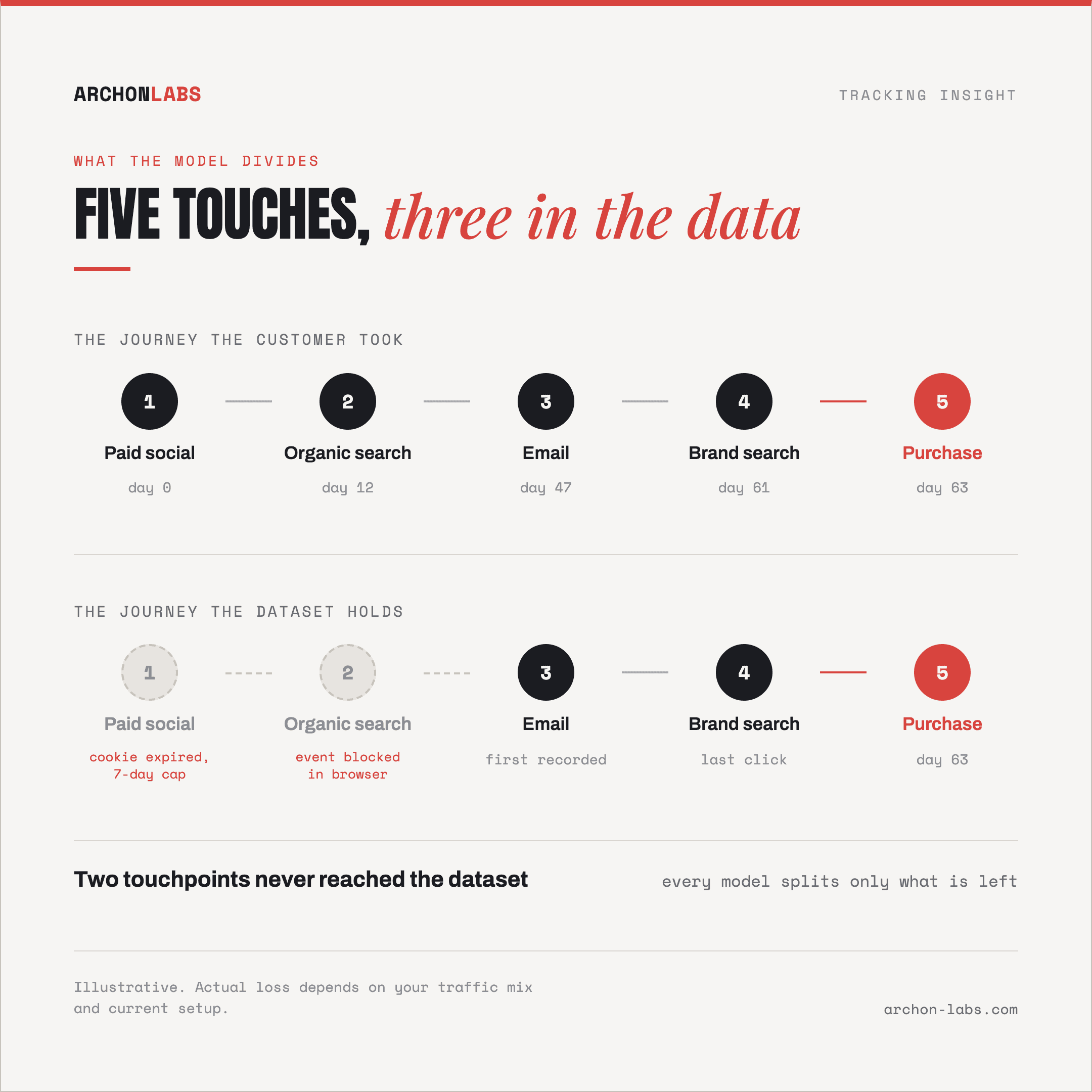
Here is the part the model guides skip. Attribution models do not measure anything, they divide credit across touchpoints that were recorded. A touchpoint that never reached the dataset cannot receive credit under any model, and switching models only redistributes what survived.
That input is thinner than the interface implies. Safari caps persistent cookies created through document.cookie to a seven day expiry, so for that share of traffic a 90 day lookback is not really a 90 day lookback. It is a run of short ones, and the early touchpoints come back as new visitors. Ad blockers strip 30-40% of events before they leave the browser, and across agency accounts 15-30% of conversions stay uncaptured for reasons like these.
How much of your model spread that explains is client-specific, and it depends on two things: the share of traffic behind Safari or a blocker, and how long the typical path is. A single channel client with a one touch path sees almost no difference between models. A client running four channels with a long consideration window sees a spread wide enough to move a budget, and part of it is missing input rather than accounting.
What good looks like
Three moves, in the order a real client relationship allows.
Declare one model per client and write the windows next to it. Not the best model, the agreed one. Put both windows in the report methodology, and treat a change to either as something you announce.
Use the model comparison as a spread check, not a menu. Where two models disagree sharply about a channel, that channel's reported value rests on an assumption, and knowing which channels those are is worth more than the number.
Then widen the input, the only move that changes the underlying answer. More of the journey recorded means less of the spread is noise.
That third move is what Archon Pixel is for: first-party collection with a server-set identifier that can hold for up to 400 days instead of the seven a client-side cookie gets in Safari, and around +25% more conversions captured than a standard GA4 setup. That is a gain against today's baseline, not an arrival. Roughly 95% of collectable events is the honest ceiling, consent refusals and blocked requests take the rest. What changes is that the models argue about more of the journey, which is the difference between a credit split you can defend and one you can only describe. The cookie lifetime side of it is in what a 400 day first-party cookie actually changes.
FAQ
Which attribution model should we report to the client?
It depends, on three things worth naming: how many channels the client runs, whether there is enough volume for a data-driven model to learn anything, and whether the client will accept a number that is not last click. Google's guidance for data-driven in Google Ads is a volume recommendation, at least 200 conversions and 2,000 ad interactions in 30 days, and the model still runs below that with less to work with. Pick one, document the windows, keep it stable.
Do the totals change between models, or only the split?
Only the split. Each model divides the same set of key events across channels, so the property total does not move when you switch. If the total moved too, that is a counting or collection difference rather than an attribution one, which is the subject of every tool showing a different number.
We use data-driven everywhere. Why do GA4 and Google Ads still disagree?
Because those are two data-driven models over two universes. Google says each one is specific to the advertiser, built by comparing the paths of customers who convert to the paths of customers who do not. GA4's spans paid and organic channels, the Google Ads one covers Google Ads interactions, so they learn from different data. Analytics also reports Google Ads key event conversions on last click, so switch GA4 to paid and organic last click before you call the gap a problem.
Last month's report changed and we deployed nothing. What happened?
Check the attribution settings before the tags. A change to the GA4 reporting attribution model applies to historical data as well as future data, so it moves numbers you already sent. Lookback and conversion window changes apply going forward only. One rewrites the past, the other splits the period in two.
If you cannot say whether a model disagreement is an accounting rule or a touchpoint that was never recorded, that is the first thing a free tracking audit settles.