Event deduplication is how a measurement or advertising platform recognises that two copies of the same conversion have arrived, usually one sent from the visitor's browser and one sent from a server, and counts them once instead of twice. It works by matching an identifier that both copies carry, such as a shared event ID or the order's transaction ID. Each platform applies its own key, scope and time window, so deduplication is a per-destination behaviour, never one setting on a tracking setup.
Why it matters for agencies
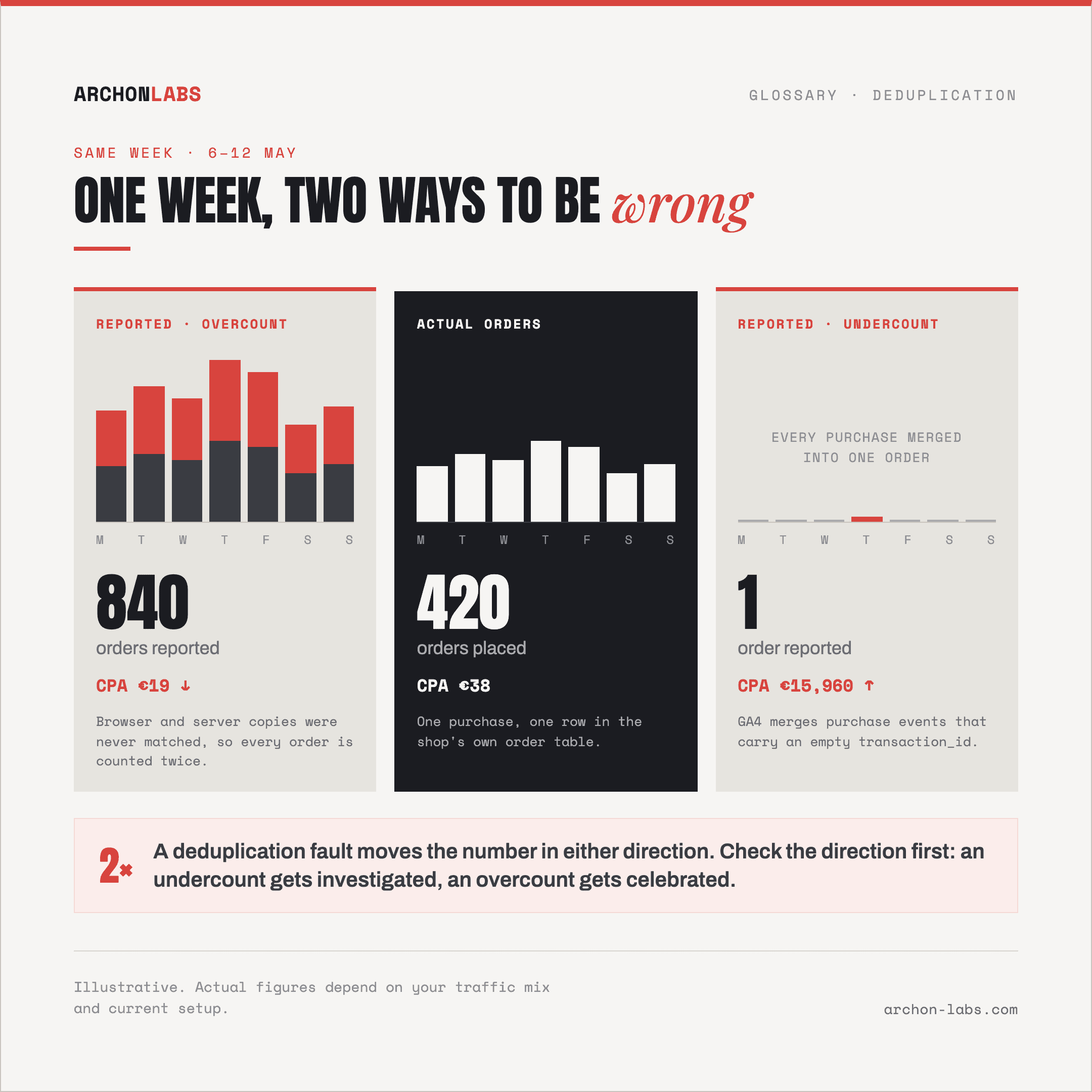
Duplicate conversions do not look like an error, they look like a good month. The dual setup that recovers 15-40% more conversions is also the one that sends the same purchase twice, so when the two copies are not matched, the client's reported conversions rise, cost per acquisition falls, and nobody escalates a number that improved. It reaches the bidding too: a platform optimising towards an inflated count learns from examples that did not happen, and moves budget towards the campaigns duplicating most.
What teams get wrong
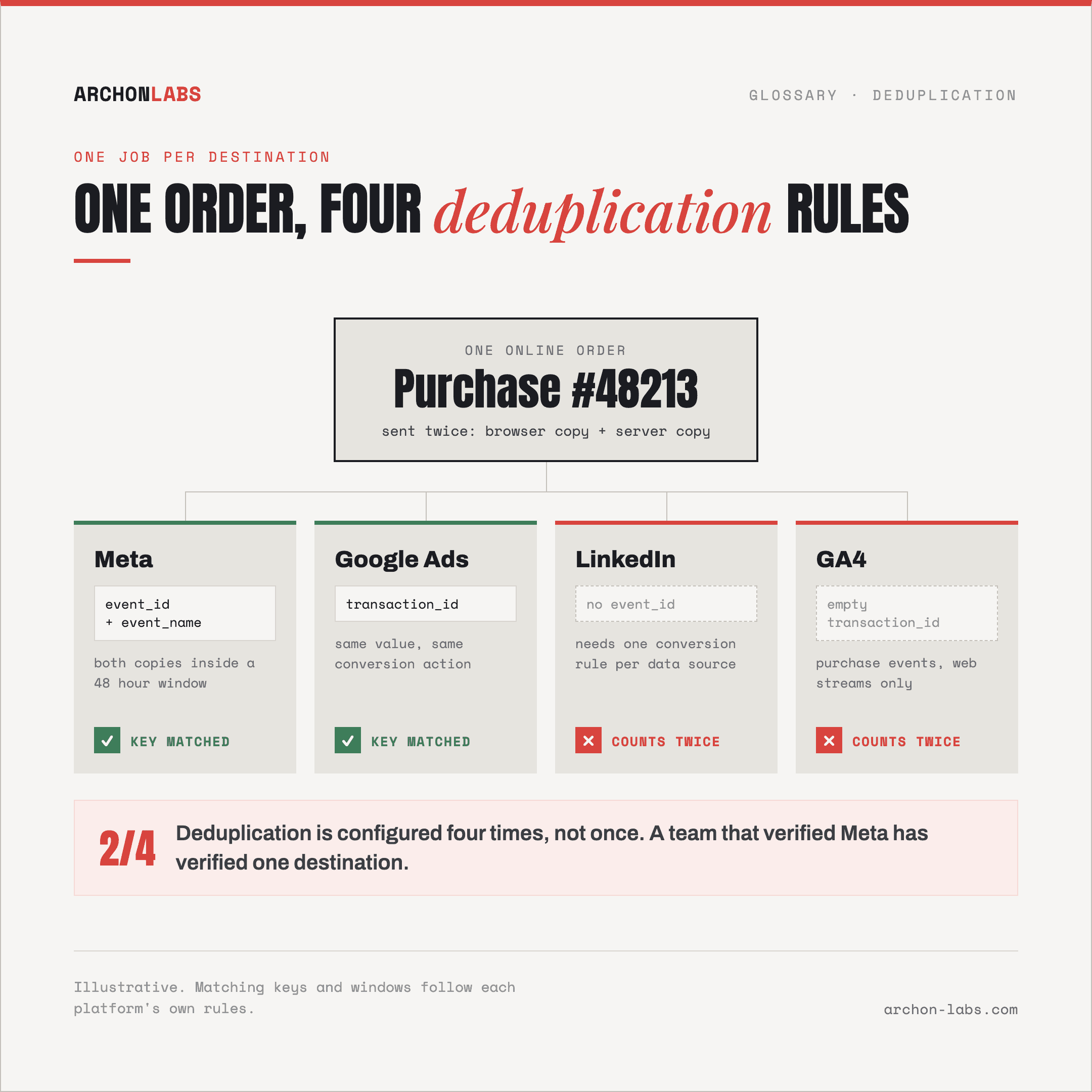
Most teams treat a shared identifier as one job, done once. It is one job per destination, and the rules do not line up. Meta discards a duplicate only when the pixel's event ID and the server event's event ID match, the event names match too, and both arrive within 48 hours of each other. Google Ads treats the second conversion as a duplicate when it carries the same transaction ID for the same conversion action. LinkedIn needs a conversion rule per data source. GA4 merges purchase events on transaction ID, and only on web streams. A team that verified Meta has verified one of four.
The second surprise is that the surviving copy is not yours to choose. Where the two do not differ meaningfully in content, Meta prefers the one it received first, and LinkedIn counts the Insight Tag event when both share an event ID, so the browser copy tends to win and the server copy that was added to survive ad blockers is the one discarded. Deduplication also fails in the other direction: GA4 merges purchase events carrying an empty transaction ID together, so one broken field reads as a single order. Archon Labs checks the direction of the error first, because an undercount gets investigated and an overcount gets celebrated.