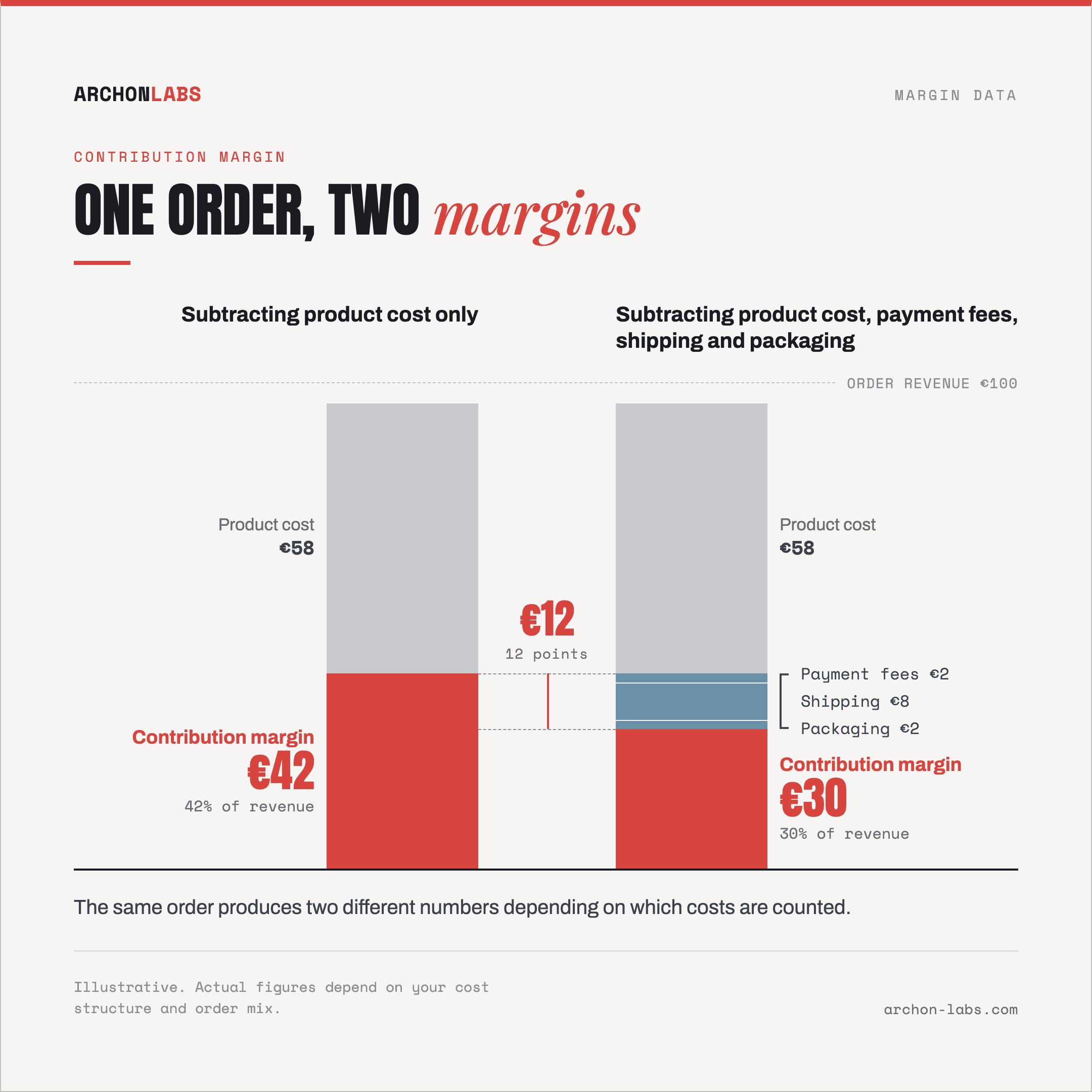
Contribution margin is what is left from a sale after subtracting only the costs that move with that sale, such as product cost, payment fees, shipping and commission, and before subtracting costs that stay the same, such as salaries, rent or software licenses. It is usually stated as an amount per order or unit, or as a ratio once divided by revenue. Because it isolates variable costs, contribution margin shows how much of a sale is left to cover fixed costs and profit, a different number from gross margin or net profit margin, which subtract different costs.
Why it matters for agencies
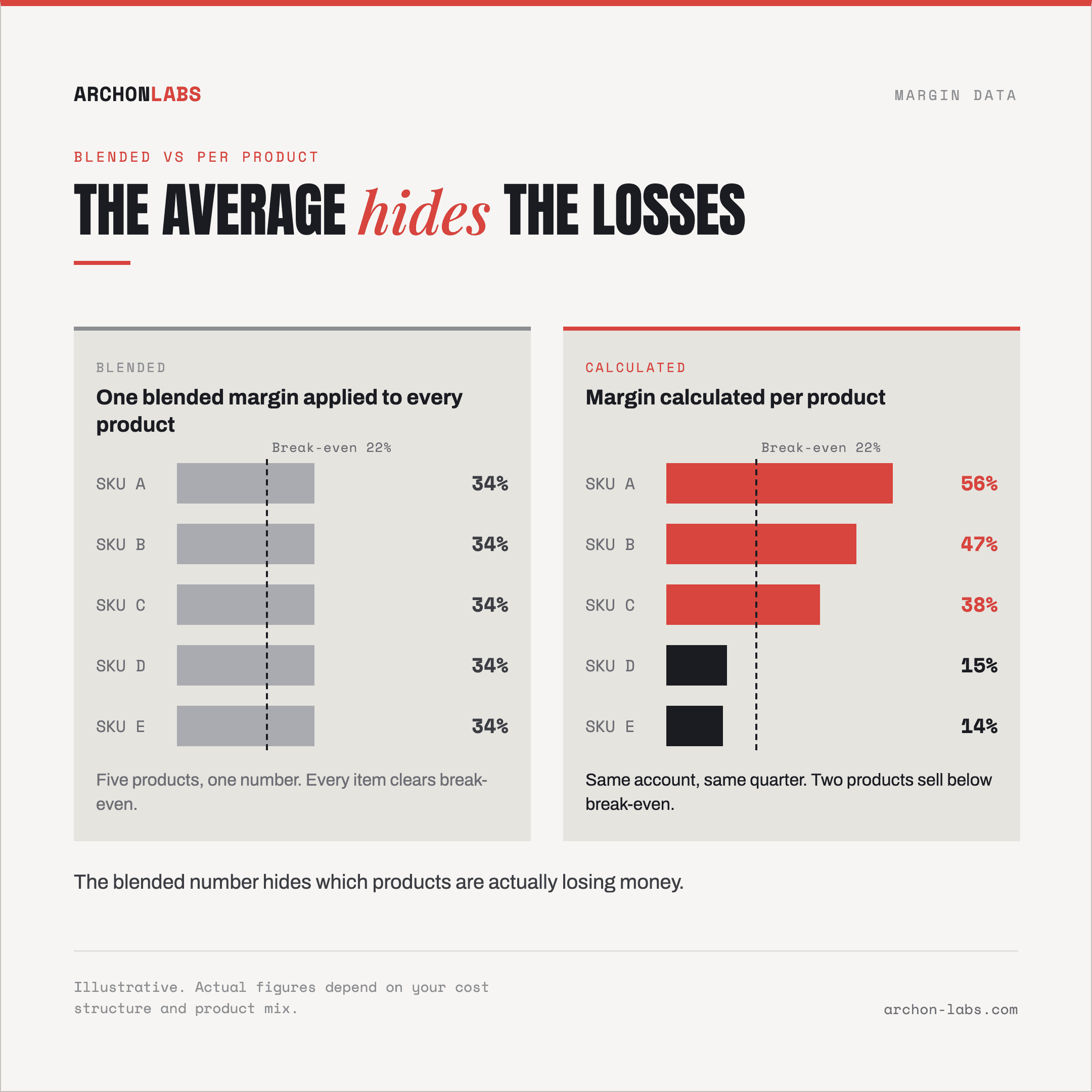
Contribution margin is the number agencies eventually have to defend in a client conversation, because it is the input behind POAS and value-based bidding: an ad platform can only optimize on the profit figure it is handed, and contribution margin is meant to be that figure. When it understates cost, because a payment fee or a return was left out, a campaign gets judged more profitable than it is. When it is calculated once for a whole account instead of per product or client, the average hides the items that lose money on every sale next to the ones that fund the business, and a portfolio decision on that blended number protects the wrong half of the catalogue.
What teams get wrong
The most common mistake is treating gross margin as contribution margin. Gross margin subtracts cost of goods sold and stops there, while contribution margin has to subtract every cost that moves with the sale, including payment fees, delivery, packaging and marketing cost outside media spend. A figure built the gross margin way is inflated, and it is the version that ends up feeding a value-based bidding column, because product cost is the easiest number to pull.
The second failure is one blended contribution margin covering a whole account instead of one per product or client, workable only if every item in that account carries the same margin. A cost that is fixed in one business and variable in another moves the number for reasons that have nothing to do with that week's sales, and a team that never separated the two reads the swing as a real change in profitability. Archon Labs sees this most often on accounts where the margin figure was never joined to the order data at the source, so nobody can tell a blended estimate from a calculated one.