The symptom
Someone on the team raises server-side tracking, the client asks what it will cost, and nobody in the room can answer. A hosting price takes a minute to find. The number that actually matters, what it costs to get a setup that recovers conversions and keeps recovering them next quarter, is nowhere on any pricing page.
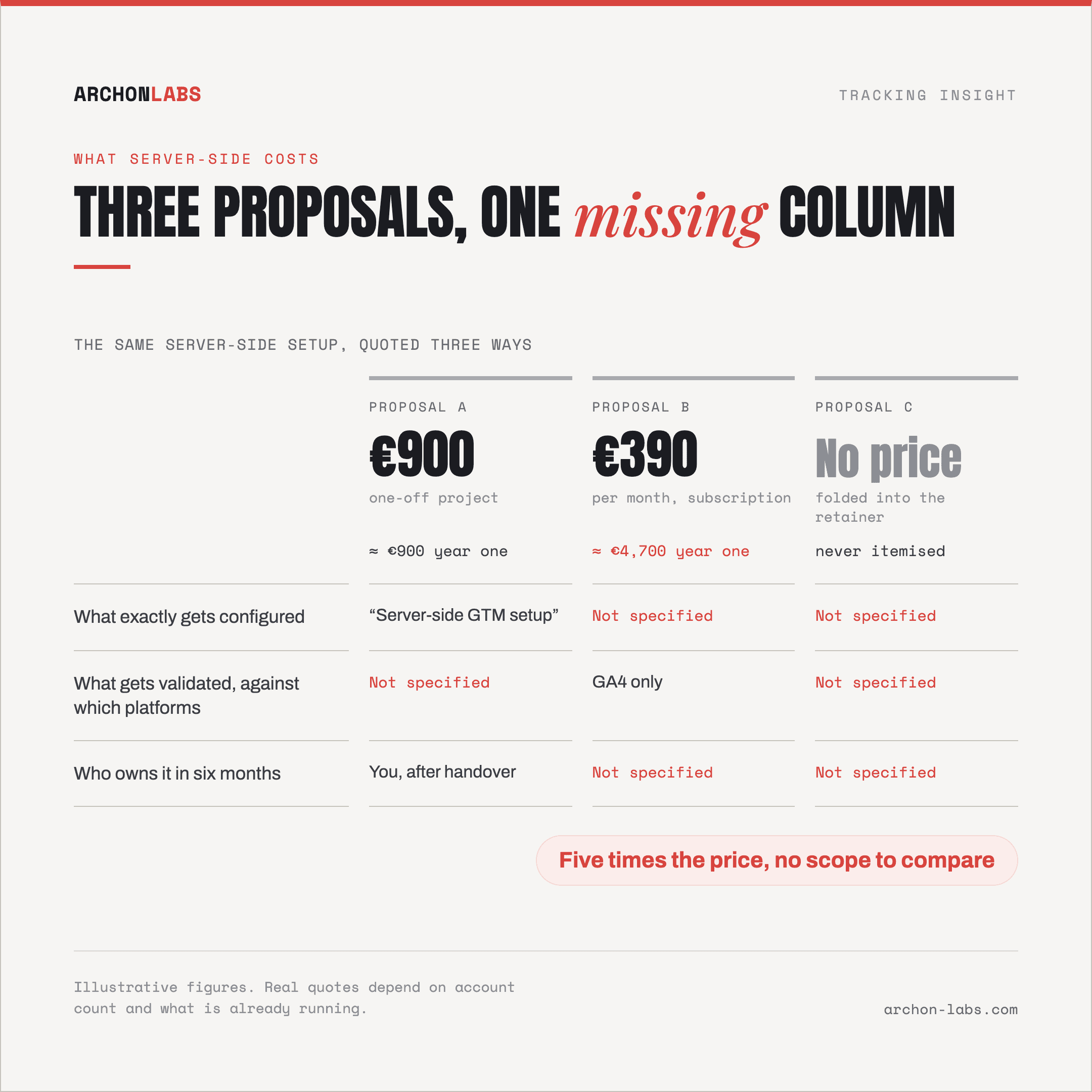
So you collect quotes and they refuse to line up. One vendor prices it like a subscription, the next like a one-off project, a third folds it into a retainer where the tracking line is invisible. The same three words appear in every proposal, the totals differ by a factor of five, and there is no way to compare them because nobody defines what is included.
The one option you could price to the cent is the one nobody quotes: leaving things as they are. That cost is real, it just never arrives as an invoice.
Why the number is so hard to pin down
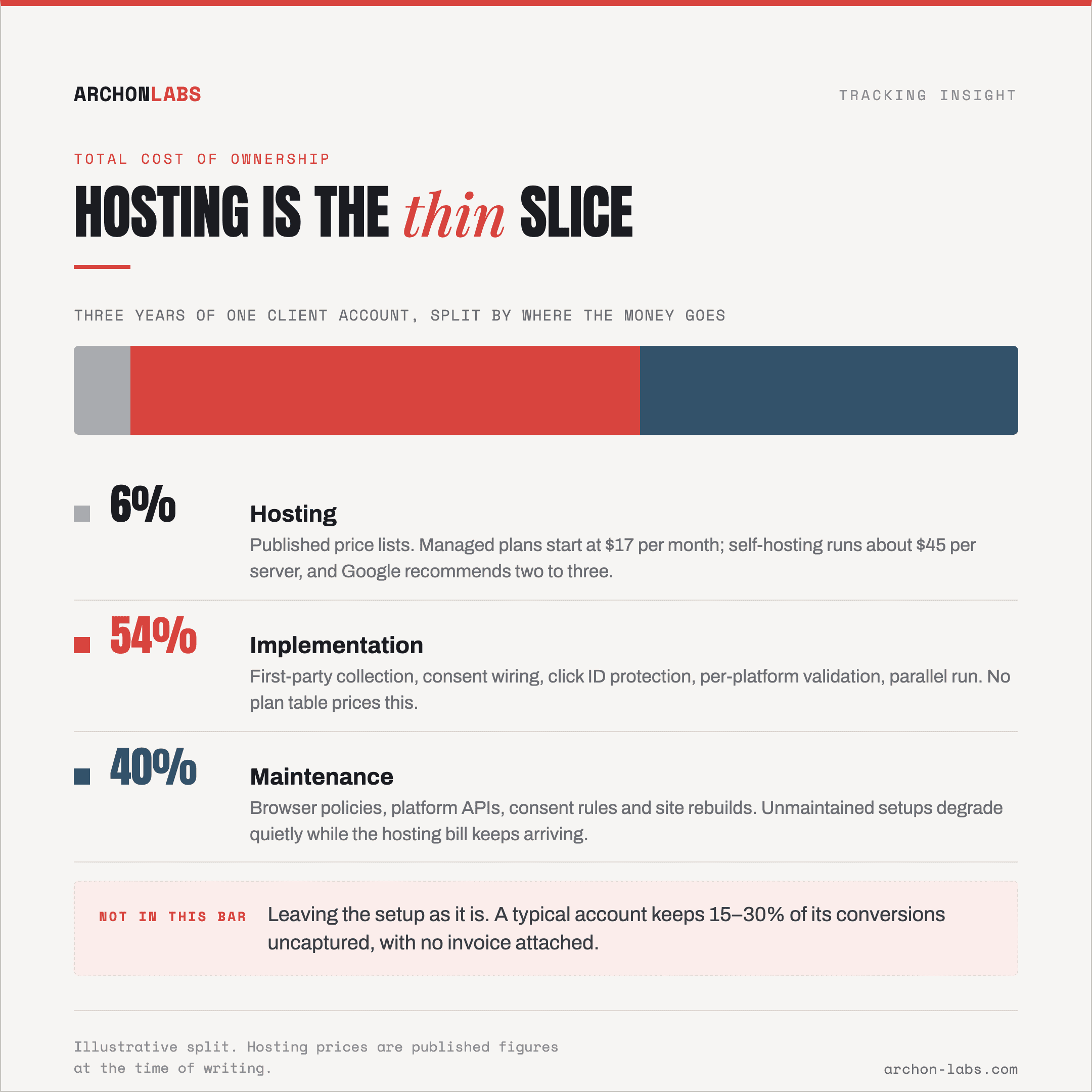
Server-side tracking is three different costs wearing one label, and only the first of them has a public price list.
Hosting is the small, knowable part. On managed hosting, Stape's published plans start with a free tier for very low volume, then $17 a month up to 500,000 requests, rising to $83 and $167 a month for high-volume sites. Self-hosting on Google Cloud lands in the same territory: Google's Cloud Run setup guide puts one tagging server at roughly $45 a month and recommends running at least two of them, and Google's guidance for live traffic raises that to a minimum of three once real production traffic is involved. Those are the published figures at the time of writing. Either route, the infrastructure is a rounding error next to the media budget it protects.
Implementation is where the money actually goes, and where the quotes diverge. No plan table prices this part, because it is work rather than capacity. Done properly it covers:
Collection moved onto your own domain, so ad blockers and browser cookie limits stop deciding what you are allowed to measure.
Consent wired in correctly, so measurement respects consent instead of defensively dropping conversions you are permitted to count.
Click IDs and campaign parameters protected end to end, so late conversions still tie back to the campaign that earned them.
Every event validated against what each platform actually receives, not against what the container reports it sent.
A parallel run before the switch, so nothing goes live until the new numbers have been checked against the old ones.
A cheap quote is usually cheap because it stops after the first line. The container exists, the dashboards look normal, and the recovery is a fraction of what it should have been. That is the most expensive outcome on the menu, because it also removes the reason to ever look again.
Maintenance is the cost everyone forgets. Browser policies change, platform APIs change, consent requirements change, and client sites get rebuilt without anyone warning the person who owns the tracking. A setup nobody maintains degrades quietly, which is how an account ends up roughly back where it started while the hosting bill keeps arriving on time.
Set against all of that is the cost of the setup you already have, and it is the line agencies almost never put in the comparison. A typical account has 15 to 30% of its conversions consistently uncaptured, ad blockers strip 30 to 40% of tracking events before they ever leave the browser, and the algorithms spending the budget optimise on whatever survives. There is an internal cost on top: for one performance agency, manual reconciliation was eating 14 hours per project before we took it over. We put the payback side of the same decision under the microscope in is server-side tracking worth it for your agency.
What good looks like
A quote you can compare is one where the scope is explicit. Three questions do most of that work: what exactly gets configured, what gets validated and against which platforms, and who owns it in six months when Safari changes something. A proposal that answers all three can be weighed against another proposal that answers all three. A price with no scope attached cannot be weighed against anything.
The second move is to price the outcome instead of the container. Hosting buys capacity. What you are actually buying is complete, validated signal arriving in the ad platforms every day, which is the job Archon Signal does: recover the conversions the browser was dropping, verify them against what each platform receives, and keep them arriving without touching your campaigns.
Done properly, a server-side setup typically recovers 15 to 40% of the conversions that were going missing. For one performance agency that meant 38% of client traffic affected by tracking prevention brought back into measurement and a 26% average uplift in measured conversions, plus the 14 hours per project that went back to the campaign team. Those are the terms a cost conversation is worth having in.
The last decision is the shape of the cost rather than the size of it. A permanent hire makes it fixed, whether the work shows up that month or not, which is the comparison we ran through in in-house data hire or external specialist. An external specialist keeps it variable and tied to work that actually exists.
Frequently asked
So what will it cost us?
Hosting you can look up today, and it is the smallest line on the page. Implementation and ongoing ownership depend on how many client accounts are involved, what is already running, and how much of that survives inspection. This is why we scope after the audit instead of quoting blind, and why an audit-backed number is the only one you can fairly compare with the other quotes on your desk.
Is Stape cheaper than running it on Google Cloud ourselves?
Usually yes at low and medium volume, and the published figures above show why: a managed plan bundles capacity you would otherwise pay for per server, and Google recommends two to three servers before you put production traffic through them. Self-hosting wins on control and at very high volume. Neither choice changes how much signal you recover, which is the part worth spending your decision time on.
We already pay for a server container, is that money wasted?
No, and it usually means the cheap part is already done. Most setups we improve already have hosting in place, and the recoverable value sits in the consent wiring, the click ID protection and the validation. Having the tool is not the same as having it configured right, so the honest way to find out is to check what the platforms are actually receiving.
Does the cost scale with every client we add?
Hosting does, per client site, in line with request volume. Implementation cost per account tends to drop as patterns repeat across your roster, and maintenance is where consolidation pays off: one owner watching every account costs less than every account being somebody's occasional side task.
What does it cost to leave things as they are?
Whatever 15 to 30% of uncaptured conversions is worth against your clients' media budgets, plus the hours your team keeps spending on numbers that will never reconcile. It is the only option in the comparison with no invoice attached, which is exactly why it survives so many budget conversations.
If you want a number for a specific client account rather than a range from a blog post, start with the measurement. Request a free tracking audit and we will map what the current setup is losing before anyone talks price.