The symptom
You already know the tracking is not what it should be. Conversions do not reconcile, the consent banner was set up once and never revisited, and every time a client asks why GA4 and the ad platform disagree, someone on your team loses an afternoon to it. The work is real and it keeps recurring, but it never quite adds up to a full-time job, so it lands on whoever happens to have a gap in their week.
So the question surfaces in a leadership meeting. Do we finally hire a data person? And it stalls in the same place every time. A dedicated tracking and analytics hire is a serious fixed cost, and the honest worry is that there is not enough clean, focused tracking work month after month to keep one person busy and sharp. Meanwhile the gap does not close, it just stays a line item nobody owns.
At Archon Labs we hear this from agency owners constantly. It is not a talent problem, it is a shape problem. Tracking work is spiky, specialised and business-critical all at once, which is close to the worst possible fit for a single permanent seat.
Why it happens
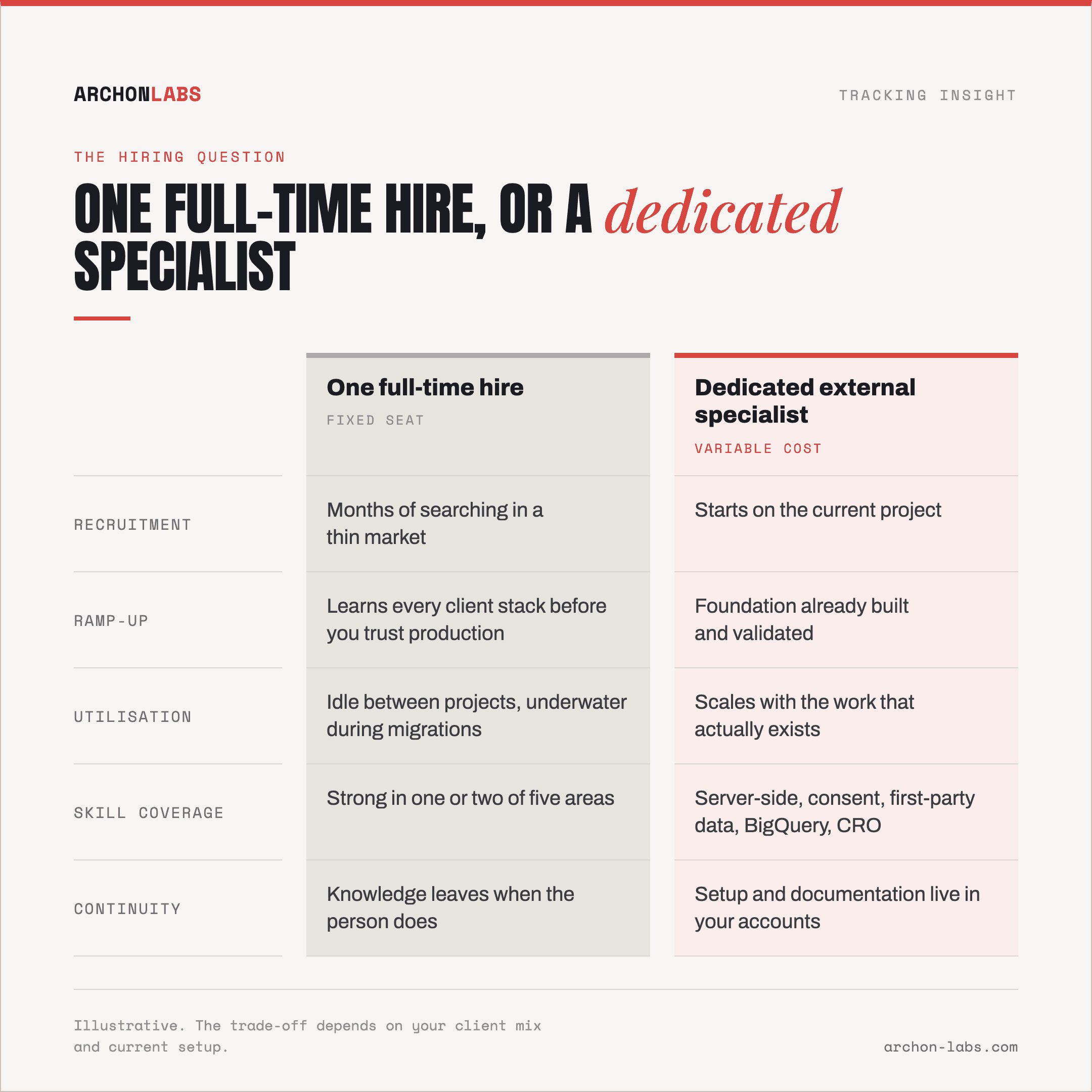
The reason the maths never quite closes is that the salary line is the smallest part of the real cost. Whether the number pencils out has almost nothing to do with the payslip and almost everything to do with what surrounds it.
Recruitment before you gain anything. Finding, vetting and onboarding someone who genuinely knows server-side collection, Consent Mode and BigQuery takes months, and that market is thin. You pay in time and lost focus long before a single conversion is recovered.
Ramp-up before productivity. Even a strong hire has to learn every client stack, every container and every consent config before you trust them with production. That is months of cost against setup work, not results.
Utilization that never sits still. The workload is spiky by nature. One hire is idle between projects and completely underwater during a migration or a heavy onboarding month. You carry a flat cost for a workload that is anything but flat.
One person cannot cover the surface. The job is not one skill. It is server-side tracking, consent, first-party data, BigQuery pipelines and technical CRO support, and almost nobody is genuinely strong across all five. Hire for one and the rest stay weak.
Single point of failure. When your one data person is on holiday, off sick or resigns, the knowledge walks out with them. Every client's tracking becomes a black box, and you are recruiting from zero again.
None of this appears on the salary line, which is exactly why the decision feels harder than it should. The honest figure is total cost of ownership: recruitment, ramp, idle time, the breadth you cannot buy in one head, and the risk that the whole function resigns in one email. Set against that, the visible cost of the gap looks small, 14 hours of manual reconciliation on a single project, a lost afternoon on the next, until you add it up across every account and realise it recurs forever.
And the gap itself is not trivial. A typical account has 15 to 30% of its conversions consistently uncaptured, and the causes are structural rather than a bug you fix once, which we broke down separately in why conversions never reach GA4. That is the picture your campaigns are optimising on while the hiring decision sits in limbo.
What good looks like
The way out is to treat tracking the way you already treat the other specialisms you deliberately do not staff full time. You get a dedicated specialist who owns the data foundation, without carrying a permanent seat, the idle months, or the single point of failure. The cost becomes variable and tied to work that actually exists, instead of fixed and hoping the workload shows up to match it.
It also skips the part a new hire would struggle with most, building the foundation from scratch. That first-party analytics layer already exists as Archon Pixel, capturing the conversions the browser was quietly dropping, so you are buying the outcome rather than a year of assembly. The breadth problem disappears too, because you are not betting on one person being equally strong at server-side, consent, BigQuery and CRO.
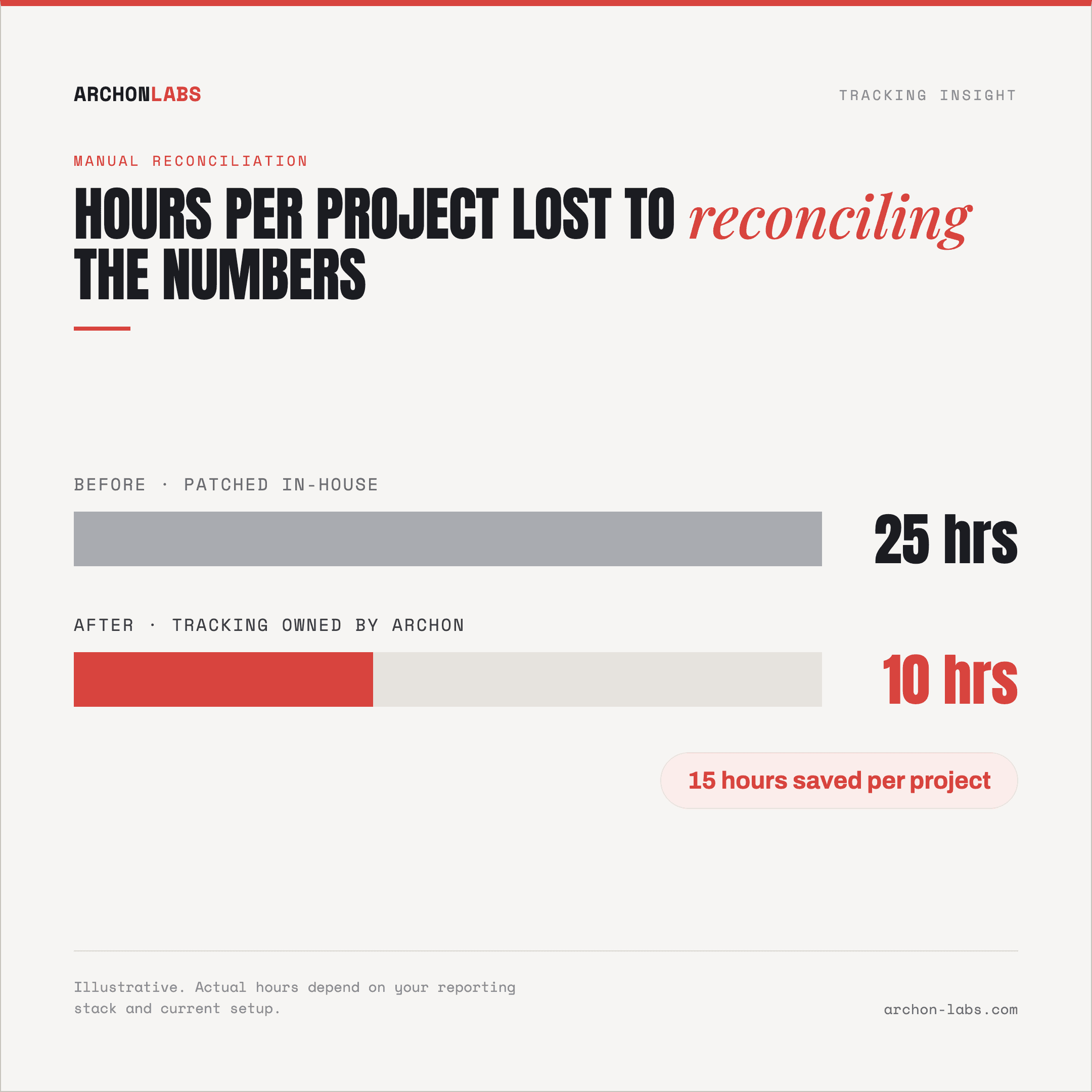
For one performance agency, moving this off the internal to-do list meant 38% of client traffic affected by tracking prevention recovered, 26% more measured conversions, and 14 hours saved per project that used to vanish into manual reconciliation. Those hours go straight back to the campaign team, which is where an agency actually earns its margin.
Frequently asked
Why not just train someone we already have?
You can, and for light maintenance it is fine. The trouble is that real depth across server-side, consent and BigQuery takes years to build, and the person you train is then a single point of failure who is also being pulled onto campaign work. You end up with a part-time specialist covering a full-time surface.
We already run Stape, why would we need you?
Most agencies we work with already have a server-side container running. Having the tool is not the same as having it configured right, adblocker-proof, Safari-proof and wired correctly into consent. The value is in the configuration and the validation, not in owning yet another platform.
Isn't an external specialist just more expensive per hour?
Per hour, maybe. Per outcome, that is the wrong comparison. A permanent hire costs recruitment, ramp-up, idle months and the risk of the whole function resigning, none of which shows up in an hourly rate. Variable cost tied to real work usually wins on total cost of ownership.
What about continuity if we rely on someone outside the team?
Continuity improves, it does not weaken. The setup, the documentation and the monitoring live in your accounts, not in one person's head, so there is no knowledge that leaves when a colleague does. That is the opposite of the single-point-of-failure risk a lone internal hire creates.
If you want to see what the gap is actually costing across your accounts before you weigh up a hire, the fastest way is to have someone look. Request a free tracking audit and we will map where the conversions are going missing.