The symptom
The three-way comparison always drags Stape into the room, but plenty of agencies never seriously consider it. A client insists on EU-only infrastructure, or the agency already ruled Stape out for other reasons, and the actual decision on the desk is narrower: Taggrs or Addingwell. Both promise close to the same thing, a European home for the server container and a shorter path back to first-party measurement.
Neither vendor makes the choice easy on its own. Taggrs has been the default European answer for longer. Addingwell is newer, owned by a name from the consent world rather than the tracking world, and its pricing page is built for a different kind of buyer. Whoever has to sign off on this wants to know what actually changes, not another feature list that reads the same as the last one.
Why the two look more different than they behave
Underneath the dashboard, both vendors host the same thing, a Google Tag Manager server container. Google supplies the tag templates, the event model and the clients that turn a page hit into a server-to-server request. Taggrs and Addingwell each wrap that container in their own billing and infrastructure, but the container itself does not change with the vendor.
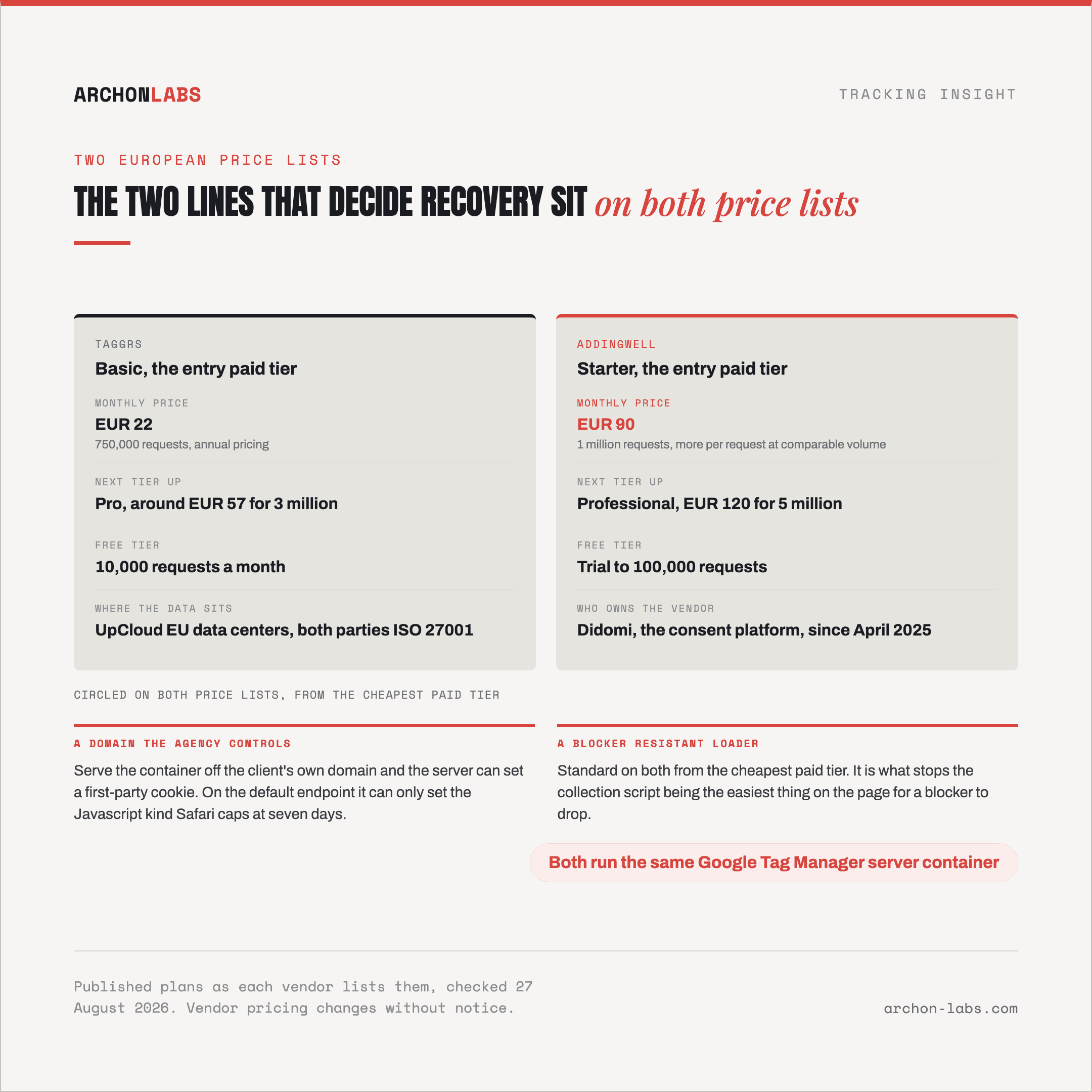
What decides the outcome is where the container is served from, not who bills for it. Google's own documentation states that "your tagging server and your website have to run on the same domain," and a server on the default endpoint instead "can only set Javascript cookies." That kind of cookie is the kind Safari caps at seven days, where a server-set first-party cookie can run to the 400-day maximum Chrome allows. We covered that mechanism in full in what a first-party tag gateway actually does, and it holds on either vendor. We answered the wider vendor question, Stape included, in does the server-side tool actually matter.
Taggrs and Addingwell, priced and dated
Pricing changes without notice on both sides, so here is what each published, checked on 2026-08-27.
Taggrs, published plans, annual EUR pricing: Free at €0 for up to 10,000 requests a month, Basic around €22 a month for 750,000, Pro around €57 for 3 million, Ultimate around €127 for 10 million, Enterprise custom. A custom subdomain, an ad blocker resistant tracking script and cookie recovery ship on every tier, Free included.
Addingwell, published plans: Starter at €90 a month for 1 million requests, Professional at €120 for 5 million, Business at €210 for 12 million, up to Ultimate at €1,190 for 100 million, with per-request overage pricing that drops at higher tiers. A custom domain is included from the entry tier, and a free trial covers up to 100,000 requests.
At comparable volume Addingwell costs more per request than Taggrs, and the features that decide how much signal survives, a controlled domain, a resistant loader, ship on both from their cheapest paid tier. The price difference buys something else: Addingwell is owned by Didomi, the consent management platform, which acquired the Lille-founded vendor in April 2025.
What good looks like
Split the decision the way the three-way comparison does: procurement is small, configuration is what moves the numbers. Procurement is still real, though. A client's data residency policy, the request volume the account actually runs, whether a certificate needs to be shown to legal, all of that is worth getting right.
On procurement, Taggrs is the more proven of the two. It has the longer European track record, and its infrastructure partnership with UpCloud puts client data in UpCloud's own EU data centers, with both companies holding ISO 27001 certification. That answers a data residency question directly, in writing, which is usually what a client's legal team is actually asking for. Addingwell's case is narrower: an agency already running Didomi for consent gets one vendor relationship instead of two, a real convenience but not a reason to move on its own.
Neither answer changes what Archon Signal does on top of whichever host an agency already pays for. The starting point is the same on either vendor: 15-30% of conversions go uncaptured before any server-side fix, and ad blockers alone strip 30-40% of events outright. Archon Signal's work is collection served from the client's own domain, consent handled without discarding conversions the agency is permitted to measure, click identifiers kept alive across the visit, and every event checked against what each ad platform actually reports receiving. For one performance agency that work recovered 38% of the client traffic tracking prevention had been hiding, lifted measured conversions by 26% on average, and returned 14 hours per project to the team. No setup on either host recovers every event a browser restriction or a consent refusal removes; the honest ceiling sits around 95%, a ceiling rather than a promise.
Frequently asked
So which one should we actually pick?
Taggrs by default, on the strength of its longer track record and a data residency position backed by a named infrastructure partner and a certification. Addingwell only if the agency already runs Didomi for consent and wants one vendor relationship instead of two. Neither choice moves the recovery rate on its own, since both run the identical server container underneath.
Is Addingwell's higher price justified by anything technical?
Not on recovery. At comparable request volume Addingwell costs more per request than Taggrs, and the features that actually protect signal, a controlled domain and a resistant loader, are standard on both from their entry paid tier. The premium buys managed provisioning and, for the right agency, the Didomi relationship.
We already run Taggrs. Is switching to Addingwell worth it?
Rarely on technical grounds. A migration costs time, and per request Addingwell tends to cost more at comparable volume. Switch only for a specific procurement reason, consolidating around Didomi, for example, not for anything it changes downstream.
Does the free tier on either one work for a live client site?
Not for long. Taggrs caps its free tier at 10,000 requests a month, and Addingwell's free trial covers up to 100,000 requests before it ends. Both suit a test property, not an active account, so move to a paid tier once real traffic starts.
What if a client specifically demands EU-only hosting?
Both make that case, but Taggrs makes it more thoroughly on paper, with a named infrastructure partner and ISO 27001 certification stated outright. Addingwell is EU-founded and EU-run, but its own published material names the certification less specifically.
If a client account needs an answer specific to its own setup rather than another feature list, request a free tracking audit and we will check what it is actually sending, on whichever of the two is behind it.