The symptom
Everyone in tracking tells you to go first-party. Move server-side, put a gateway on your own domain, stop leaning on third-party scripts. It is good advice, and it is almost never explained in a way an account team can actually act on. So it sits on the roadmap as a line labelled "server-side" that nobody can quite describe to a client.
When a client does ask for it, the reaction is usually one of three, and none of them is a real capability. You say no and hope they do not wonder what else you cannot do. You say yes and quietly hope someone can work it out. Or you spin up a container because it looked like the right move, glance at the dashboards afterwards, see roughly the same numbers, and file the whole idea under expensive and unclear.
Meanwhile the thing a gateway is meant to fix keeps surfacing. GA4 and the ad platforms disagree on the same week. A client asks why last month's conversions look thinner than the sales they actually booked. The honest problem is that "first-party tag gateway" sounds like plumbing, and plumbing is easy to postpone, but it decides whether the numbers your clients make decisions on are real or quietly wrong. This is the plain-language version of what it changes, and where teams get it wrong.
Why it happens
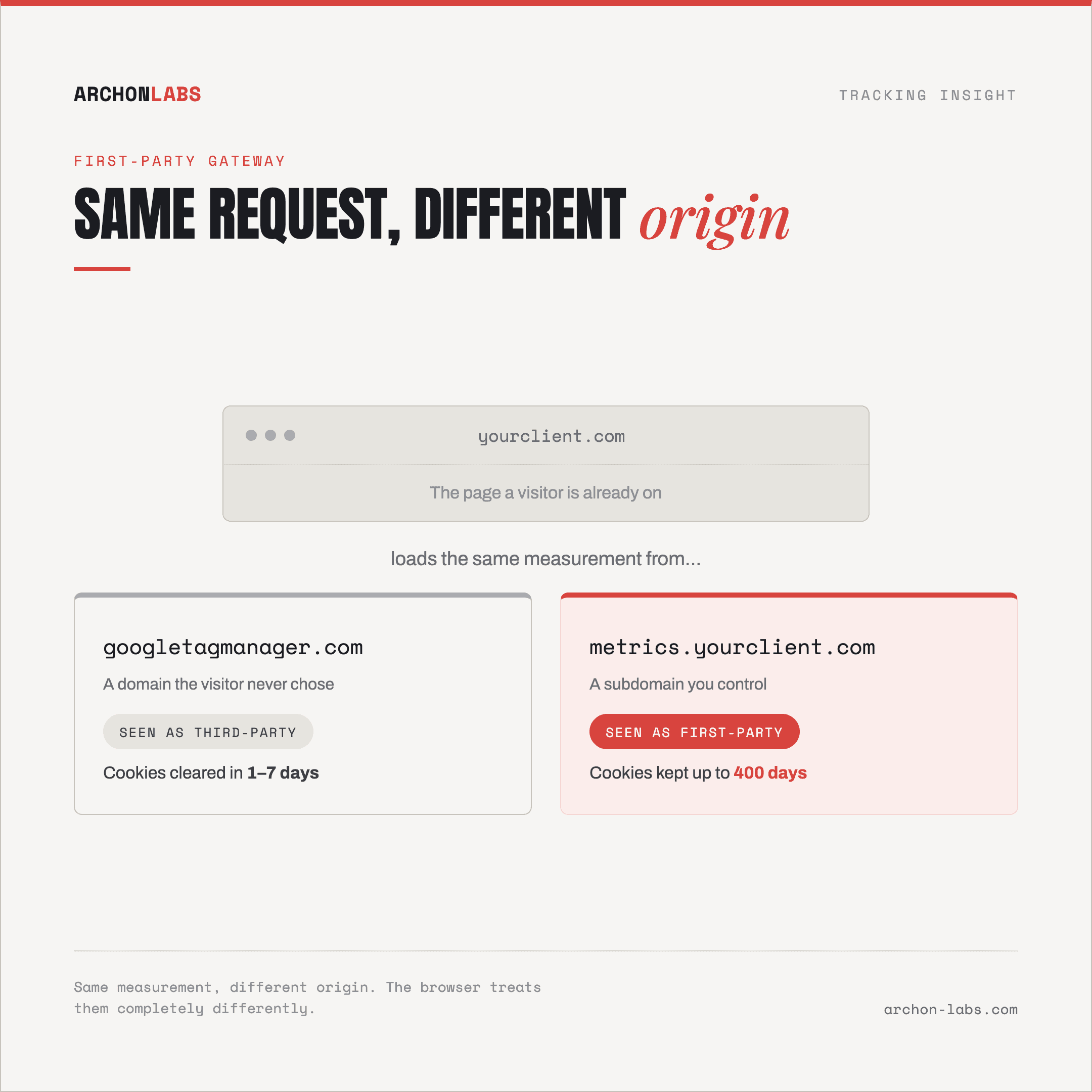
Normally your tracking loads from a domain that is not yours. The script comes from googletagmanager.com, the cookies are set by a domain the visitor never chose to be on, and to the browser that is the textbook definition of a third-party tracker, exactly the thing modern browsers and ad blockers are built to shut down.
A gateway changes one thing, and it is the thing everything else hangs on: the origin. Instead of loading from googletagmanager.com, your measurement loads from your own domain, a path on a subdomain you control. To the browser, a first-party script and a first-party cookie look like part of the site the visitor is already on, not an outsider following them around the web. Same measurement, different origin, completely different treatment.
That treatment is where the losses live, and they stack up quietly rather than breaking anything you would notice:
Safari and iOS clear third-party cookies in one to seven days, so a returning visitor is counted as new and a later conversion never ties back to the campaign that earned it. A first-party cookie set server-side can last up to 400 days instead.
Ad blockers strip 30 to 40% of tracking events before they ever leave the browser. No request, no event, no conversion, and nothing in the report to show it happened.
Consent, wired defensively, drops conversions you are actually allowed to measure, because tags get blocked before Consent Mode has a chance to do its job.
Enhanced conversions and CAPI run half-wired, so the platforms optimise on thinner data than they think they have.
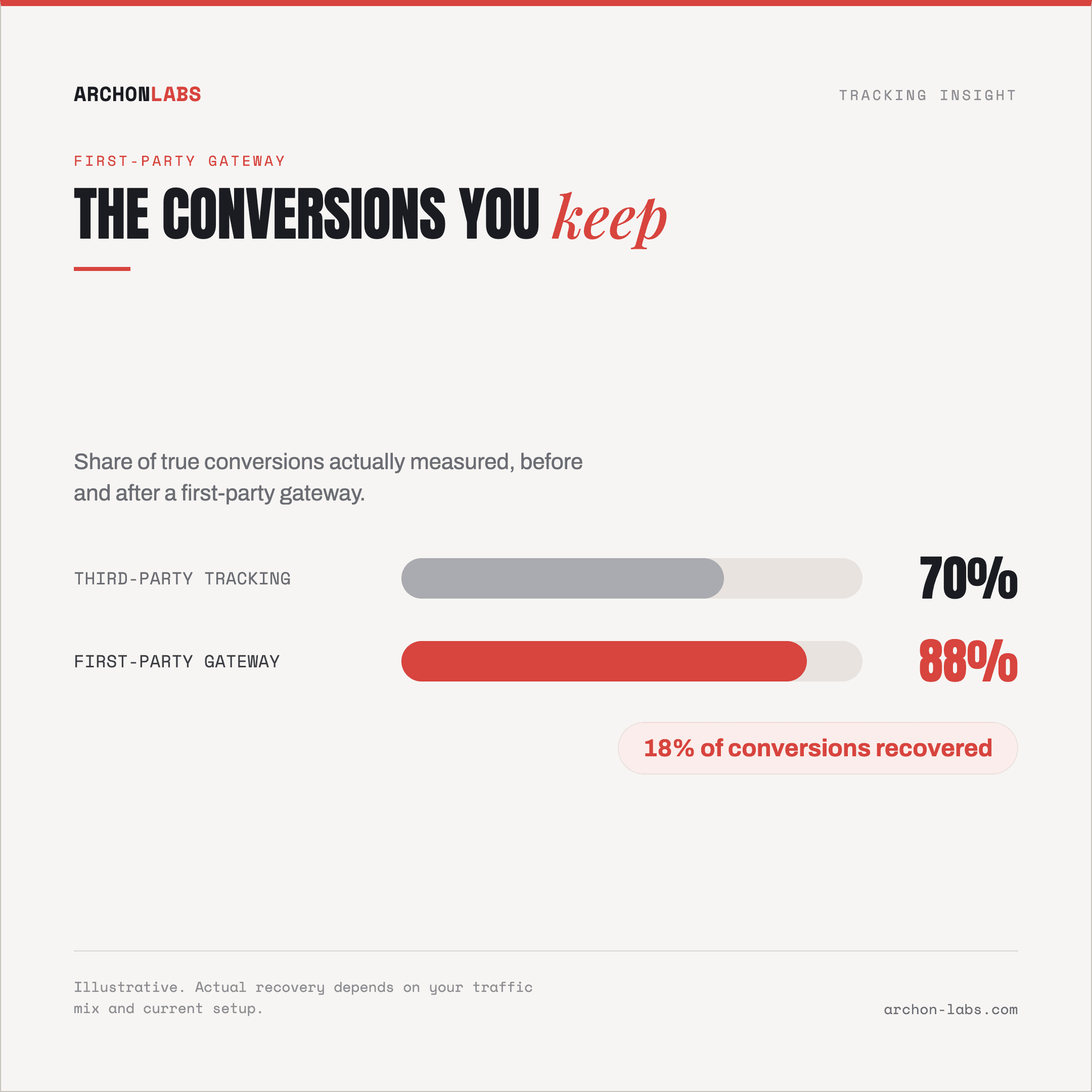
Each of these is small and defensible on its own, which is exactly why it stays hidden. Added together, a typical account has 15 to 30% of its conversions consistently uncaptured, and the algorithm spending the client's budget is optimising on that holed picture without anyone noticing. We mapped exactly where those conversions disappear before they reach GA4 if you want the full breakdown.
What good looks like
The gateway is not the destination, it is the door. Getting the origin right is step one, not the whole job, and what actually recovers the signal is what you do once you are through it.
At a business level it is three moves, and none of them touch your campaigns. Collect first-party, so events go to a container on your own subdomain instead of a blockable third-party script. Enrich and hash, so first-party identifiers are hashed in the browser and passed server-side for enhanced conversions and CAPI, compliant and complete. Then verify before you switch, running the new path in parallel with the existing setup so every conversion is checked against the old numbers before anything goes live.
Done properly, this is the job Archon Signal does: a server-side setup that recovers the signal the browser was dropping, typically 15 to 40% of the conversions that were going missing. For one performance agency we worked with, that meant 38% of client traffic affected by tracking prevention brought back into measurement, a 26% average uplift in measured conversions, and 14 hours saved per project versus wiring it together in-house.
Having the tool is not the same as having it right.
That line is the whole point. Anyone can stand up a container in an afternoon. Whether it is adblocker-proof, Safari-proof, consent-correct and actually validated is what separates a gateway that recovers signal from one that just exists. The usual ways it goes wrong are worth naming: copying one container config across every client instead of configuring per account, sending unhashed personal data server-side when it is neither compliant nor necessary, switching over before validating against the existing setup, and shipping it once and never monitoring it, so a later break goes unnoticed until a client is the one who spots it.
Frequently asked
Do we have to replace our current tracking setup?
No. In almost every case we run the server-side path in parallel and validate each conversion against your existing setup before anything is switched over. Nothing goes live unverified, so there is no window where you are flying blind.
We already run Stape or Taggrs. Does a gateway still help?
Usually yes. Many of the setups we improve already have a container running. Having the tool is not the same as having it configured right, and the value is in the configuration, the consent wiring and the validation, not in owning another platform. If nobody can prove how much signal the current setup recovers, that is the gap.
Is a first-party gateway still compliant?
Yes, when consent is wired in correctly. Server-side collection runs alongside Consent Mode v2, so measurement respects consent rather than working around it, and first-party identifiers are hashed in the browser before anything is sent. Recovery and compliance are two sides of the same setup, not a trade-off.
How fast do we see recovered conversions?
A typical client account is live one to two weeks after the audit. Recovered signal starts arriving as soon as the new path is verified and the platforms begin receiving the fuller event stream, and because it keeps arriving, the value builds rather than fading after launch.
If you are not sure how much a client account is losing to third-party tracking, the fastest way to find out is to have someone look. Request a free tracking audit and we will map where the conversions are going missing.