The symptom
Two tabs open, two pricing pages, two feature lists that say almost the same thing. Someone asks which one you are going with, and the answer has been "we are still comparing" for a week. Both vendors promise recovered conversions, ad blocker resistance and first-party cookies. Neither page tells you which one will actually get you those things.
The comparison posts do not settle it either. Most are written by one of the two vendors, by an affiliate, or by a third tool positioning itself as the better alternative to both. The differences they list are real enough, request limits, dashboard polish, how many integrations sit on the shelf, and not one of them is the reason conversions are missing from your ad platforms today.
Meanwhile the client account keeps losing whatever it was losing. That is the frustrating part. The decision you are stuck on takes about ten minutes, and the decision that determines the result is one nobody has put in front of you yet.
Why the choice feels bigger than it is
Stape and Taggrs are both hosting for the same thing. Underneath either dashboard runs a Google Tag Manager server container: Google's tag templates, Google's clients, Google's event model. The vendor supplies the infrastructure and a control panel around it. What your tags collect, how they recognise a returning visitor and what each ad platform receives is decided by the configuration inside that container, not by whose logo sits above it.
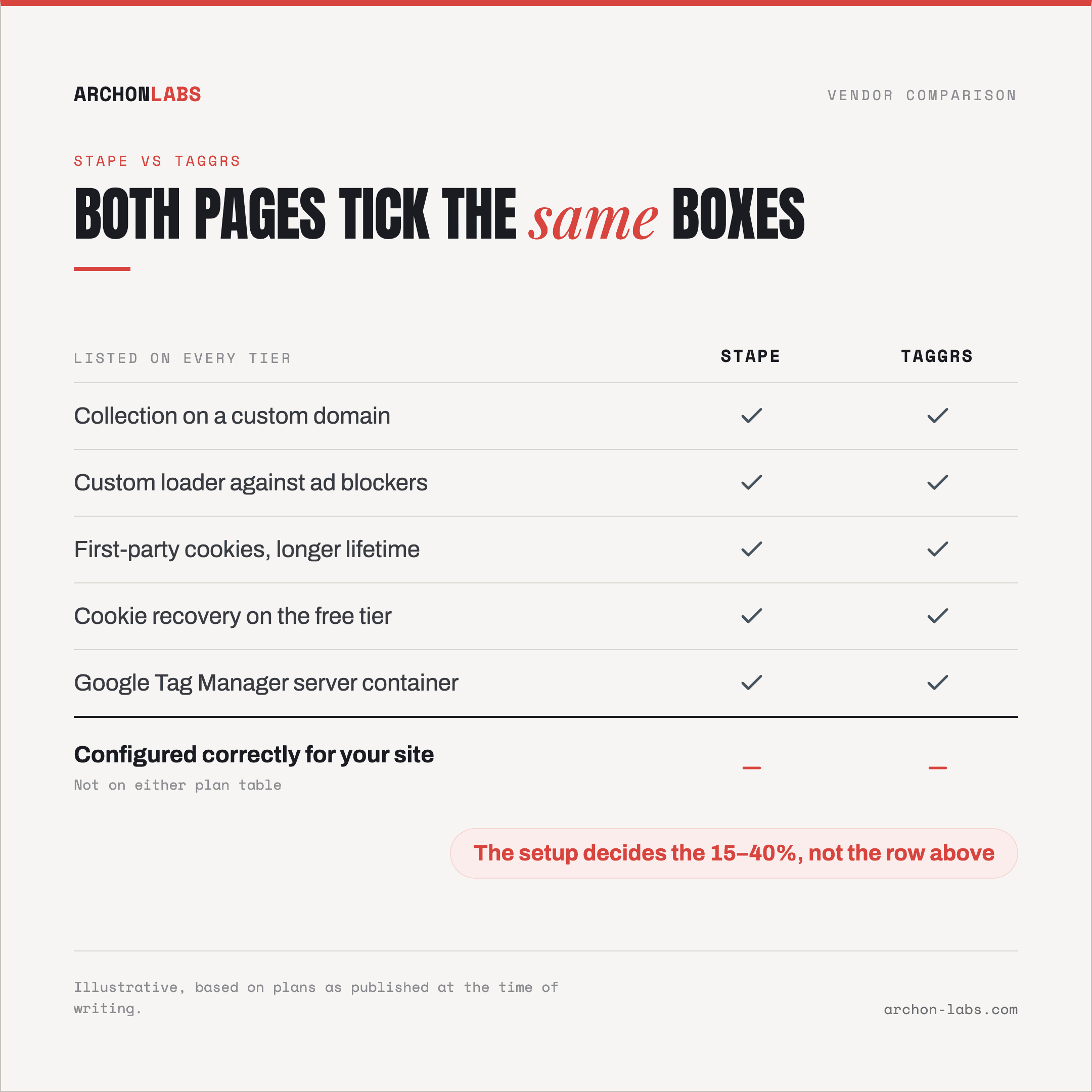
Read the two pricing pages closely and they make the point for you. Stape's published plans put a Custom Loader on every tier, described as making "your tracking resistant to tracking prevention algorithms or ad blockers", and a Custom Domain across all tiers to "set first-party cookies and increasing cookie lifetime". Taggrs's published plans list a custom subdomain, an enhanced tracking script for ad blocker defence and cookie recovery on every tier, the free one included. As published at the time of writing, the features that decide how much signal survives are standard equipment on both. They are not what separates a setup recovering 15 to 40% of the conversions it was missing from one recovering a fraction of that.
What separates those two setups is a list of decisions no plan table mentions. Start with where collection is served from. Google's own documentation is blunt about it: "your tagging server and your website have to run on the same domain", otherwise the server sits in a third-party context and can "only set Javascript cookies". A JavaScript-set cookie is exactly the kind Safari expires early, since WebKit caps script-writable storage at seven days, while a server-set first-party cookie can run to the 400-day maximum Chrome allows. Same vendor, same monthly invoice, and a returning visitor is either remembered for a week or for more than a year depending on how that one thing was wired. We took that origin question apart in what a first-party tag gateway actually does.
The rest of the list has the same shape, and none of it appears on a comparison page:
Consent handled so the visitor's choice is respected without defensively discarding conversions you are permitted to measure.
Click IDs and campaign parameters kept alive long enough that a conversion two weeks later still ties back to the campaign that earned it.
The loader genuinely served from your own domain and referenced correctly in the site's code, rather than switched on in a dashboard and never checked.
Every event verified against what each platform reports receiving, not against what the container says it sent.
A parallel run alongside the old setup before anything is switched over.
This is why two agencies on identical plans at the same vendor land at opposite ends of the same range. A typical account has 15 to 30% of its conversions consistently uncaptured, and ad blockers strip 30 to 40% of events before they ever leave the browser. How much of that comes back is a configuration outcome. The vendor row in your comparison spreadsheet reads the same either way.
What good looks like
Split the problem into two decisions and give each the weight it deserves. The first is procurement, and it is genuinely small. Does a client's data residency requirement force European processing and a certificate you can show them, which is where Taggrs's published European infrastructure and ISO 27001 certification settles it outright. What does the plan cost at your real request volume. Do you need multi-zone routing or multi-domain support yet. Whoever owns supplier contracts can answer all of that in an afternoon, and none of it moves your recovery rate.
The second decision is the setup, and it carries the entire outcome: collection on your own domain with server-set cookies, consent wired so measurement stays compliant without giving up more data than it has to, click IDs protected end to end, every event validated against what the platforms actually receive, and a parallel run before the switch. That is the job Archon Signal does, on whichever vendor you already pay for. We do not ask agencies to migrate, because the migration was never what held the numbers back.
Done properly it shows up in the reporting. For one performance agency, 38% of client traffic affected by tracking prevention came back into measurement, measured conversions rose 26% on average, and 14 hours per project went back to the campaign team. The vendor was not the variable in any of that. If you are still weighing whether the exercise pays back at all, we made that case separately in is server-side tracking worth it for your agency.

Frequently asked
So which one should we pick, Stape or Taggrs?
Whichever one clears your client's requirements at your request volume. Taggrs publishes European infrastructure and an ISO 27001 certification, which decides it outright for some clients. Stape publishes a lower entry price and a wider ecosystem of integrations and templates. Both host the same Google server container, so treat it as a supplier choice, make it quickly, and spend the time you saved on the configuration.
We already run one of them, is switching worth it?
Almost never. A migration costs a week and returns nothing measurable, because the host is not what limits your recovery. Check what the current setup actually does first: is collection on your own domain, are cookies server-set, is consent handled without dropping permitted conversions, do click IDs survive the round trip. Anything wrong there will still be wrong at the other vendor.
Is the free plan enough?
On features it is closer than you would expect, since both vendors list the custom domain and loader pieces on their free tier. Volume is the real limit, and 10,000 requests a month is a test property rather than a client site. Included is also not the same as configured, which is the point of the whole article.
Does the ad blocker protection work out of the box?
Partly, and the remainder is where the money sits. The custom loader is the right mechanism, but switching it on in a dashboard is one step of several: it still has to be served from your own domain, referenced correctly in the site's code, and checked against real traffic in real browsers. With ad blockers stripping 30 to 40% of events, how much you win back depends on how completely that chain was finished.
What about self-hosting on Google Cloud instead?
It is a third way to run the identical container, trading a managed dashboard for more control and more operational work. It changes who maintains the infrastructure and what the infrastructure costs. It changes nothing on the configuration list above, which is where your recovery is actually decided.
If you want an answer for one specific client account instead of another feature matrix, request a free tracking audit and we will check what your current setup is really sending, whichever vendor is behind it.