The symptom
Two tabs used to be the problem. Now there are three: Stape's pricing page, Taggrs's pricing page and Addingwell's pricing page, each open at once and each promising close to the same thing, first-party cookies, resistance to ad blockers, European hosting if a client needs it. Whoever is meant to sign off on this has already read all three twice and still cannot say what actually changes if the agency picks wrong.
The pressure to decide fast is real. A client is waiting on a server-side setup, a proposal has a line item for hosting that needs a number next to it, and every comparison post online seems to end in a recommendation nobody trusts, usually because the post was written by one of the vendors.
Meanwhile the question that actually matters, which choice gets more conversions back into the ad platforms, sits underneath all three tabs and none of them answer it. That question does have an answer. It is just not the one on any pricing page.
Why the choice feels bigger than it is
All three vendors host the identical thing underneath their own dashboard: a Google Tag Manager server container. Google supplies the tag templates, the event model and the clients that turn a page hit into a request to an ad platform. Stape, Taggrs and Addingwell each wrap that container in their own billing and infrastructure, but the container itself is the same container regardless of which one is on the invoice.
What does change the outcome is where that container is served from. Google's own documentation states plainly that "your tagging server and your website have to run on the same domain," and that a server run on the default endpoint instead "can only set Javascript cookies." A cookie set that way is the kind Safari expires early, since WebKit caps script-writable storage at seven days, while a server-set first-party cookie can run to the 400-day maximum Chrome allows. We went through that mechanism in full in what a first-party tag gateway actually does, and it holds regardless of which of these three names is on the invoice.
We answered the two-way version of this question, Stape against Taggrs, in does the server-side tool actually matter. Addingwell earns a place in the comparison now because agencies keep asking for a European-only shortlist, and it is the third serious name on that shortlist, not because the underlying mechanics changed.
Stape, Taggrs and Addingwell, priced and dated
Vendor pricing changes without warning, so here is what each published, checked on 2026-08-27.
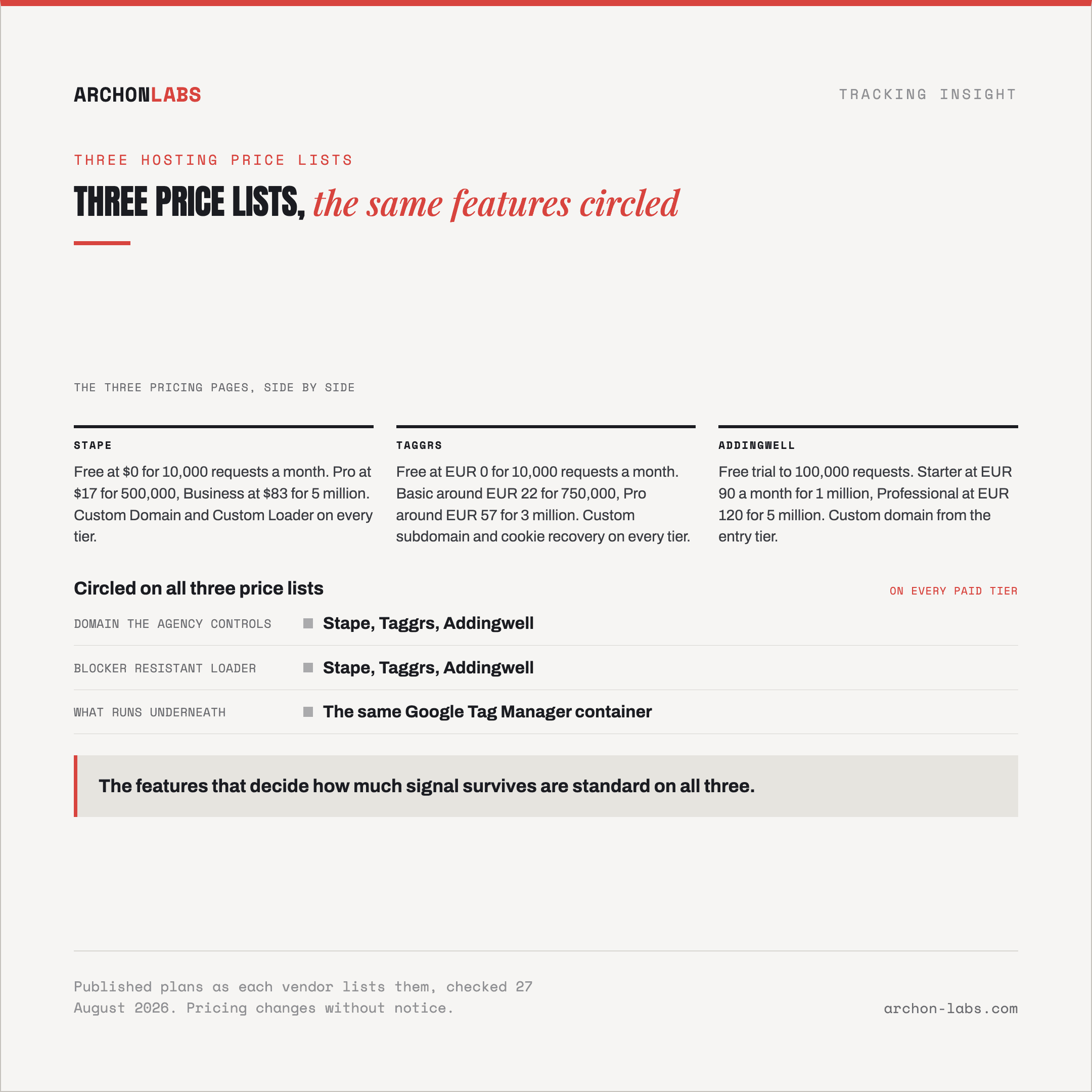
Stape, published plans: Free at $0 for up to 10,000 requests a month, Pro at $17 for up to 500,000, Business at $83 for up to 5 million, Enterprise at $167 for up to 20 million, Custom above that. Custom Domain and Custom Loader ship on every tier, including Free.
Taggrs, published plans, annual EUR pricing: Free at €0 for up to 10,000 requests, Basic around €22 a month for 750,000, Pro around €57 for 3 million, Ultimate around €127 for 10 million, Enterprise custom. A custom subdomain, an ad blocker resistant tracking script and cookie recovery ship on every tier, Free included.
Addingwell, published plans: Starter at €90 a month for 1 million requests, Professional at €120 for 5 million, Business at €210 for 12 million, up to Ultimate at €1,190 for 100 million, with per-request overage pricing that drops at higher tiers. A custom domain is included from the entry tier, and a free trial covers up to 100,000 requests.
Read the feature lists next to the prices and the comparison mostly cancels itself out. The features that decide how much signal survives, a domain the agency controls, a loader that resists blockers, are standard on all three from the cheapest paid tier up. Addingwell's per-request cost lands higher at comparable volume, and that premium buys managed provisioning rather than a materially different recovery outcome.
What good looks like
Split this into the decision that is genuinely small and the one that is not. Procurement is small: what a client's data residency policy requires, what the plan costs at the agency's real request volume, whether a certificate needs to be shown to a client's legal team. None of that changes how many conversions come back.
Inside procurement, the three do differ enough to sort by agency type rather than by one universal winner. Stape is the more mature tool of the three, a wider Power-Ups library, its own Stape Store for data enrichment, a dedicated user ID feature, and a blog and support operation built up over more years in the market. For an agency without a hard EU-only requirement, that maturity is the reasonable default. Taggrs stays a credible European option on its own merits, its infrastructure partnership with UpCloud puts client data in UpCloud's own EU data centers, and both companies hold ISO 27001 certification, which answers a data residency question outright for clients who ask it directly. Addingwell is the newest of the three and the smallest ecosystem, founded in Lille in 2021 and acquired by the consent platform Didomi in 2025. That ownership is the one differentiator worth naming: an agency already running Didomi's consent management platform gets one vendor relationship instead of two, which is a real convenience and not a recovery advantage.
None of that procurement decision is where the outcome lives. Archon Signal does the configuration work, on whichever of the three an agency already pays for: collection served from the client's own domain, consent handled without discarding conversions the agency is permitted to measure, click identifiers kept alive across the visit, and every event checked against what each platform actually reports receiving. For one performance agency that work brought back 38% of the client traffic tracking prevention had been hiding, lifted measured conversions by 26% on average, and returned 14 hours per project to the team. The vendor on the invoice was not the variable in any of it. No setup on any of the three hosts recovers every event a browser restriction or a consent refusal removes. The honest ceiling sits around 95%, a ceiling rather than a promise.

Frequently asked
So which one should we actually pick?
Stape by default if nothing forces a European-only stack, on the strength of its ecosystem and support. Taggrs if a client needs EU data residency stated plainly and verifiably. Addingwell if the agency already runs Didomi for consent and wants one vendor relationship instead of two. All three run the identical server container underneath, so none of the three choices moves the recovery rate on its own.
Is the free tier on any of them enough for a live client site?
Not for long. Each free tier caps out around 10,000 requests a month, which suits a test property, not an active account. Move to a paid tier once real traffic starts, the core recovery features are already present at the entry paid price on all three.
We already run Stape or Taggrs. Is switching to Addingwell worth it?
Almost never on technical grounds. A migration costs time and, per request, Addingwell tends to cost more at comparable volume than Stape or Taggrs. Switch only for a specific procurement reason, consolidating vendors around Didomi, for example, not for anything it changes downstream.
Does picking the better vendor improve our conversion recovery?
No. The configuration on top of the container, the domain it runs on, how consent and click identifiers are handled, decides the recovery rate. That work is the same job on any of the three, which is the whole point of this comparison.
What if a client specifically demands EU-only hosting?
Taggrs and Addingwell both make that case directly, with Taggrs's UpCloud partnership and ISO 27001 certification the more thoroughly documented of the two. Stape also offers named EU server zones for agencies who want Stape's ecosystem without leaving European infrastructure.
If a client account needs an answer specific to its own setup rather than another feature list, request a free tracking audit and we will check what it is actually sending, on whichever of the three is behind it.