The symptom
The stack works. Reports go out on time, conversions land in the ad platforms, the client is happy. Then a contract ends, or a new lead marketer asks a question nobody has answered in three years: what do we actually own here?
That is where it gets uncomfortable. The Google Analytics property sits in an account someone at your agency created in 2022. The server container runs in a cloud project billed to your card. The reporting connector is on your subscription, and the definition of a qualified lead lives in the head of a freelancer who moved on.
Taking over an account shows the same problem from the other side: four tools doing overlapping jobs, two still billed to someone who left the client a year ago, and a setup only the previous agency can explain. Nothing is broken. Nothing is transferable either.
Why it happens
Measurement stacks grow by addition. Someone needed a conversion in Google Ads, so a tag went live. Someone needed a weekly report, so a connector was bought. Someone read that server-side was the fix, so a hosting subscription appeared. Each was sensible on the day, and none was an ownership decision, because nobody asked the question that settles it: if this relationship ended tomorrow, what would the client still hold?
Platforms treat ownership as a fact, not a courtesy
The platforms have already decided what ownership means, and their rules are more absolute than most agencies expect. In Google Ads a client account can only have one owner manager account, and per Google Ads Help that owner can grant or revoke administrative access, unlink other managers, transfer ownership, or turn it off, while client account users may always unlink a manager. Whoever holds that seat sets the terms of the handover, in either direction.
Google Analytics is stricter about time than about access. On a standard GA4 property, event-level retention is set to either 2 or 14 months, and 14 months is the ceiling. The longer windows of 26, 38 and 50 months exist only on 360, according to Analytics Help. So "we have years of history in GA4" is usually not true, whoever owns the login. And if a property is deleted, Google documents that it sits in the trash for 35 days, is not processed while it is there, and is permanently deleted after that.
Renting the machine is a different question from renting the address
Server-side collection is where own versus rent gets genuinely debatable, and where agencies assume they own more than they do. Google does not run the server for you. Its own server-side tagging documentation says you can set up a tagging server using Google Cloud or a platform of your choice, so the infrastructure is provisioned and paid for by somebody, and that somebody controls the endpoint.
The endpoint is not a plumbing detail, because it decides how long a visitor stays recognisable. Chrome caps cookie lifetime at 400 days, from release M104 in August 2022, while WebKit states that Safari's tracking prevention caps the expiry of client-side cookies to seven days. That is the gap between a returning visitor you can still connect to their first campaign touch and one who arrives as a stranger, and it hangs off which host writes the cookie. Renting that host is a good decision. Renting it without the domain and the account in the client's name is not.
Ownership is a legal position, not just a login
There is a layer underneath the platform settings. Under the GDPR, the party determining the purposes and means of processing is the controller and the party processing on their behalf is the processor, which for client tracking normally makes the client the controller and the agency the processor. Article 28(3) requires that arrangement to be governed by a contract setting out the subject matter, duration, nature and purposes of the processing, and requires the processor to return or delete the personal data when the work ends.
Read from the ownership angle, the client's claim on their own data is a contractual fact rather than a matter of who can log in, and that clause is what makes a handover enforceable instead of a favour.
What good looks like
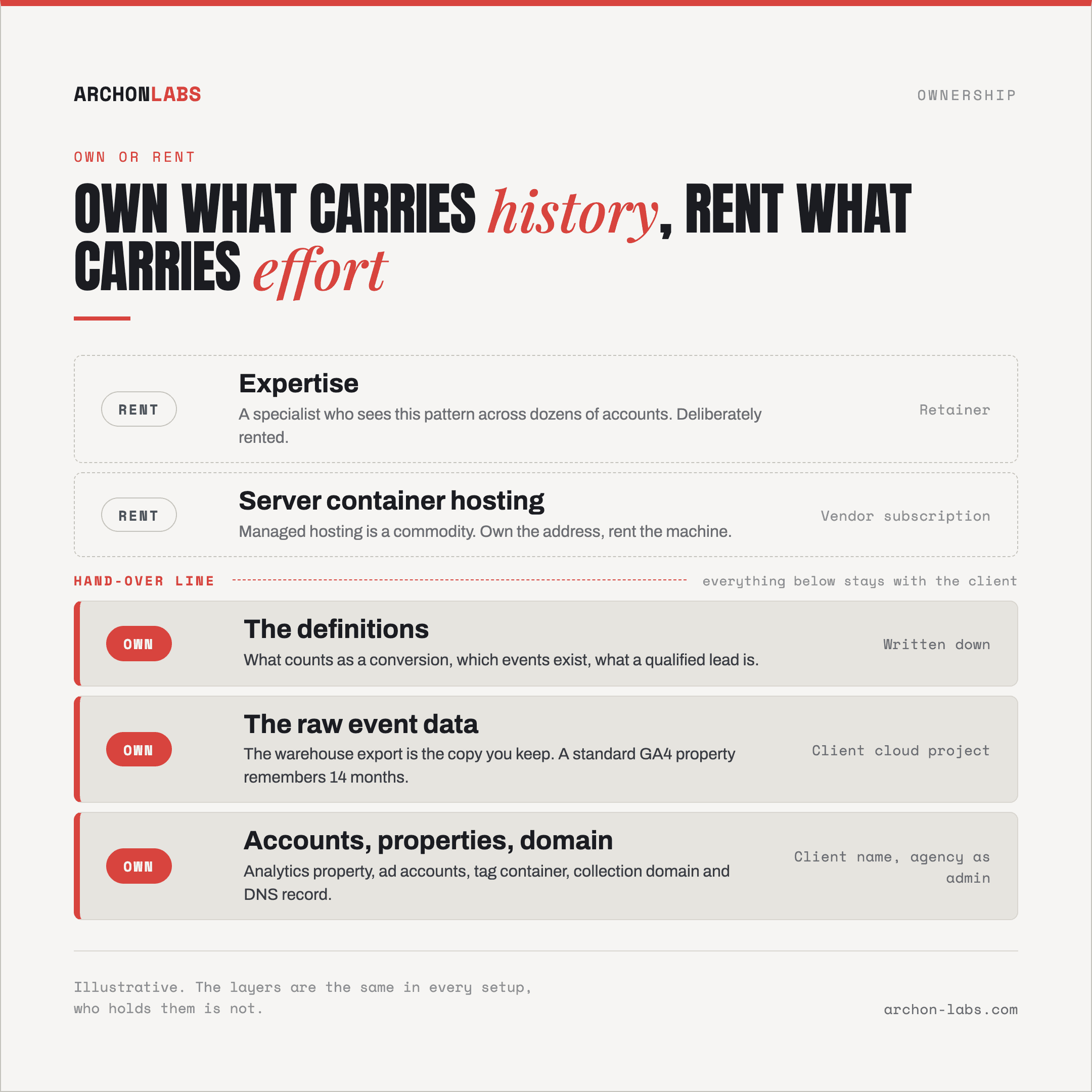
Stop sorting tools and start sorting layers. The dividing line that holds up across clients: own what carries history and identity, rent what carries effort.
Accounts and properties: own. The Google Analytics property, the ad accounts, the tag container and the cloud project belong in the client's own organisation, with your agency added as administrator or manager. It costs nothing at setup and saves the offboarding conversation later.
The raw event data: own. The GA4 interface is a reporting view with a 14 month memory on standard. The export to BigQuery is the copy you keep, and Google is explicit that in your own project you own that data and manage permissions with BigQuery ACLs. Worth knowing before you promise it: the same page puts the standard-property export limit at 1 million events per day.
The collection endpoint and the domain: own the address, rent the machine. Managed hosting for a server container is a commodity and buying it is usually right, and which vendor matters less than most comparison pages suggest, the argument in does the server-side tool actually matter. The domain, the DNS record and the account the subscription sits under are the parts to keep.
The definitions: own. What counts as a conversion, which events exist, what each parameter means, what a qualified lead is. Undocumented, this is the layer that makes a stack unmovable, and the cheapest to write down.
The expertise: rent. Deliberately. A specialist who sees this pattern across dozens of accounts is worth more per hour than a generalist learning it on yours, the trade-off we set out in an in-house data hire versus an external specialist.
Turning those owned layers into something a client can use is the job of Archon Pixel: a first-party measurement foundation in the client's own accounts, collecting from their own domain so cookie lifetime runs to 400 days instead of 1-7 days, writing into a dataset the client keeps, and capturing around 25% more than a standard GA4 setup. Documented on handover, so the next agency or in-house hire can pick it up without an archaeology project.
Be blunt about what ownership does not buy. It changes who controls the measurement and how far back it reaches. It does not make the numbers whole. Consent refusals, ad blockers and plain network failure always remove a share of events, 15-30% of conversions go consistently uncaptured on a standard setup, and roughly 95% is the realistic ceiling, a ceiling rather than a promise.
FAQ
We hold client accounts in our own name to keep things simple. Is that really a problem?
It is efficient until it is contested. The risk is not that you behave badly, it is that the client's history then depends on your goodwill and your billing details, while a GDPR processor arrangement expects the controller to be the client. Move the ownership, keep administrative access, and the daily work does not change.
Does owning our data mean paying for a warehouse for every client?
No, and it depends on the client. Switching the export on early is the default, because retention on a standard GA4 property tops out at 14 months and you cannot backfill what was never exported. Whether that data then needs modelling, scheduled jobs and a dashboard layer depends on volume and on whether anyone will act on the output. Small accounts are well served by the export sitting there and nothing more.
We already pay a vendor for server-side hosting. Should we move it in-house?
Usually not. Managed hosting is a commodity, and running your own container means owning uptime, scaling and updates for it. Check something narrower instead: whose name is on the subscription, whose domain the collection host sits on, and whether the DNS record can be handed over. If those three sit with the client, renting the machine is not an ownership problem.
Where do we start if the stack we inherited is a mess?
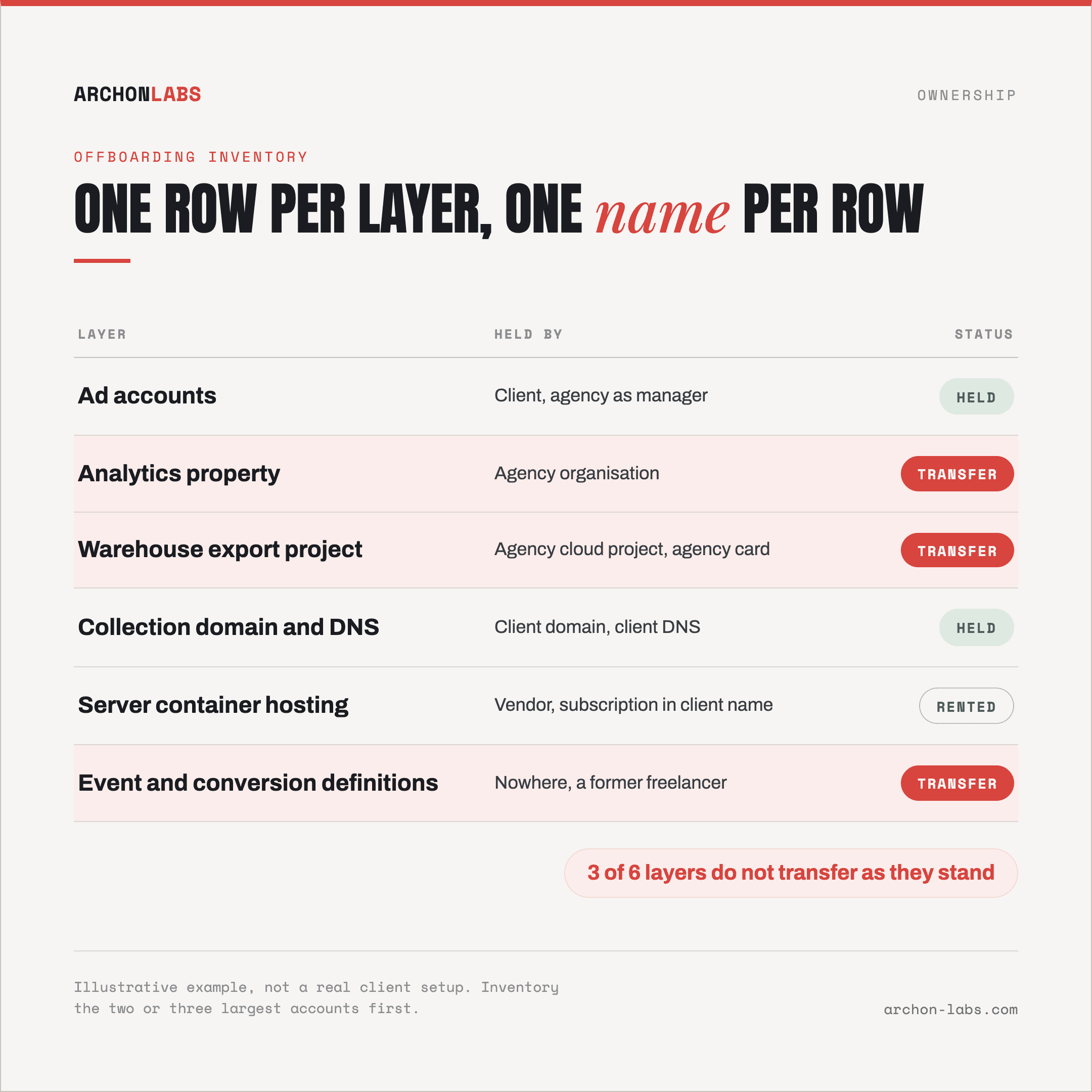
Inventory before change. List each layer, who holds it, whose card pays for it and whether it can be transferred, on the two or three largest accounts first. That list shows what is genuinely at risk and what merely looks untidy, and it turns the tidy-up into a handful of admin changes rather than a rebuild.
If you would rather not build that inventory from scratch, mapping who owns which layer across a client setup is part of a free tracking audit.