The symptom
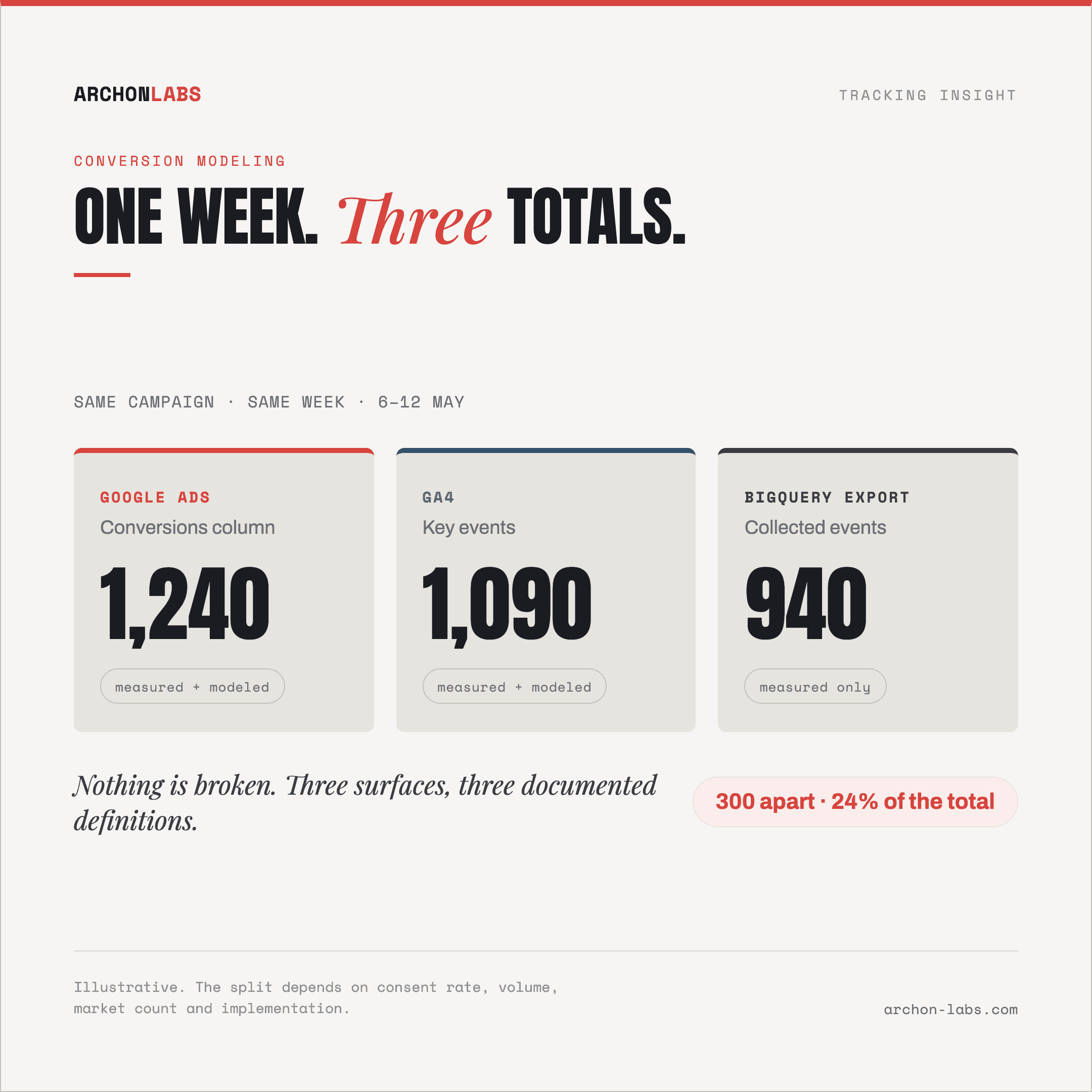
A client asks whether the conversions in the monthly report are real. It is a fair question, and the awkward part is that the three places you could check disagree about the same week: the Conversions column in Google Ads, the key events in GA4, and the raw export underneath GA4.
Then the number moves on its own. You export on Monday, the client opens the dashboard on Thursday, and the same date range shows more conversions than the report you sent. Nothing was changed in between.
Neither interface tells you which of those conversions were counted and which were estimated. Both kinds sit in the same column, in the same font. The split is documented, just not in the report.
Why it happens
A refusal removes the identifier, not the conversion
When a visitor declines the banner, the purchase or the lead still happens. What disappears is the ability to tie it back to the click that caused it, because Article 5(3) of the ePrivacy Directive allows storing or reading information on someone's device only with their consent, outside a narrow strictly necessary carve-out. No cookie, no join.
So the hole is in the report, not in the business. Across agency accounts, 15-30% of conversions are consistently uncaptured for reasons like this one. Google's answer is to estimate the missing part from the visitors who did consent, and to publish that estimate as part of the total you report.
The estimate arrives in the same column as the measurement
Google Ads Help is explicit about it: modeled conversions appear in the Conversions column and are reflected in all downstream reports that use that data, and modeled values land in the Conversion value column the same way. There is no documented way to split that column back into counted and estimated. Everything built on it inherits the mix, including your bid strategies, your CPA targets and the number on the QBR slide.
The estimate also settles slowly. Google's conversion modeling documentation puts that at up to five days to fully process and stabilize in Google Ads reporting, and the modeled key events page says GA4 can keep updating attributed conversion data for up to twelve days after a conversion is recorded. That is your Thursday number.
Whether a client gets modeling at all depends on volume
This is the part most agencies never hear, because the vendor explainers skip it. Modeling is not a switch that flips for every account. Google Ads requires consent mode or the IAB Transparency and Consent Framework v2.0 implemented correctly, plus a threshold of 700 ad clicks over a seven day period, per country and per domain grouping.
Read that last clause twice, because it decides what a multi-market client sees. The same campaign can clear the threshold in a large market and miss it in a smaller one, so the smaller market reports its measured conversions only. It looks like that market underperforms. It is being counted differently.
GA4 gates its own modeling behind its own numbers. Behavioral modeling for consent mode needs at least 1,000 events a day with analytics storage denied for at least seven days, at least 1,000 daily users sending events with consent granted on seven of the previous twenty-eight days, tags that load before the consent dialog appears, and the reporting identity set to Blended. Leave it on Observed and the modeled part is not in the reports at all.
Wiring changes the estimate too. Google's tag platform documentation puts basic consent mode on a general model and advanced consent mode on an advertiser-specific one, so two clients with the same consent rate and different plumbing get different estimates. One correction worth making, since it circulates the other way round: advanced mode is not stated as a hard requirement for Google Ads modeling, either consent mode or TCF v2.0 qualifies. It is a requirement for GA4's behavioral modeling.
Each surface answers a slightly different question
GA4's modeled data reaches the standard reports and part of the explorations. Google also lists where it does not reach: audiences, user explorer, cohort and user lifetime explorations, sequence segments, retention reports, predictive metrics, and the BigQuery export.
That last one is useful rather than annoying. The export is the observed floor, the events that were actually collected. Google's comparison of reporting surfaces explains the side effect as well: the export holds cookieless pings where each session carries a different pseudonymous id, so user counts there and in the reports will not line up.
Tools disagreeing, then, is not always a broken setup. Sometimes it is three surfaces doing exactly what they are documented to do, which is a very different client conversation than "we will look into it". When the gap is not explained by any of the above, it is usually the collection layer instead, which is why conversions never reach GA4 to begin with.
What good looks like
You do not have to purge estimates from client reporting. You have to know the split before the client asks, and label it.
Three questions settle it for any account. Is consent mode basic or advanced. Does the account clear the modeling thresholds, per country and per domain grouping. Is the GA4 reporting identity Blended or Observed. That is ten minutes per client, and it changes what the report means.
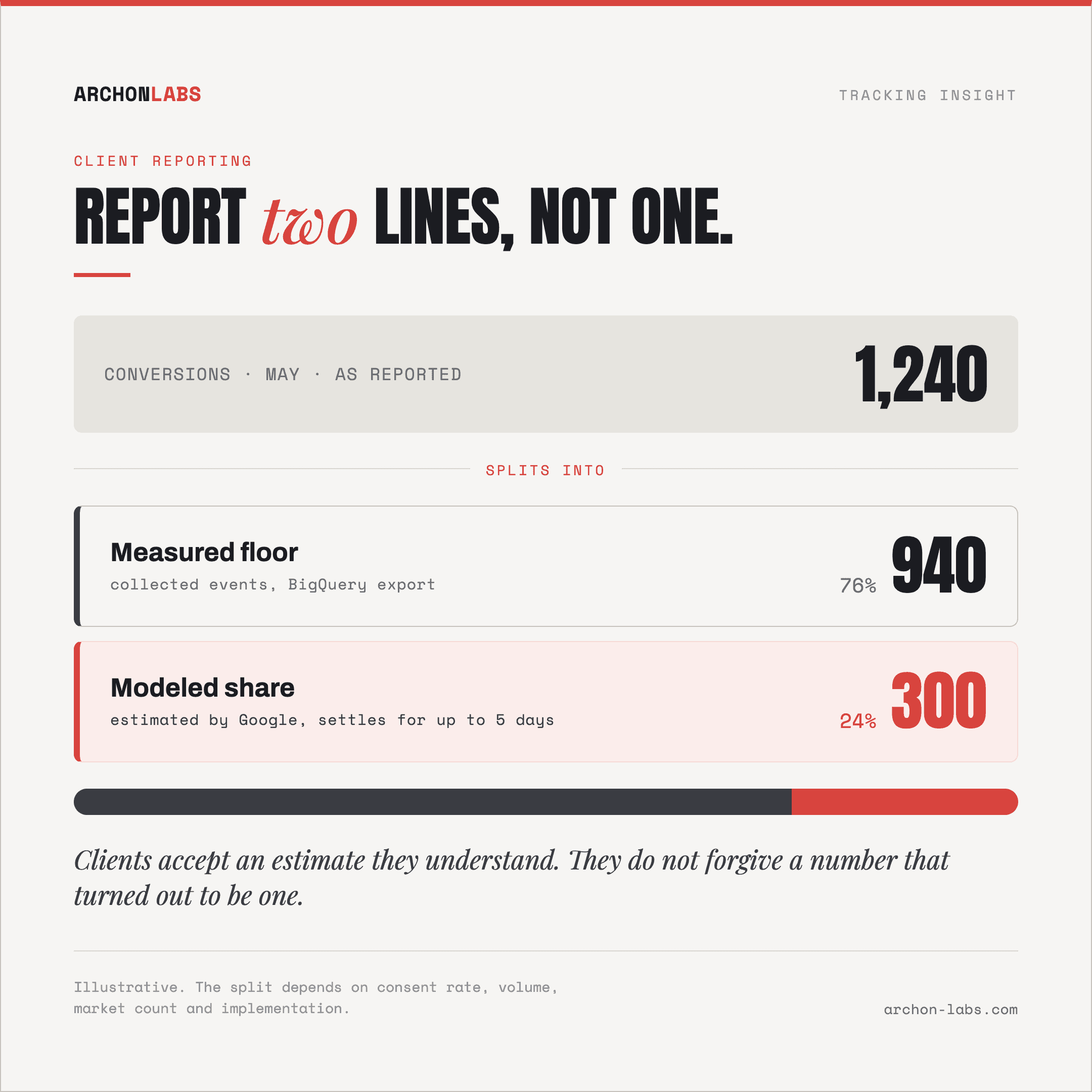
Then report two lines instead of one: the measured floor from the export, and the reported total including the modeled share. It reads like more work and it buys the one thing that matters when a number gets challenged, which is that you knew the answer first. Be straight about fitness too. Modeling is a reasonable input for bidding, where direction beats precision. It is a weak input for anything finance signs off on, and how weak depends on volume, the number of countries, the consent rate, and whether the implementation is basic or advanced.
The lever underneath all of this is the measured share, because a conversion that is counted needs no estimate, and a larger consented base also trains a better model. That is the work Archon Consent does: consent wired so it stays compliant and still measurable, defaults that are not stricter than the law asks, and a written record of what is measured and what is estimated. At best that gets a setup to roughly 95% of collectable events, never all of them, and an honest report says so. What the defensive alternative costs is covered in what a cookie banner really costs you in data.
FAQ
Are modeled conversions fake?
No. They are statistical estimates of conversions that did happen, built from the behavior of visitors who consented. The problem is not that they exist, it is that they are reported combined with measured conversions and nothing labels the mix. Treat them as an estimate with an error bar around it, not as a count.
Can I separate modeled from measured conversions?
Not inside the Google Ads Conversions column, where no split is documented. Two things do work. Setting the GA4 reporting identity to Observed gives you reports without the modeled part, and the BigQuery export contains collected events only, which gives you a measured floor to compare against. The distance between that floor and the reported total is roughly the modeled share.
Why does one country look worse than the others?
Check the threshold before you rebuild the campaign. Google Ads modeling needs 700 ad clicks over a seven day period per country and per domain grouping, so a smaller market can be reporting measured conversions only while a larger one reports measured plus modeled. Same performance, different counting.
Would switching consent mode off make the numbers honest?
It would make them smaller, not more honest. You would lose the modeling, keep the refusals, and give up the consent signals Google requires for its measurement and personalization features. The refused conversions do not come back either way.
Do we tell the client their numbers are partly modeled?
Yes, and it lands better from you than from their next agency in six months. Frame it as what it is: a documented platform behavior, measured for their account, reported as a floor and a total. Clients accept an estimate they understand. They do not forgive a number that turned out to be one.
If you cannot say which part of a client's conversion total was measured and which part was estimated, that is the first thing a free tracking audit tells you.