The symptom
A client asks why the lead count in GA4 is lower than the conversions in Google Ads. Somebody on the call says they will look into it. The person who actually built that tracking is on a campaign for another client, or left the agency last year, and the answer that comes back a week later is a shrug dressed up as an explanation.
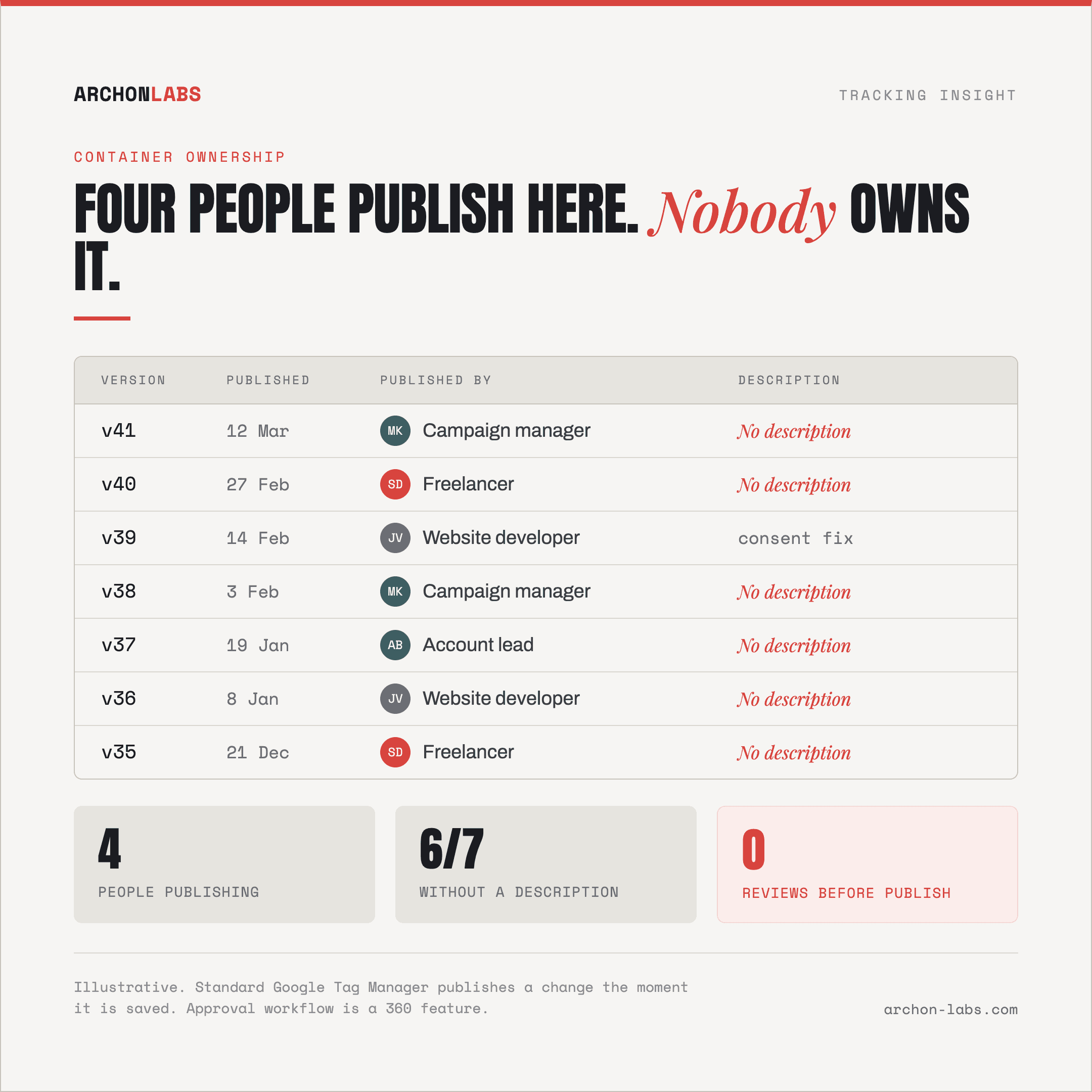
Nothing looks broken, which is exactly why nobody has looked. Numbers arrive in dashboards, the client gets a report, campaigns keep running. The setup was built in fragments by whoever was closest to the account at the time, and each fragment was correct on the day it was added. There is no document saying what is configured or why. There is no owner. There has never been a review.
So when the question in the title gets asked honestly, the answer in most agencies is "partly". Not because the marketers did a bad job, but because they were handed a specialist job on top of a full-time one, and nobody senior ever scheduled a moment to check the result.
Why it happens
Tracking arrived at your agency as a task and never became a role. It started as one snippet on a website. Then a conversion action, then a consent banner, then a server-side container, then audience lists and offline conversion imports. Each addition was small enough to hand to whoever was free that week. Added up, it is a system with a dozen moving parts, and it is still nobody's job.
The tooling encourages that. Setting up Google Tag Manager is genuinely accessible, and getting the configuration right under consent rules, ad blockers and browser restrictions is not. Having the tool is not the same as having it right, and the distance between the two is invisible from a dashboard.
Then there is the review step, which does not exist by default. According to Google Tag Manager's documentation, publishing a container makes the change active immediately, and the approval workflow, where a change waits for a second person to sign it off, "is only available in Google Tag Manager 360". In the standard edition that most agencies use, whoever makes a change is structurally the last pair of eyes on it. That is a product tier, not a flaw. It does mean the quality of your measurement layer rests on one person's afternoon, every time.
An unowned setup gets worse without anyone touching it
This is the part that surprises agency owners. A setup does not have to be badly built to be wrong today, because the ground underneath it keeps moving.
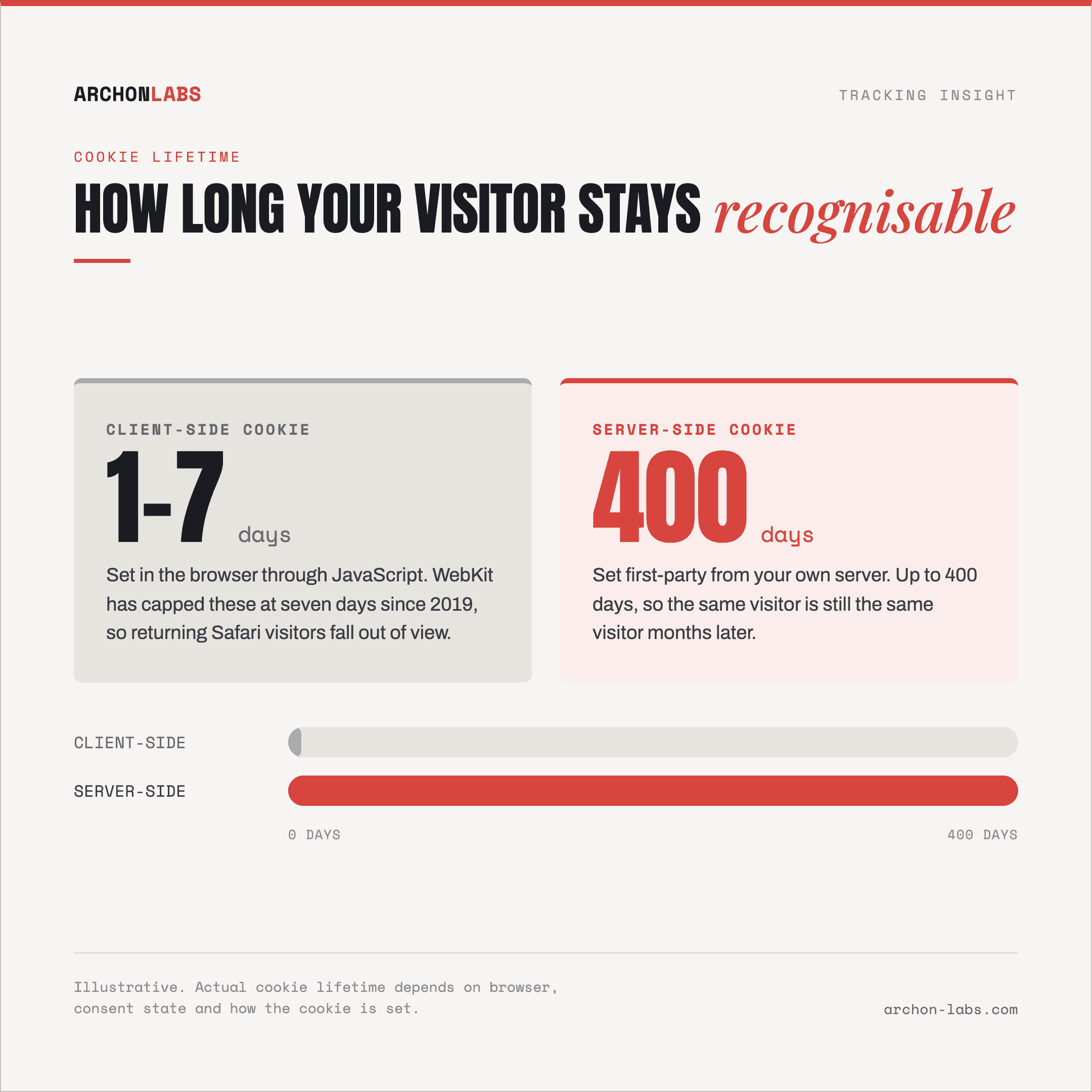
Browsers. WebKit has capped the expiry of cookies created in the browser through JavaScript at seven days since 2019. Measurement leaning on those cookies loses the thread on returning Safari visitors, and it reads as weak returning-visitor performance rather than as a tracking issue. A first-party cookie set server-side can run up to 400 days instead of 1-7.
Platform rules. Google Ads documentation states that since March 2024, Customer Match lists used in the EEA require both consent fields to be granted, and that data from unconsented EEA users "will not be processed and cannot be used for ad personalization". A setup that was fine in 2023 can stop feeding audiences without producing a single error message.
Settings nobody revisits. Google Analytics documentation gives standard GA4 properties a choice between 2 and 14 months of event-level data retention, and data past that window is deleted monthly. Whoever clicked that box once decided how far back your team can ever look. Worth checking which one your properties are on.
None of this shows up as a broken tag. It shows up as numbers that drift, disagree, and slowly stop being trusted, which points at the last reason: incentives. A campaign marketer is measured on campaign performance. Nobody in the agency is measured on the health of the data underneath it. So tracking work stays invisible until it fails, and when it fails it looks like a performance problem, so the response is a bid adjustment instead of an investigation. Meanwhile 15-30% of conversions go consistently uncaptured, and the bidding algorithms optimize against that incomplete picture with real budget.
What good looks like
The fix is not a platform and it is not a data team. It is one named owner for the measurement layer, and that person should not be the one running the campaigns. Focus is the key to results, and this is a discipline of its own, the same way nobody would ask a data specialist to manage a Google Ads budget on the side.
Ownership is worth defining concretely, because "we all keep an eye on it" is what you have now. It means four things:
A written record of what is configured, where, and why, so the setup outlives the person who built it.
A second pair of eyes before anything goes live, since the tooling will not enforce one for you.
A fixed review moment per client, tied to something that already happens, like a new campaign structure or the quarterly report.
Monitoring that tells you when a conversion stream stops, rather than a client noticing first.
Whether that owner sits inside your agency or outside it genuinely depends: on how many clients you run, on how much monthly spend rides on the data, and on how often the setups change. An agency with a few stable accounts can build the habit internally. An agency with thirty accounts and constant new builds needs someone whose whole job this is. We wrote up the in-house hire versus external specialist trade-off separately, because it deserves more than a paragraph here.
Whichever way you go, start with a baseline instead of a rebuild. You cannot own a setup you have never measured, and most of what needs fixing turns out to be smaller than feared. A tracking audit gives you the list, ordered by what each item costs you. Where it turns out the collection layer itself is the problem, Archon Signal is the server-side layer we build to repair it, typically recovering 15-40% more conversions than a client-side setup and extending cookie lifetime from 1-7 days to up to 400. It does not get you everything, and nothing does. Roughly 95% of events is the realistic ceiling, because consent refusals, ad blockers and plain network failure always take a share.
FAQ
Should our marketers stop touching Google Tag Manager?
No, and removing their access would slow everything down for no real gain. What changes is who signs off. They keep making changes, and a specialist reviews those changes before they go live, since Google Tag Manager will not hold anything back for review unless you are on the 360 edition. The habit is what matters, not the permission structure.
How do we check what we built without becoming specialists ourselves?
Three questions get you most of the way. Do the conversion numbers in the ad platform and in GA4 differ by an amount somebody on your team can explain? Does the setup still record anything useful when a visitor refuses consent or arrives in Safari? And would anyone find out this week if a conversion tag stopped firing? Any answer of "not sure" is itself the finding, and you do not need to diagnose it yourself.
We already run server-side tracking through a hosting tool. Isn't this handled?
Running a server-side container is not the same as having it configured well, and it is a common place to find work left half-finished, because the hard part was never the hosting. The three questions above apply unchanged. If anything, a server-side setup raises the cost of nobody owning it, since more of the measurement now depends on configuration that no dashboard displays.
Is this a hiring problem or a process problem?
Process first, almost always. An agency that adds documentation, a review step and monitoring gets most of the value without adding headcount, and it will judge far better afterwards what kind of help it actually needs. Hiring before the process exists tends to produce one overloaded person in the same position your marketers are in now.
If nobody can tell you when your client tracking setups were last checked, that is your answer, and a free tracking audit turns it into a list you can act on.