The symptom
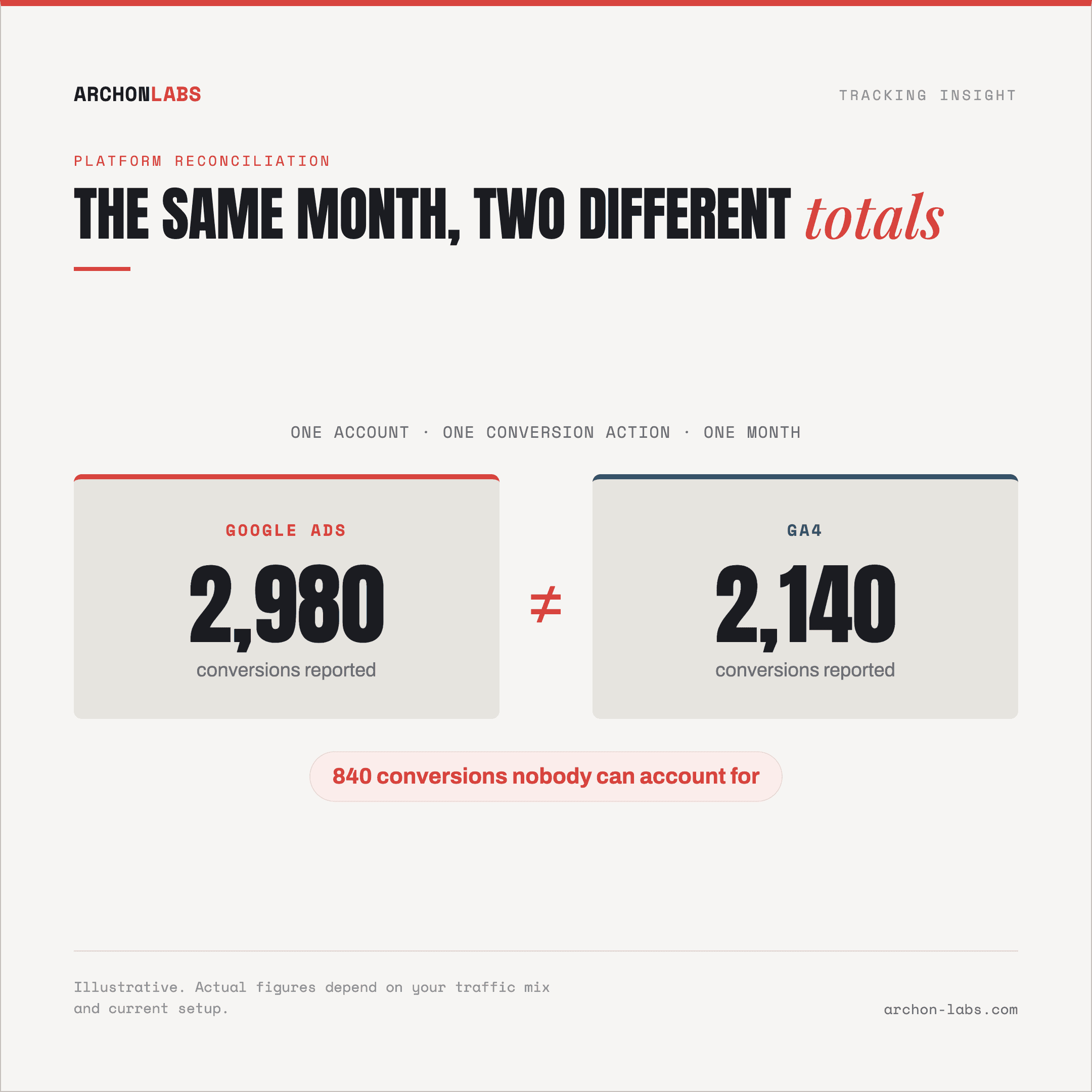
A client asks why Google Ads reports more conversions than GA4, and you do not have a clean answer. The month-end numbers do not reconcile across the platforms, the returning-customer count looks wrong, and somewhere in the back of your mind you suspect the measurement itself is off, not the campaigns. You just cannot point to where.
So someone suggests a tracking audit. The trouble is that nobody tells you what that actually involves. Is it a five-minute look at whether the tag fires, a full teardown of the data layer, or something a freelancer runs once and forgets? At Archon Labs we get asked this constantly, usually by agency owners who have been quoted for an audit and have no way to judge what they are buying.
This matters because "we checked the tracking" can mean almost anything. A quick tag test and a full audit both get called an audit, and they find completely different things. Knowing what a proper one covers is the difference between closing the leak and confirming the tag exists while the leak keeps running.
What a tracking audit actually checks
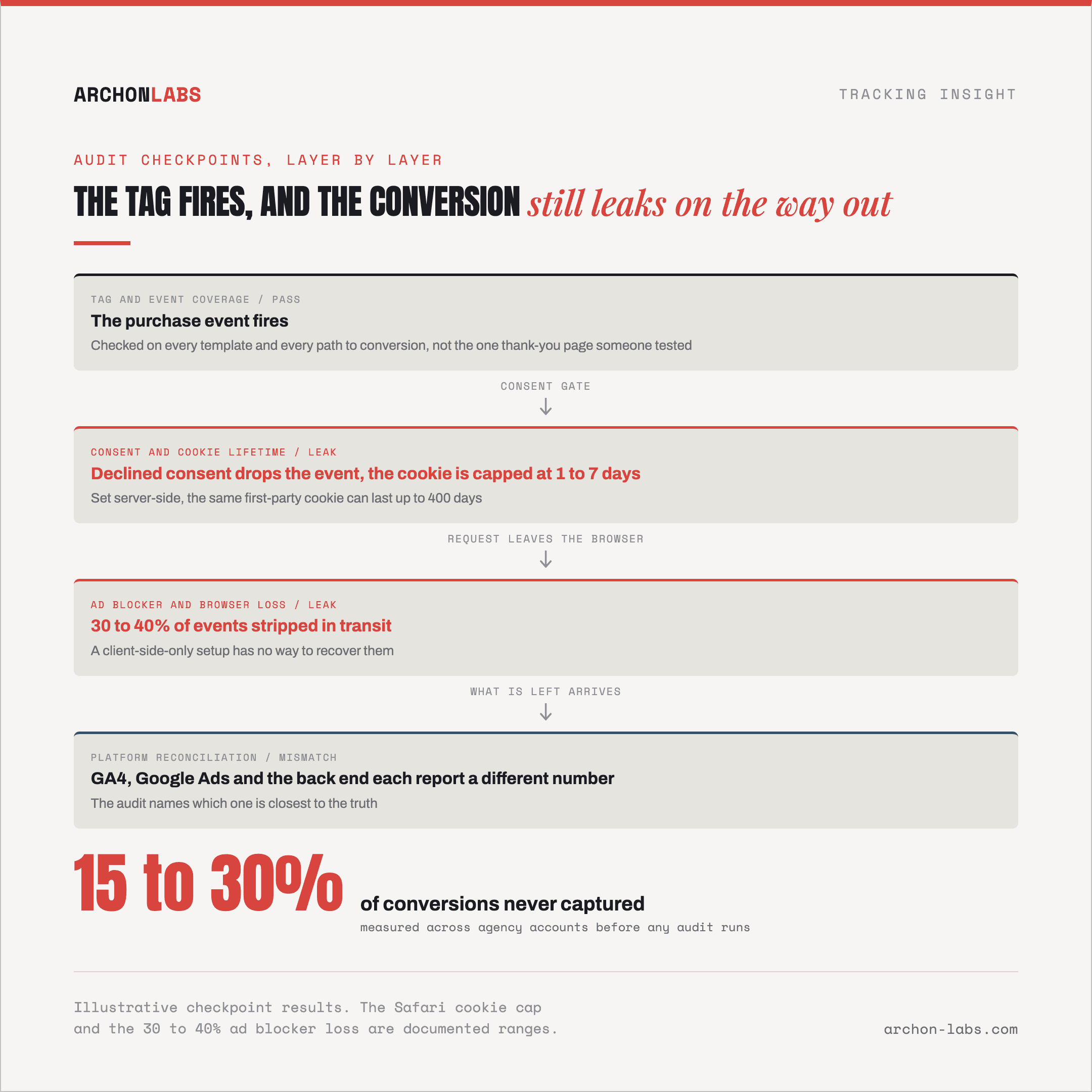
A proper tracking audit is not a yes or no test on whether a tag fires. It works through every layer where a conversion can be lost, dropped, or double counted between the moment a visitor acts and the moment that action shows up in a report or an ad platform. Across the agency accounts we review, 15 to 30% of conversions are consistently going uncaptured before anyone runs an audit, and the audit's job is to find exactly where.
These are the layers a complete audit works through.
Tag and event coverage. Does every key action, purchase, lead, add-to-cart, phone call, actually fire an event, on every template and every path to conversion, not just the one thank-you page someone tested once?
Consent and privacy flow. Is Consent Mode configured so that a declined consent is handled correctly rather than silently dropping the event, and are the defaults set the way you think they are? A misconfigured consent flow quietly deletes data you were allowed to keep.
Cookie lifetime. How long do the identifying cookies really survive? A browser-set cookie can be capped at 1 to 7 days under Safari's tracking prevention, while the same first-party cookie set server-side can last up to 400 days. The audit measures which one you actually have.
Ad blocker and browser loss. How much is stripped before it ever reaches the ad platform? Ad blockers and browser protections remove 30 to 40% of events on many accounts, and a client-side-only setup has no way to recover them.
Server-side configuration. If server-side tracking already exists, is it doing the work, protecting click IDs and UTM parameters and firing reliably, or is it a container that was switched on once and never tuned?
Platform reconciliation. Where and why do GA4, Google Ads, Meta, and the back-end each report a different number, and which one is closest to the truth?
Advanced measurement readiness. Can the setup even feed enhanced conversions, offline conversions, and customer match, or are those out of reach because the signal underneath is too thin to support them?
The output is not a vague "your tracking has issues". It is a specific map: here is what is firing, here is what is not, here is how much data each gap costs you, and here is the order to fix it in. That is what separates an audit from a spot check.
What good looks like
A good outcome starts with knowing, not guessing. Once the audit has mapped where conversions are being lost, the fix is almost always the same shape: move the critical measurement server-side so it survives the browser restrictions and ad blockers that were quietly eating it, and validate every recovered signal against the old numbers before anyone relies on it.
This is the job Archon Signal does. It is the server-side conversion tracking layer that recovers the signals ad platforms lose, so bidding algorithms optimize on a much fuller signal than the one they get today. On the accounts we take through this, server-side recovery typically returns 15 to 40% more conversions, and the numbers you report to clients finally line up with what actually happened.
The real value of the audit is that you fix the right thing in the right order. You are not adding budget to paper over a data leak, you are closing the leak so the budget you already spend is measured properly. If you want the mechanics of how much of that loss never even reaches your analytics, we cover it in why conversions never reach GA4.
Frequently asked
How long does a tracking audit take?
A focused audit is measured in days, not weeks. Reviewing a single client account is quick because we are not learning tracking from scratch, we do this across dozens of accounts. The longer part is the fixing, and even that is faster than in-house trial and error. On our case work it saved around 14 hours per project compared to handling it internally.
We already run server-side tracking with Stape or Taggrs. Do we still need an audit?
Often yes. Having the tool is not the same as having it configured right. Plenty of setups we review send events server-side but still let the browser write the identifying cookie, leave click IDs unprotected, or never validate that the recovered events match reality. The audit checks whether your setup is doing the work you think it is, not whether the container exists.
What do we actually get at the end?
A prioritized list of what is firing, what is not, how much measurable data each gap costs, and the order to fix it in. It is written to be read by an agency owner, not only a developer, so you can decide what to act on yourself and what to brief out.
Will an audit disrupt our live campaigns?
No. An audit is read-only, it inspects and measures without changing anything in your live setup. Nothing about your bidding, budgets, or creative is touched. Any changes come afterwards, deliberately, once you have decided what is worth fixing.
The fastest way to find out what your clients' tracking is losing is to have someone look. Request a free tracking audit and we will show you, account by account, where the data is leaking and what it is worth.