The symptom
The CPA line on the monthly report has been climbing for three months. Nobody touched the budget, the bid strategy is the one that worked all last year, and the creative is the set that carried the first quarter. You go through the change history looking for the thing you broke, and there is nothing in it.
So the conversation moves to the usual suspects. Competition is up, the market is harder, the creative is tired, the target was always too tight. All plausible, none provable in one meeting, and one of them ends up in the report as the explanation. The client accepts it the first month and asks a sharper version the second.
At Archon Labs we usually get called in around month four, after creative refreshes and bid changes that did not move the number. The CPA had gone up, that was never in doubt. What nobody checked first is whether the cost went up or the conversion count went down, two different problems wearing the same symptom.
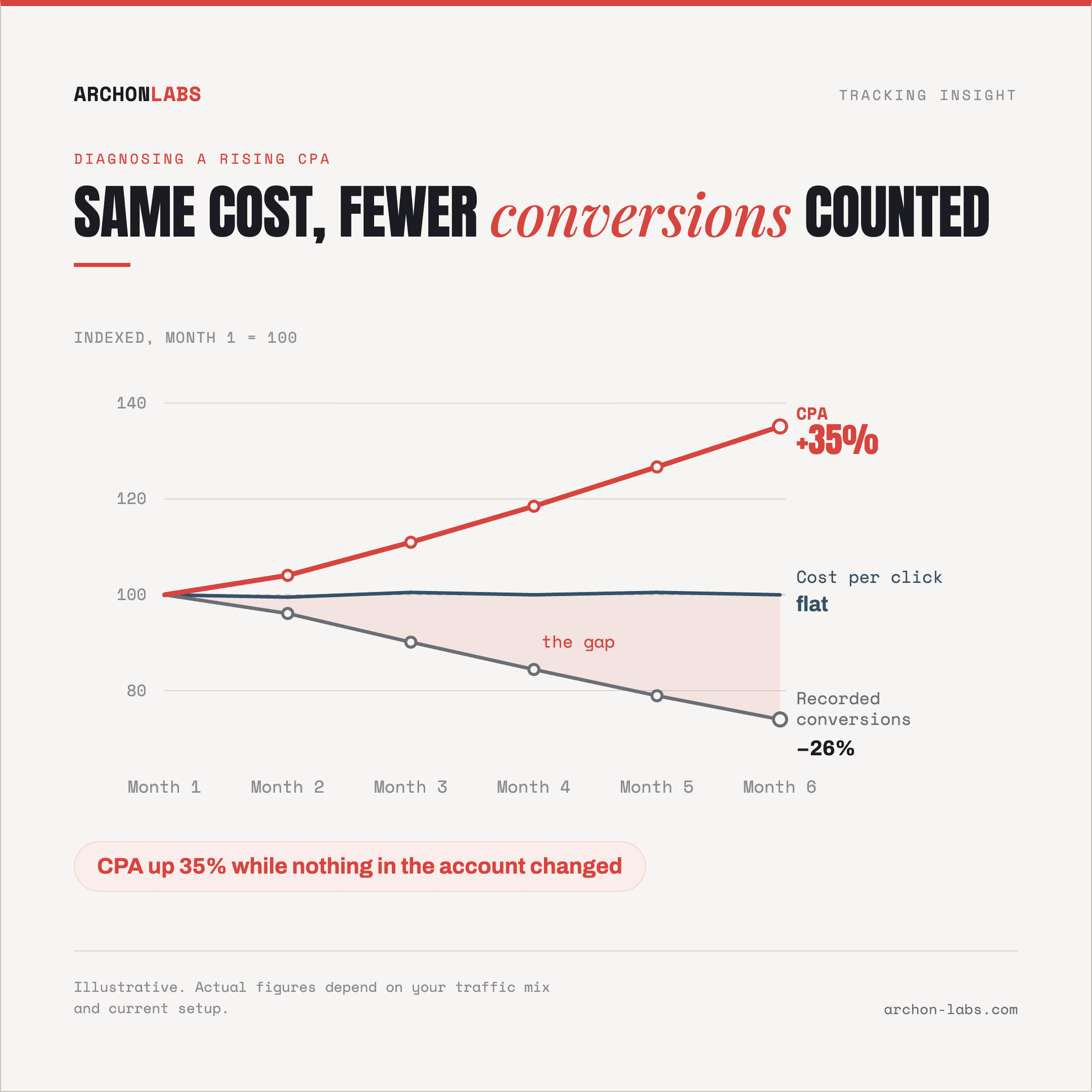
Why does a CPA rise when nothing changed?
Start with the arithmetic, because it decides where to look. CPA is cost divided by recorded conversions, and those two numbers are not equally trustworthy.
Cost is measured by the party sending the invoice. Every click is billed, nothing goes missing, the number is complete by construction. Conversions depend on a request leaving a visitor's browser and arriving somewhere. An extension can block it, a storage policy can erase the identity that ties it to the click, a consent choice can prevent it. One half of your CPA is an audited fact, the other half is a best effort.
In the setups we audit, 15 to 30% of conversions are never captured at all, before any attribution rule applies, and ad blockers alone strip 30 to 40% of events on some audiences. Where those events die is covered in why conversions never reach GA4. What matters here is the effect on a ratio. A denominator that shrinks while the numerator stays honest produces a rising CPA on flat performance. Same customers, same revenue, worse number.
Nothing changed in the account, so what did change?
The collection environment, on its own schedule, without an entry in anyone's change log.
Browser storage keeps expiring sooner. Safari caps the expiry of cookies set by JavaScript at seven days, and deletes a site's script-writable storage after seven days of Safari use without interaction, per WebKit. Your traffic shifts a few points toward iOS and returning visitors stop being recognizable.
Consent rates drift. A banner variant, a new market, a legal review that flipped a default. The ad account did not move, the number of events allowed to fire did. That half is worked through in how much data your cookie banner is throwing away.
Blocker lists and releases land on their own schedule. A filter rule added upstream, or a renamed button in a rebuilt checkout. The tag still fires, just not on everything it used to.
None of these announce themselves. There is no error state for a conversion that was never sent, so signal loss is found late and looks like a performance problem by the time it surfaces.
The part that turns a reporting problem into a real one
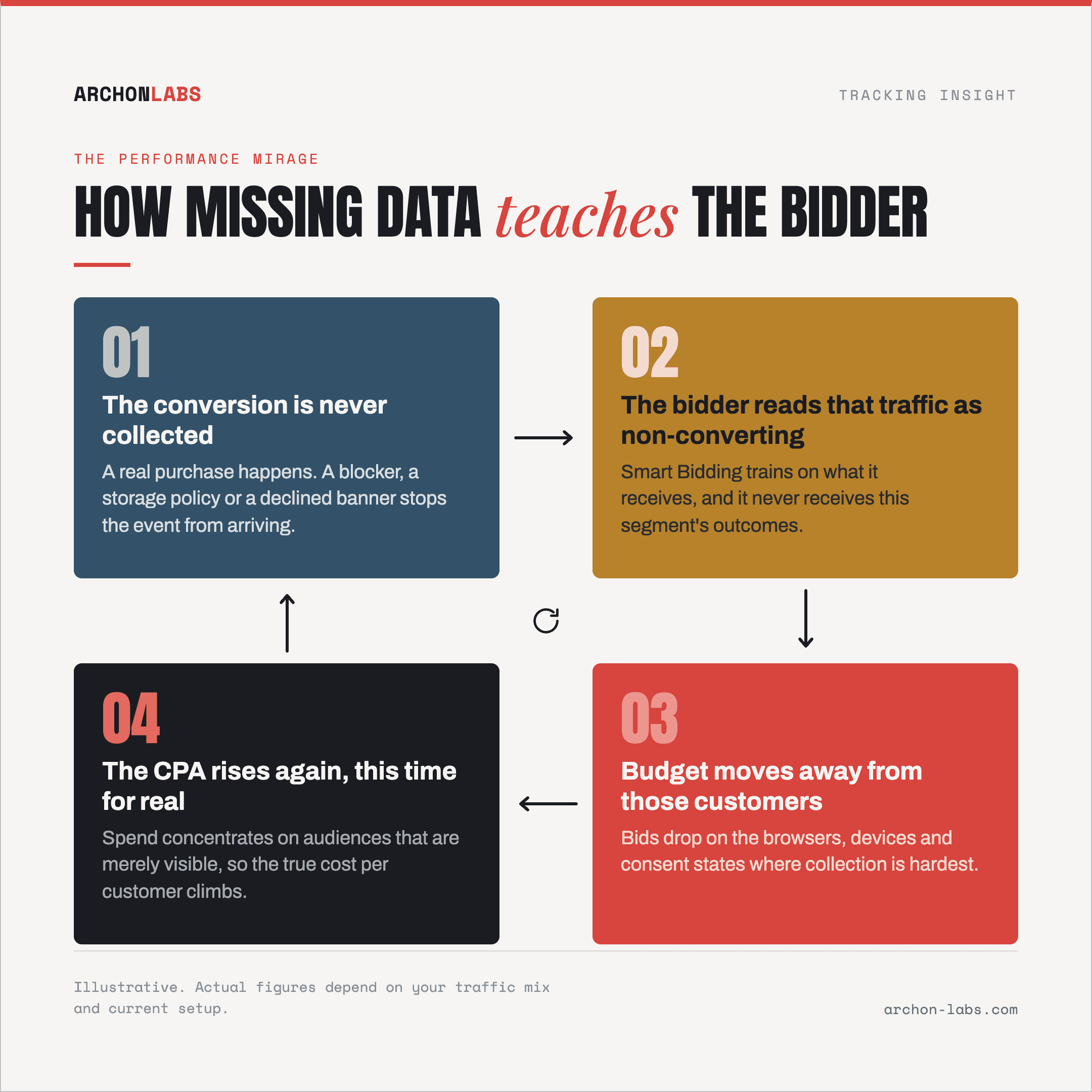
If it stopped at arithmetic this would be an annoyance in a slide. It does not, because that same incomplete conversion set is the training data for your bidding.
Google is explicit about the inputs. Target CPA bidding "finds an optimal bid for your ad each time it's eligible to appear by using historical information about your campaign", and the auction-time signals it names include device, browser, location and time of day, per Google Ads Help. Smart Bidding requires conversion tracking to be enabled, and its models "train on data at a vast scale", per Google Ads Help.
Now pair that with the shape of signal loss. It is never spread evenly. It concentrates on the browsers, devices and consent states where collection is hardest, the same dimensions the bidder segments on. So the model does not see a measurement gap, it sees evidence. Someone on an iPhone who declined the banner and bought anyway converts in reality and never in the data. Repeat that a few thousand times and the algorithm learns, correctly given its inputs, to bid less on that traffic.
That is where a reporting artifact becomes a performance loss. The reported CPA rose first, by division. The real CPA follows, because budget moved away from customers who convert and toward audiences that are merely visible.
One asymmetry explains why this bites mid-market accounts hardest. When consent is denied, Google models some of the missing conversions into the Conversions column, and that data "makes its way into Google's bidding tools", per Google Ads Help, but only above "a daily ad click threshold of 700 ad clicks over a 7 day period". Above that line you get an estimate over the hole, below it just the hole.
What good looks like
The first move is diagnostic and costs an afternoon, not a strategy session. Split the CPA before you optimize it. Pull cost, clicks, cost per click and recorded conversions for the period the CPA rose, then segment those conversions by browser and device.
Two outcomes, both useful. If cost per click climbed, you have a genuine auction story and can tell it with evidence instead of adjectives. If cost per click is flat while recorded conversions per click fell, especially on Safari and iOS, nothing about your campaign got worse and you have been optimizing against a measurement failure.
Fixing that second case is the job Archon Signal does. Conversion collection moves out of the browser and onto a server-side setup on your client's own domain, so events are recorded where an extension, a storage policy or a failed script cannot delete them first, and the cookie linking a return visit to the original click can live up to 400 days instead of the one to seven a browser allows. On a typical setup that recovers 15 to 40% more conversions than a browser-only setup.
Two things then change, and neither is a campaign change.
The reported CPA corrects itself. Conversions that were always happening start being counted, so the denominator matches reality and the number comes down without touching a bid.
Bidding learns from your real customers. Recovered events reach the ad platforms, so budget stops draining away from the segments that were invisible, which shows up in the business rather than only in the dashboard.
Do the diagnosis first either way. Fixing tracking will not rescue a campaign losing to a better offer, and no creative test fixes a conversion that was never recorded.
Frequently asked
How do we tell signal loss apart from real auction pressure?
Look at cost per click and recorded conversion rate separately over the same period. Auction pressure raises what you pay per click and shows up there. Signal loss leaves cost per click alone and thins the conversion count. Then segment by browser: a decline steeper on Safari and iOS than on Chrome desktop is a measurement pattern, not a market pattern, because buying intent does not vary by browser that neatly.
Could the site be the cause rather than the tracking?
Yes, often enough to belong in the same check. A release that moved a button or added a step is a conversion-rate problem, and it also shows up as fewer conversions on stable cost. The difference is in the funnel: a site regression loses people at a specific step, while signal loss keeps the funnel intact and loses only the recording of the outcome.
We already run server-side through Stape, so why is our CPA still climbing?
Having the tool is not the same as having it right. A server-side container that still receives its events from a browser request an extension blocks, or that sets its cookie from JavaScript instead of from the server, inherits the loss it was bought to prevent. Most of what we repair is not an absent setup, it is a partial one everybody assumed was finished.
Will fixing the tracking lower our CPA?
The reported CPA falls to the extent that real conversions were going uncounted, and that part is arithmetic rather than a promise. The real CPA improves more slowly, because it depends on bidding relearning from a much fuller signal, which takes weeks and depends on your conversion volume. Anyone quoting one number for both is selling.
If your CPA is up and the account has no explanation for it, request a free tracking audit and we will separate the arithmetic from the auction on one real account.