The symptom
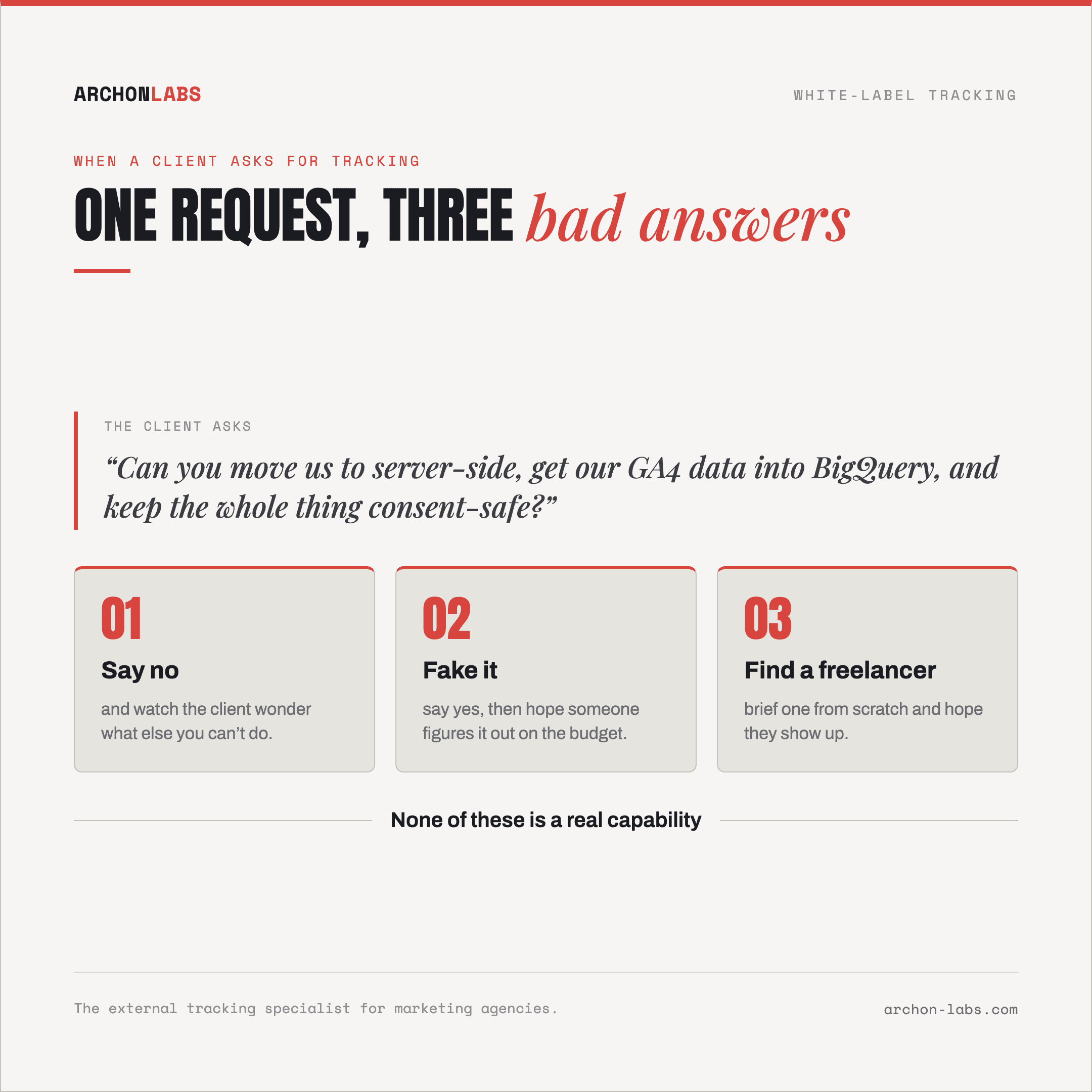
A client asks whether you can move them to server-side tracking, get their GA4 data into BigQuery, and keep the whole thing consent-safe. It is a fair request, and increasingly a common one. The problem is that nobody on the account team actually does this work, and now you have to answer.
So you pick one of three bad options. You say no, and watch the client wonder what else you cannot do. You say yes and quietly hope someone can figure it out on the client's budget. Or you scramble to find a freelancer, brief them from scratch, and hope they show up the way you promised the client they would. At Archon Labs we hear this from agency owners constantly, usually right after a pitch went sideways.
None of those three is a real capability. They are ways of getting through the conversation. The client hears yes, we do tracking, the account team hears please do not ask me how, and the gap between those two is where the relationship quietly gets exposed.
Why it happens
Tracking is a full discipline, not a task you slot between campaign work. Server-side setup, first-party collection, Consent Mode, GA4-to-BigQuery pipelines, and the validation that proves any of it works, that is a specialism the same way SEA or CRO is. Agencies staff those roles deliberately. The data layer underneath usually got set up quickly by whoever had time, and never revisited.
The tool being accessible makes this worse, not better. Anyone can spin up a Stape or Taggrs container in an afternoon. Having the container is not the same as having it configured right, adblocker-proof, Safari-proof, with click IDs and consent wired correctly. A basic setup and a properly built one recover very different amounts of signal. Ad blockers alone strip 30 to 40% of events before they leave the browser, and a server-side setup that is done properly typically recovers 15 to 40% of the conversions that were going missing. The tool is the easy part.
Then there is the freelancer route, which looks like a fix and is really a single point of failure. One part-time person holds all the client context, takes holidays, gets busy, or moves on, and takes the setup knowledge with them. When a client escalates, our freelancer is on holiday is not an answer any agency wants to give.
What good looks like
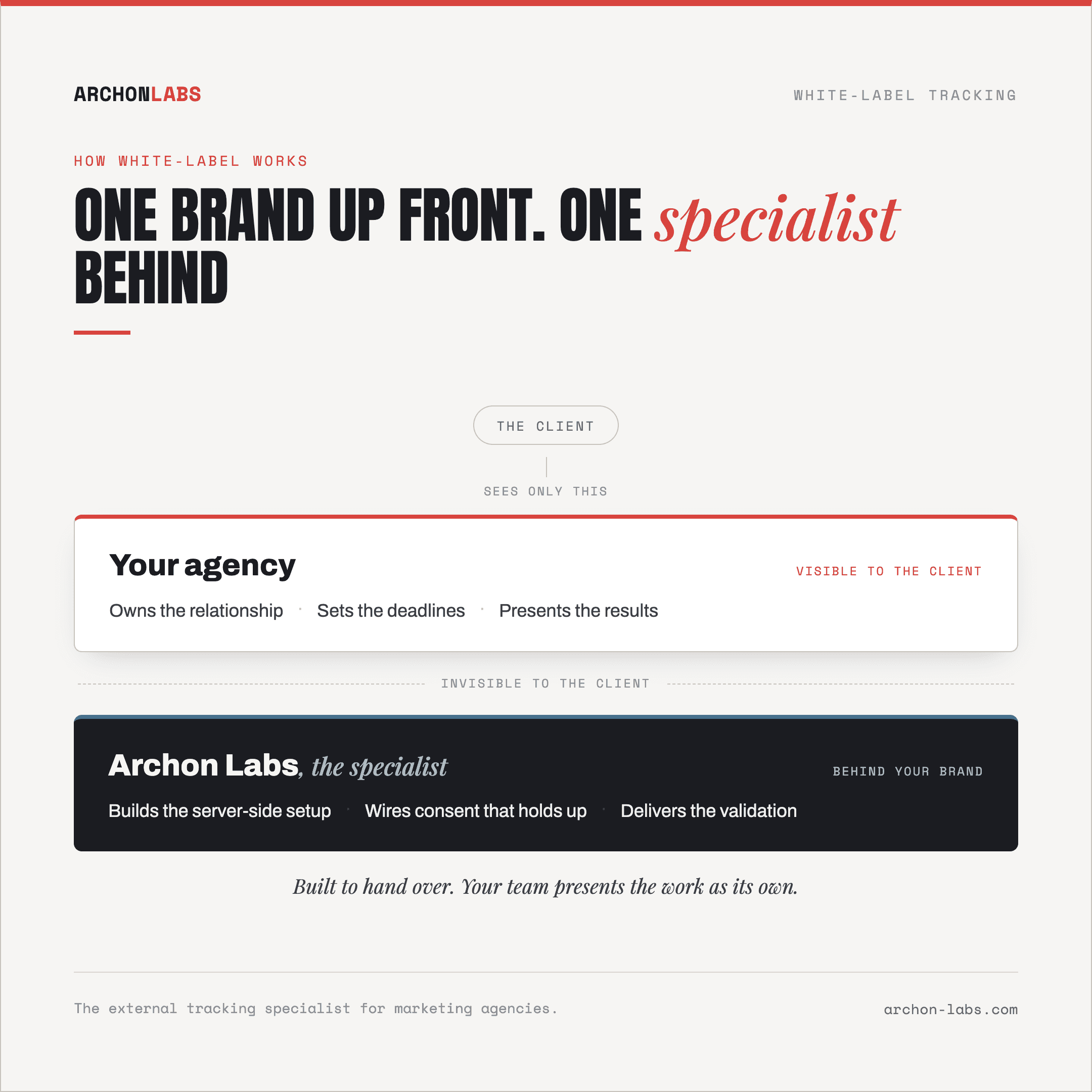
White-label tracking means a dedicated specialist does this work behind your brand, as if they sat inside your agency. Your account team keeps the client relationship, sets the deadlines, and presents the results. The specialist stays invisible to the client and delivers work the account team can hand over as its own.
In practice the deliverables are built to be handed over, a documented server-side setup, a consent flow that stands up to scrutiny, GA4 data landing in BigQuery, and validation that shows what was recovered against what came before. This is the work Archon Signal is built to deliver, a server-side foundation that recovers the signal browsers and ad blockers were dropping. If you want to see the depth behind it, our write-up on the first-party tag gateway shows the level the setup is built to.
The business case is the part agency owners care about. You add a senior capability you can put in front of clients without a hire, without onboarding, and without exposing a supplier. You keep the client relationship and you keep the margin. For one performance agency we worked with, the setup recovered 38% of client traffic that tracking prevention had been blocking, drove a 26% average uplift in measured conversions, and saved 14 hours per project compared with piecing it together in-house.
Frequently asked
We already run Stape, why would we need you?
Running a container and running it right are different things. Most setups we improve already have Stape or Taggrs in place, and the value is in the configuration, the consent wiring, and the validation, not the tool. If nobody on your team can prove how much signal the current setup recovers, that is the gap we close.
Will the client know you are not in-house?
No. White-label means we stay invisible. We work behind your brand, on your timelines, and the account team presents everything as its own. The client sees your agency delivering senior tracking work, which is the point.
How is this different from hiring a freelancer?
A freelancer is one person you brief from scratch each time, and a single point of failure when they are unavailable. We do only tracking, across many agency accounts, so the depth is already there and the setups are proven. You get a specialist function, not a dependency on one person's calendar.
Do we keep the margin?
Yes. You own the client relationship and the commercial terms. We are your tracking layer, and what you charge the client is yours to decide. The point of white-label is that you resell the capability under your own name.
What do we actually hand the client?
Deliverables the account team can present without translating, a working server-side setup, a compliant consent flow, GA4 data in BigQuery, and a before-and-after that shows the recovered conversions. Concrete outputs, not a technical hand-wave.
If you want to see what a white-label tracking layer would look like on one of your client accounts, request a free tracking audit and we will map where the conversions are going missing.