The symptom
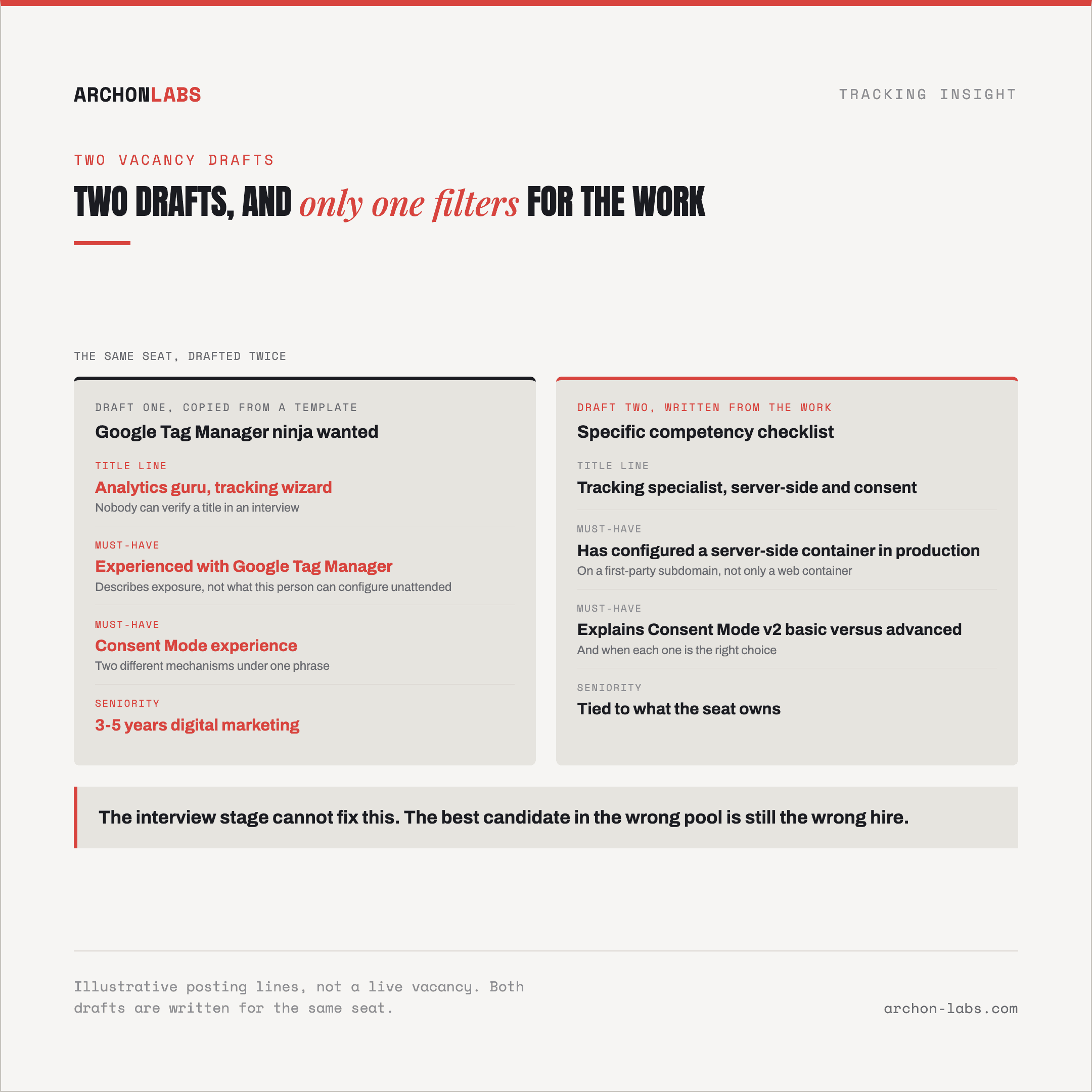
The decision to hire got made in a meeting. Writing the actual vacancy happens an hour later, alone, with a blank job board template open. The fastest path is to copy the nearest thing that looks close, a "digital marketing analyst" posting, or a competitor's listing for a "GTM ninja" or "Google Analytics guru", and swap in the agency's name.
Two things go wrong from there, and they go wrong in opposite directions. A posting built from a marketing-analyst template pulls in people who can read a GA4 dashboard and build a Looker Studio report, but have never configured a server-side container or touched a consent banner's technical side. A posting built from a data-engineer template asks for SQL depth and full-stack skills the role never uses, and good tracking candidates skip it because it reads like a different job. Either way, the resumes that land do not match the work the agency actually needs done.
The interview stage cannot fix this. If the posting filtered in the wrong pool, the best candidate in that pool is still the wrong hire. The fix is upstream, in what the vacancy actually asks for.
Why it happens
Tracking sits between three job families that already have their own templates, marketing, data engineering, and privacy or legal, and none of them fit cleanly. Recruiters and hiring managers reach for the closest match instead of writing one from scratch, which is why the same posting so often asks for campaign strategy experience the role never touches, or backend engineering depth nobody on the team actually needs from this hire.
The other reason is that vague phrases are free to write and hard to catch. "Experienced with Google Tag Manager" describes exposure, not what someone can configure unattended. A server-side container specifically, per Google's own documentation, receives requests from a visitor's device, transforms them into events, and processes each one through the container's own tags, triggers and variables, work that Google's docs also note should run behind a first-party subdomain in production. That is a checkable skill: has this person set one up, not just heard of one.
Consent Mode has the same problem. "Knows Consent Mode" is not one skill, it is two different mechanisms. In the basic version, Google's documentation states plainly that "you prevent Google tags from loading until a user interacts with a consent banner." In the advanced version, tags load when a user opens the website or app and adjust behaviour once a choice is made. A candidate who cannot explain that difference in one sentence cannot be trusted to choose between them on a client account, and a posting that just says "Consent Mode experience" cannot filter for it.
A large share of agency accounts already sit on setups where 15-30% of conversions are consistently uncaptured. That gap is exactly what a specific hire is meant to close, which is one more reason a vague posting that fails to attract the right person is expensive well beyond the cost of the vacancy itself.
What good looks like
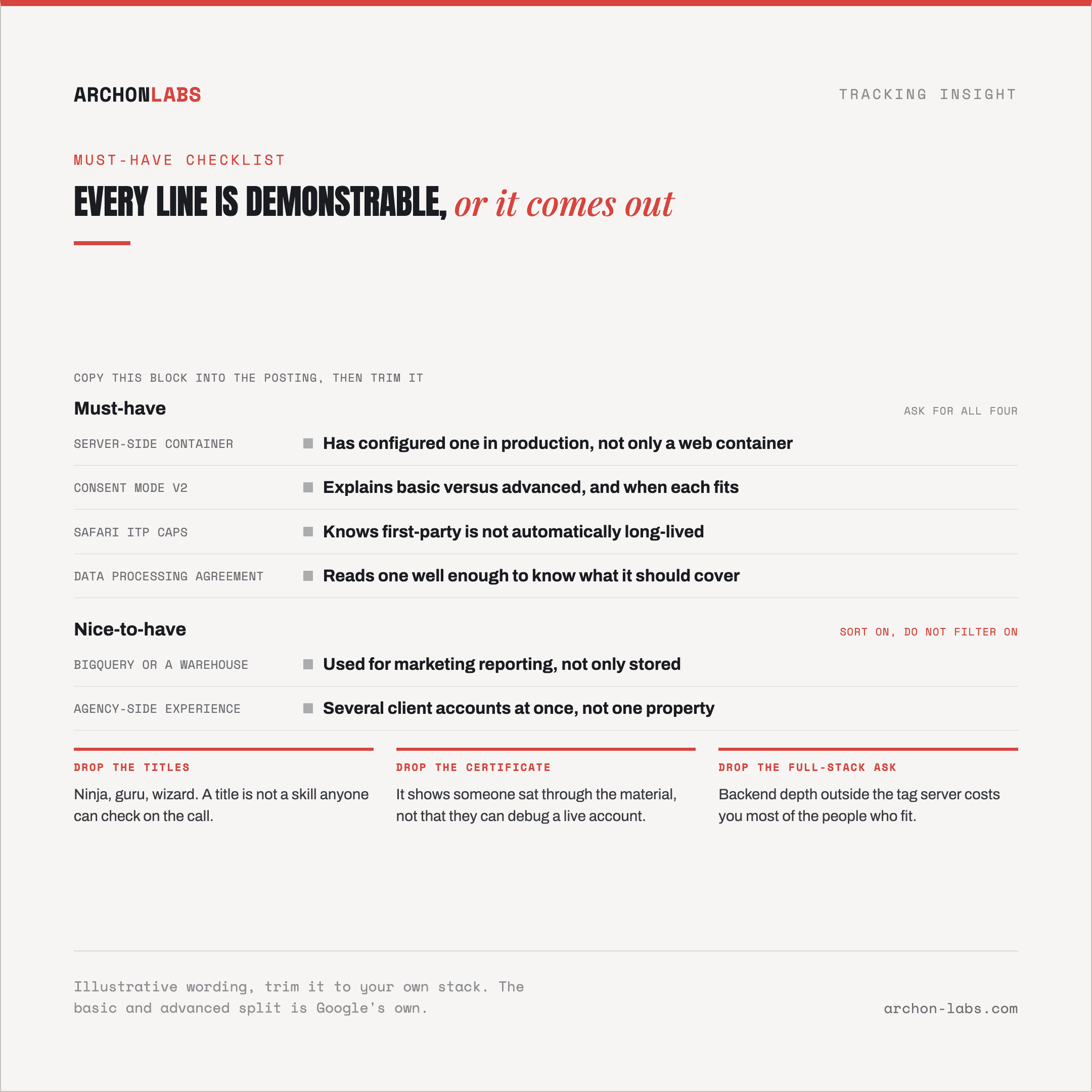
A tracking specialist job description works when every line is something a candidate can either demonstrate or admit they cannot do. The block below is written to be copied, then trimmed to the agency's actual stack.
Role summary. Own tracking accuracy across client accounts: server-side data collection, consent-aware measurement, and keeping GA4, Google Ads and Meta reporting trustworthy for account teams and clients.
Responsibilities
Configure and maintain server-side tag containers across client accounts, including first-party subdomain setup.
Implement and audit Consent Mode v2, distinguishing basic and advanced implementation per account.
Diagnose why a conversion number in GA4, Google Ads and the CRM disagree, and fix the cause rather than the report.
Set a measurement baseline before any change, and report the before-and-after against it.
Document what each client's setup sends, to whom, and under what consent state, so the answer does not live in one person's head.
Must-have
Has configured a server-side Google Tag Manager container in production, not only a web container.
Can explain the difference between Consent Mode v2 basic and advanced, and when each is the right choice.
Understands how first-party cookies behave under Safari's Intelligent Tracking Prevention caps, and why a cookie described as "first-party" is not automatically long-lived.
Comfortable reading a data processing agreement well enough to know what it should cover.
Nice-to-have
BigQuery or another warehouse used for marketing reporting.
Experience across multiple client accounts at once, rather than a single in-house property.
What to leave out matters as much as what goes in. Drop any requirement built on a buzzword rather than a demonstrable skill, "GTM ninja", "analytics guru", "tracking wizard": nobody can verify a title in an interview. Drop a specific certification as a hard requirement, a certificate shows someone sat through material, not that they can debug a live account under pressure. Drop a vague seniority range like "3-5 years digital marketing experience", which filters on tenure in an adjacent field rather than on the actual skills above. And drop full-stack engineering asks, backend language depth, infrastructure provisioning outside the tag server, unless the agency genuinely wants an engineer instead of a tracking specialist, because that line alone will cost the posting most of the candidates who fit the rest of it.
If the agency has not settled the hire-versus-external question yet, that decision belongs before this one, covered in in-house hire versus external specialist. And if writing, running and eventually replacing this seat is more than the agency wants to carry, Archon Signal is the alternative, a dedicated tracking specialist for the agency's accounts without adding a full-time hire to manage.
Frequently asked questions
Should we require a GA4 certification?
Not as a hard requirement. A certification shows someone completed a course, it does not show they can configure a server-side container or catch why a conversion number is wrong on a live account. Ask for it as a nice-to-have if it helps you sort applications, never as a filter that excludes otherwise strong candidates.
Full-time hire, or can this be part-time?
Either can work, but the posting should say which one up front. A part-time or fractional version of this role usually covers maintenance and monitoring across a smaller set of accounts rather than active buildouts, and candidates evaluate the offer differently depending on which one it is.
Is this the same role as a data analyst?
No. A data analyst typically reports on data that already exists. This role builds and maintains the pipeline that produces the data in the first place, server-side containers, consent-aware collection, cookie behaviour. Some people do both well, but they are different skill sets and the posting should not conflate them.
What seniority should we hire for?
Tie it to what the role owns, not to years of experience. Someone maintaining an already-correct setup across a handful of accounts can be more junior. Someone expected to diagnose and rebuild broken tracking across many client accounts, unsupervised, needs the senior end. A vague range in between tells a candidate nothing about which one they are applying for.
How do we know if the person we hire from this posting is actually good?
The posting only controls who applies. Vetting who is actually competent happens at the interview stage, covered separately in which questions to ask before hiring a tracking specialist.
Not ready to hire yet, or want to see what your current setup is actually missing first? Request a free tracking audit.