The symptom
Type "taggrs review" or "taggrs ervaringen" into Google and the results are almost identical to Taggrs' own pricing page, just rearranged. A listicle ranks five or six server-side tools by feature count. An affiliate comparison repeats the tier prices with a "visit site" button under each one. Nobody involved appears to have actually built a container in the tool and configured it for a paying client.
That is the gap for an agency owner deciding whether to trust Taggrs with a client's tracking setup. The pricing page tells you what is included. It does not tell you what it is like to be the person setting it up, what ships and works as described, and what still takes real configuration decisions once the wizard ends.
This is that review, written from the side of the table where Archon Labs actually sits: configuring server-side tagging tools for agency clients, Taggrs among them, not evaluating them from a demo account for a listicle.
Why every other review reads the same
Server-side tagging vendors publish a lot of the same information, because a lot of what they sell is the same underlying thing: a hosted server container for Google Tag Manager. Google's own documentation is explicit that the container "has to run on the same domain" as the website to behave differently from a third-party script, and that on the default hosting endpoint the server "runs in a third-party context" and "can only set Javascript cookies" (Google, custom domain setup). That single requirement, same-origin serving through a custom subdomain, is the mechanic every vendor's "resilient to blockers" or "extended cookie lifetime" marketing line is actually describing. It is not proprietary to any one tool.
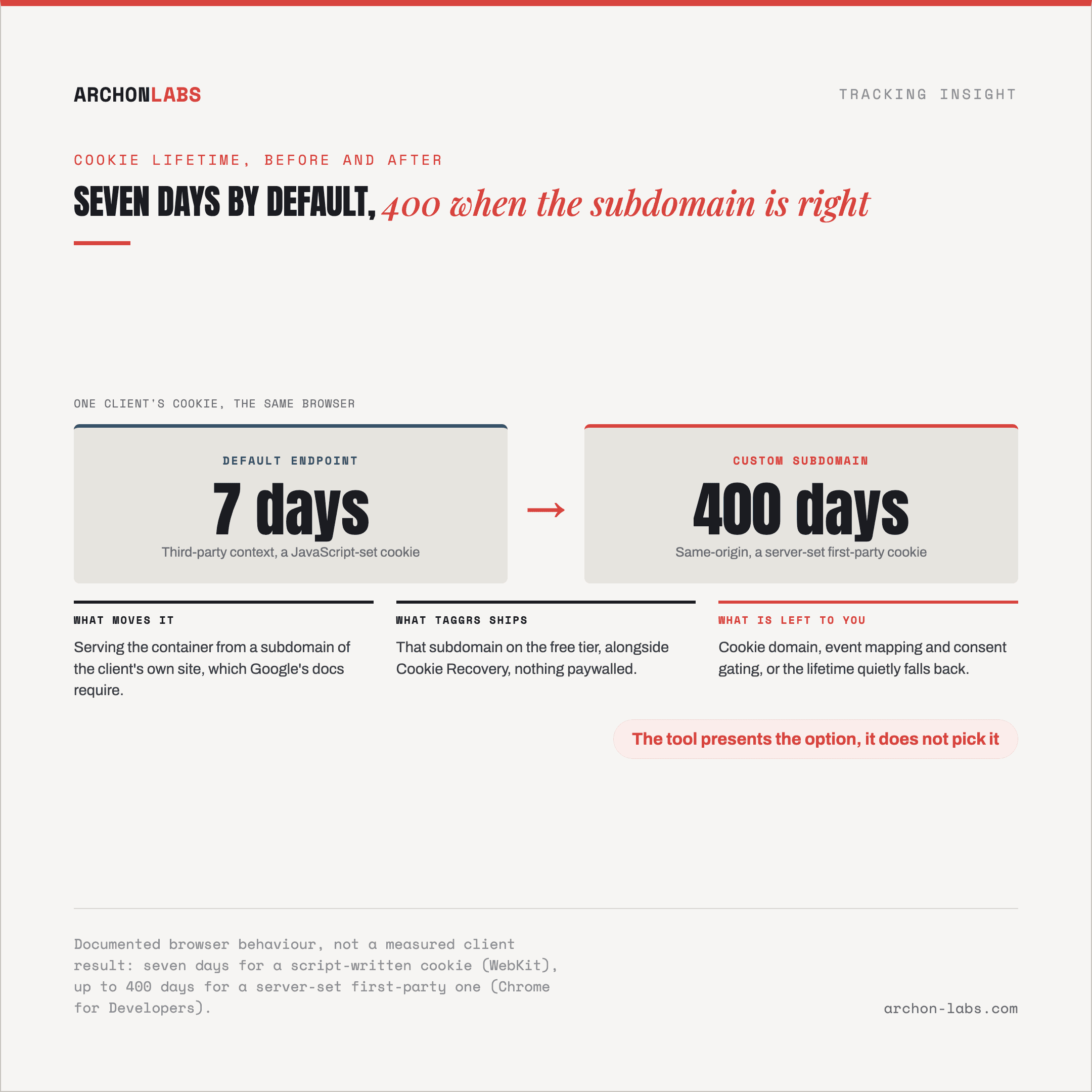
The reason it matters enough to build a whole feature category around: a JavaScript-set cookie in Safari is capped at seven days under Apple's third-party cookie policy (WebKit), while a correctly configured first-party, server-set cookie can reach up to 400 days under Chrome's own cookie lifetime rules (Chrome for Developers), a jump covered in more depth in the cookie lifetime piece. Ad blockers strip 30-40% of events before they ever leave the browser, and even before that filter, 15-30% of conversions go consistently uncaptured across a typical client account. That is the size of the problem a custom subdomain and an anti-blocking script are trying to solve, and it is why "does this tool have that feature" is the wrong first question. Every credible server-side vendor has some version of it, Taggrs included.
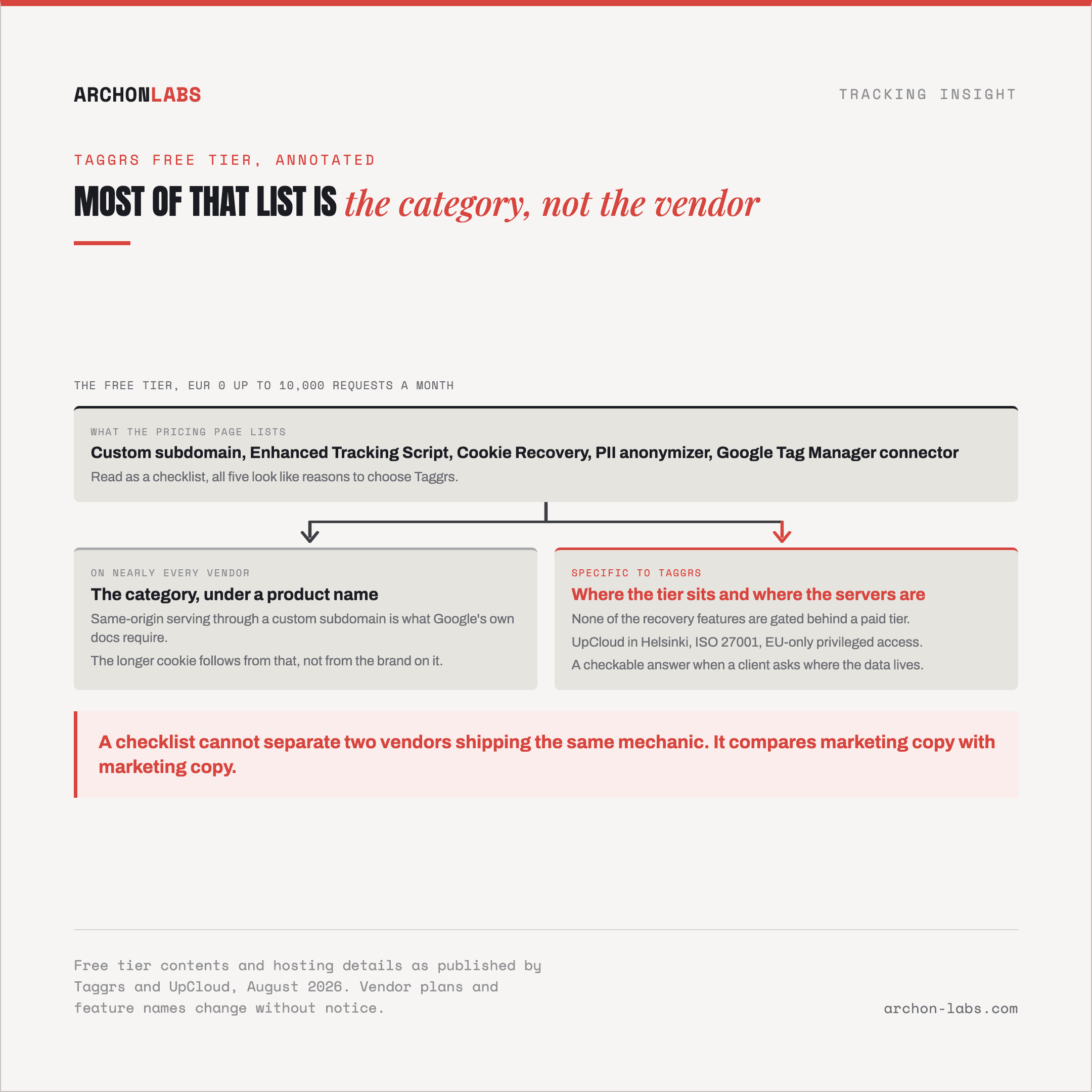
So a review built around a feature checklist ends up comparing marketing copy against marketing copy. What is actually worth reviewing is what happens once the checklist is done and the container has to be configured for a specific client's stack, which is where the tool's own documentation, not its homepage, tells the real story.
What good looks like: Taggrs on the configuration side
Taggrs' free tier is genuinely more generous than it needs to be to win a comparison table. At €0 for up to 10,000 requests a month, the custom subdomain, the Enhanced Tracking Script, Cookie Recovery, a PII anonymizer and a GTM connector are all included, alongside integrations for Shopify, WooCommerce, Magento, PrestaShop, Shopware and Lightspeed, plus a documentation hub and live chat (Taggrs, pricing). None of the recovery-relevant features are gated behind a paid tier. That lowers the bar for a small agency to get a technically correct setup running before a single client invoice covers the cost.
The infrastructure claim behind the EU positioning holds up when checked against its own source: Taggrs runs on UpCloud, headquartered in Helsinki, which carries ISO 27001 certification and restricts privileged remote access in its EU data centers to EU-based staff (Taggrs, data sovereignty). For an agency where a client specifically asks where the data lives, that is a real, checkable answer, not a marketing adjective.
The part the pricing page does not show: Taggrs' own documentation index describes its guides as covering the same path any Google Tag Manager server setup requires, container creation through testing (Taggrs, documentation). There is no shortcut around that flow, and the ecosystem around it, templates and third-party integrations, is narrower than a longer-established vendor's. In practice that means more of the customization a specific client needs ends up as manual work inside the GTM template editor rather than a one-click add-on. That is not a flaw so much as a fact worth knowing before committing a client to it: the tool gets you to a working container quickly, it does not remove the specialist work of deciding what that container should actually do with each event.
Taggrs is not the only vendor doing this well, and the vendor question is smaller than it looks from a comparison table. Whether the sGTM tool matters at all is a separate question worth its own answer. What Taggrs earns on its own merits is a legitimate, EU-hosted option with an unusually generous free tier, and a setup path that still runs through the same configuration decisions, cookie domain, event mapping, consent gating, that determine whether a client's numbers actually improve.
That configuration work is what Archon Signal is built to do properly on top of whichever vendor an agency already pays for. For one performance agency, getting that layer right recovered 38% of the client traffic affected by tracking prevention, lifted measured conversions by 26% on average, and saved 14 hours per project that used to go into manually reconciling numbers across platforms. Taggrs, or any comparable tool, gets an agency a working container. It does not get them that result on its own.
FAQ
Questions a skeptical agency owner asks before trusting Taggrs with a client account.
Is Taggrs actually GDPR compliant, or is that just a page on its site?
The EU hosting claim checks out against UpCloud's own documentation, ISO 27001 certified infrastructure with EU-only privileged access. GDPR compliance itself is not something a hosting choice alone guarantees, it also depends on how consent is configured and what data reaches the container in the first place, which is configuration work, not a box the tool ticks by itself.
Is the free tier usable for a real client, or is it a trial in disguise?
For a smaller client under 10,000 requests a month it is a genuinely usable production setup, not a crippled trial, since the recovery-relevant features are not gated behind a paid tier. Most agency clients outgrow that request volume quickly once server-side event volume ramps up, and the Basic tier at roughly €22-26 a month covers 750,000 requests.
If I set up Taggrs myself, do I still need a specialist?
The tool gets a container running. Whether that container is mapped correctly to each ad platform, whether consent gating matches the client's actual cookie banner, and whether the cookie domain is set up to reach anywhere near 400 days rather than defaulting back to a short-lived one, are all decisions the tool presents as options rather than makes for you.
How does Taggrs compare on price to what agencies typically already pay?
Its published tiers run from free up to roughly €127-152 a month for 10 million requests, with a custom Enterprise tier above that. Where that lands relative to a specific agency's current spend depends on request volume and billing cycle, both worth checking against the vendor's current published pricing before committing, since plans change without notice.
Taggrs says its tracking is "resilient to blockers." Is that true?
Directionally yes, a same-origin, server-set cookie survives ad-blocker filters and browser cookie caps that a third-party script cannot. But resilient is not immune. Ad blockers, consent refusals and browser restrictions still remove some share of events regardless of which vendor hosts the container, which is why the honest framing is recovery measured against a baseline, never a guarantee that every visit survives the trip.
An audit shows exactly how much of a client's current tracking setup a tool like Taggrs would actually recover, and how much still depends on the configuration around it. Request a free audit.