The symptom
A client's finance lead comes back from a conference and the question lands in your inbox. Should we be doing marketing mix modelling? The pitch they heard was clean. Cookies are going, attribution is unreliable, MMM does not need user-level data, so MMM is the answer.
It is a hard question, because the pitch is half right. Attribution really is losing input. MMM really is untouched by cookie policy. What gets skipped is what MMM runs on, and who supplies it.
There is a version of this where you say yes, the client spends a quarter on it, and the model comes back confirming what the reporting already said. Not because MMM failed, but because it was handed the same numbers.
Why it happens
MMM and attribution are not two answers to one question
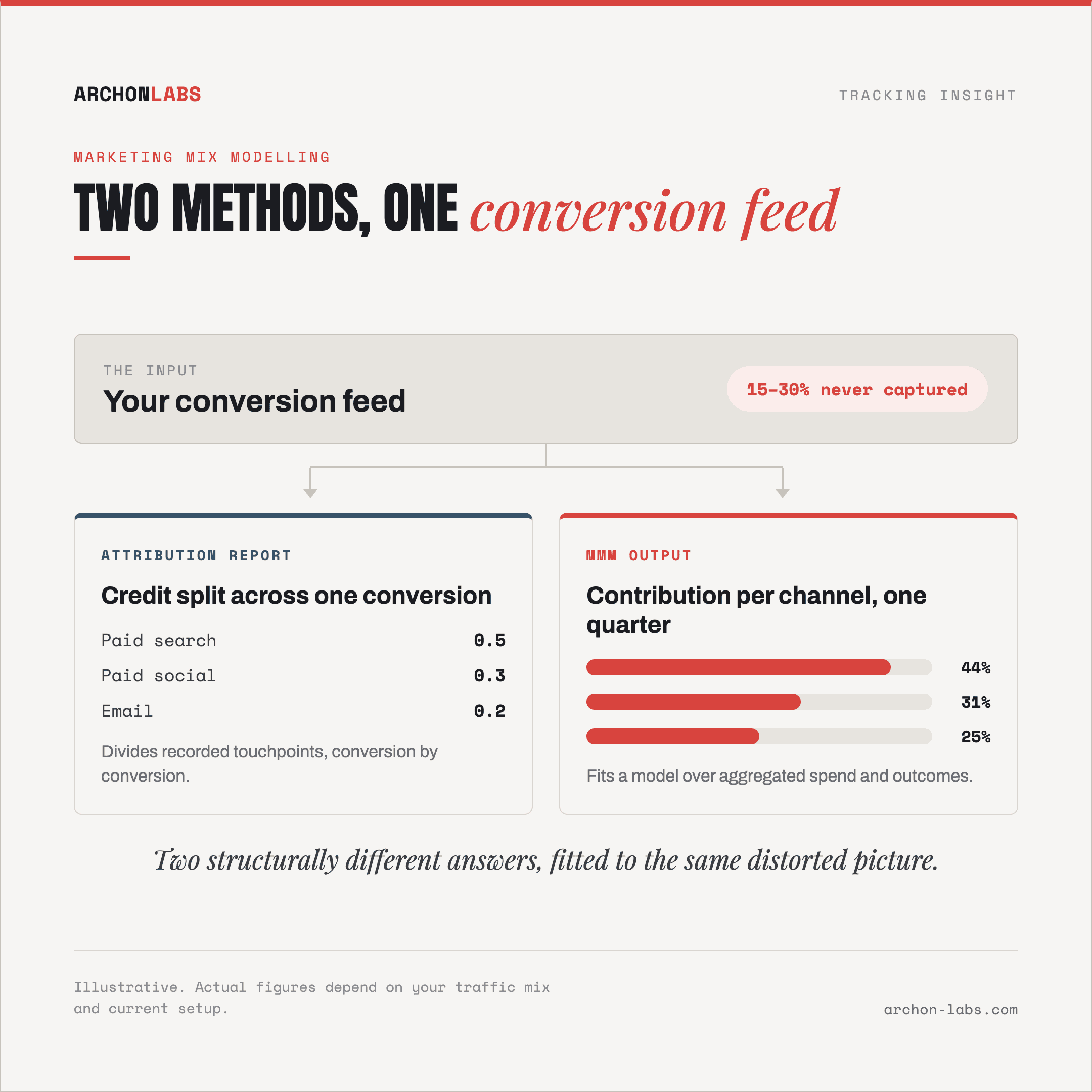
Attribution divides credit across recorded touchpoints for individual conversions. MMM does something structurally different: it fits a statistical model over aggregated spend and outcome data per time period, and estimates how much of the outcome each channel contributed. Google's Meridian is its own open-source MMM, and Meta's Robyn guide puts the appeal plainly, MMM is privacy-friendly and signal-resilient next to methods that depend on user-level data.
That resilience is real, and it is the strongest thing in MMM's favour. Nothing in the method breaks when a browser shortens a cookie lifetime. But MMM is unaffected by signal loss in its method and fully exposed to signal loss in its inputs. The pitch tends to merge the two.
The number you feed it is the number it models
An MMM's response variable is a KPI you supply. Meridian's data guidance is worth reading closely on this point: the KPI serves as the model's response variable, and the example Google gives for it is sales data, not analytics conversions.
That distinction carries the whole decision. Hand the model your GA4 conversion feed, when 15-30% of conversions stay uncaptured across agency accounts, and the model is fitted to a distorted version of the outcome. The distortion does not average out over enough weeks either. Ad blockers strip 30-40% of events, browser restrictions and consent refusals take more, and those losses concentrate in particular browsers, devices and audiences, so they land unevenly across channels. A channel whose audience blocks more looks weaker than it is, and a well-built model will quantify that weakness for you and recommend moving budget out of it.
This is not an outsider's criticism of MMM. Meta's own guide states it as an instruction: if inaccurate or poor quality data inputs are used in an MMM, it will produce inaccurate and poor quality data outputs.
It needs more history than most accounts have
Both projects publish a floor. Meridian asks for a minimum of two years of weekly data for geo-level models and three years for national-level models. Robyn's guide sets the same starting point, a minimum of two years of historical weekly data.
That rules out more client situations than agencies expect. A brand fourteen months into a rebuild, a retailer that replatformed last spring. And the history has to be consistent, which is the part that catches tracking-heavy accounts: if the measurement setup was rebuilt halfway through the period, the KPI series has a seam in it that the model reads as a real change in the market.
The model does not find the answer on its own
Google is direct about this. It can be tempting to run with weak or no guardrails in the form of non-informative priors, and that is risky and may lead to poor model results. The example Google gives is a model estimating that a channel with low spend is driving massive revenue.
Where do good priors come from? Google's answer is incrementality experiments, perhaps the strongest basis for the judgement, though it notes that translating an experiment into a prior is not a precise formula. Robyn strongly recommends calibrating against experimental results treated as ground truth. Read that twice if MMM was pitched to the client as the thing that removes measurement work. The credible version of MMM runs on experiments, which is more measurement work, not less.
And it cannot feed the thing that spends the money
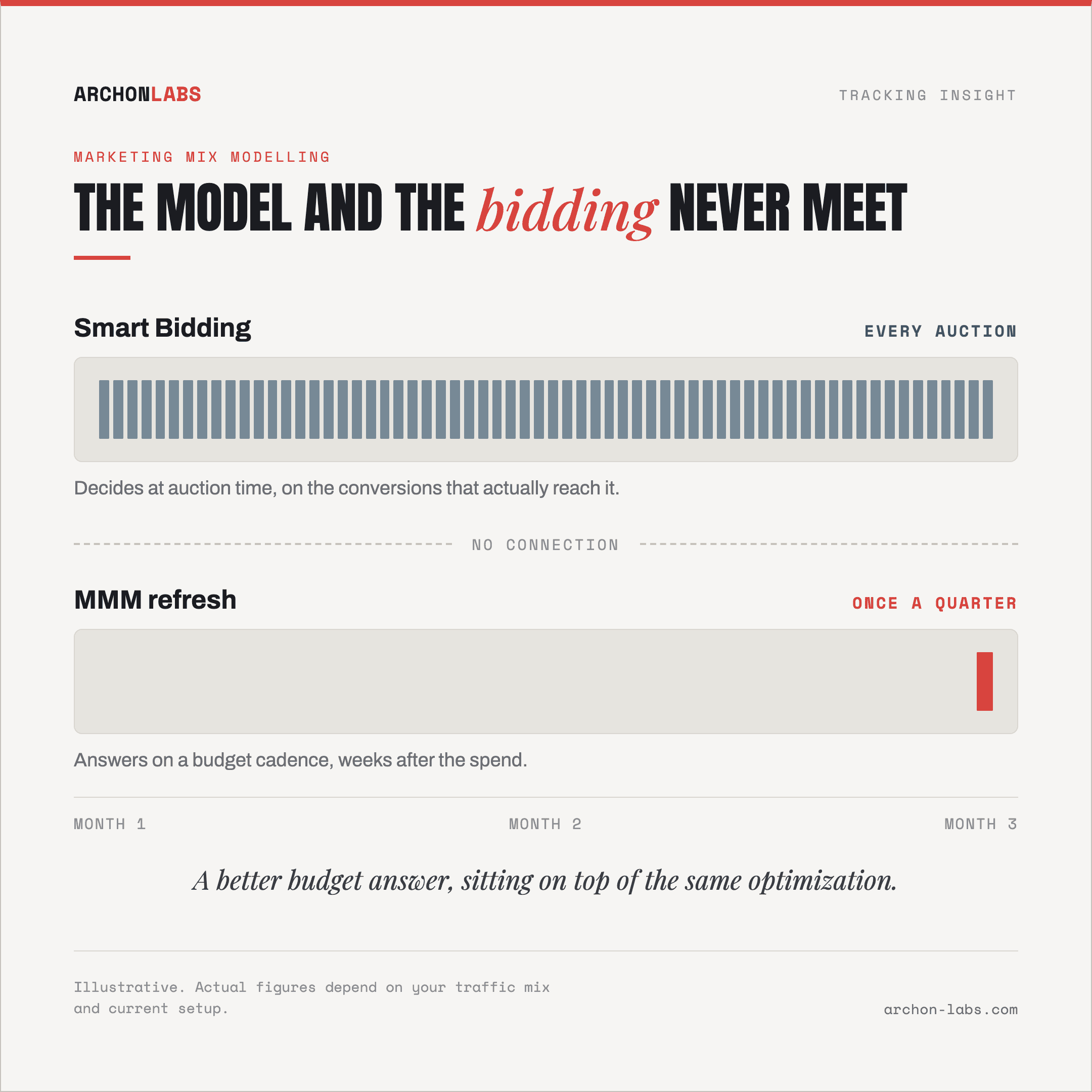
Even a well-built, well-calibrated model answers on a budget cadence. Google suggests refreshing quarterly, annually, or at a frequency that matches your budget decision making. Meanwhile the bidding algorithm is making decisions at auction time, on conversion data, and Smart Bidding requires conversion tracking to be enabled before it runs at all.
The two never touch. An MMM concluding that paid social is undervalued does not make paid social bid better, because the algorithm still optimizes on the conversions that reach it. Leave the collection layer as it is and you have bought a better budget answer sitting on top of the same underperforming optimization.
What good looks like
Treat it as a sequence rather than a choice.
Repair the input layer first. It is the cheapest step, it improves the reporting and the bidding immediately, and it is the only one that changes what every later method has to work with.
Then judge MMM on the client's actual profile. It depends on things you can check: spend spread across channels you cannot track at all, such as TV, radio or sponsorship, a consideration window long enough that last click misleads, and enough consistent history. A two-channel client with eleven months of data, no. A national advertiser with offline spend and three clean years, yes.
Feed it business outcomes, not analytics conversions. Google's example of sales data is the right instinct. Pull the KPI from the CRM or the back-end, where the record of a sale does not depend on a browser.
The first step is what Archon Pixel is for: first-party collection with a server-set identifier that can hold for up to 400 days, against the seven day expiry Safari applies to persistent cookies created in the browser by script, and around +25% more conversions captured than a standard GA4 setup. That is a gain against today's baseline, not an arrival: roughly 95% of collectable events is the honest ceiling, and consent refusals and blocked requests take the rest. What changes is that the series you model and the conversions your bidding sees are both closer to what happened. The layer below this one, where platforms fill gaps with modelled conversions, is in modelled versus measured conversions.
FAQ
The client's MMM says paid social contributes more than GA4 credits it. Which do we believe?
Check the boring explanation before the interesting one. If that channel's audience skews toward browsers and devices where more events are lost, part of the gap is missing input rather than misattributed credit. Neither number is wrong. They answer different questions over different levels of coverage, and knowing which part of the gap is collection is what makes the MMM finding usable.
MMM does not use cookies. Does our tracking problem stop mattering?
No, and this is the substitution the pitch invites. Cookie policy does not affect how an MMM works, but it does affect the outcome series it is fitted to, and the conversions your bidding algorithms receive between refreshes. An MMM sitting on a thin conversion feed produces a confident answer about a distorted picture, which is harder to argue with than an obviously broken report.
Our client only has fourteen months of usable data. Can we still run one?
That is below the floor both Google and Meta publish, so treat any output as directional at best and never as the basis for a large budget shift. The more productive use of those months is getting the collection layer and the KPI series clean, so that when the client does have the history, it is worth modelling.
If we fix the tracking properly, do we still need MMM?
It depends on how much of the spend is structurally unobservable. Server-side collection cannot see a radio spot or a billboard, and no setup captures the whole of what happens online either. If a meaningful share of budget sits in channels that leave no click, MMM is doing a job nothing else can do. If the spend is entirely in trackable digital channels and the data foundation is sound, MMM becomes a cross-check rather than a necessity, and the more useful question is usually the one behind strong ROAS with flat revenue.
If you cannot yet say how much of your client's conversion data reaches the systems that use it, that is worth settling before commissioning a model, and it is what a free tracking audit looks at.