The symptom
Lead volume is up. Cost per lead is down. The campaign report reads like the best quarter in a year, and the client's sales team says the leads got worse. Nobody is lying, both statements are true.
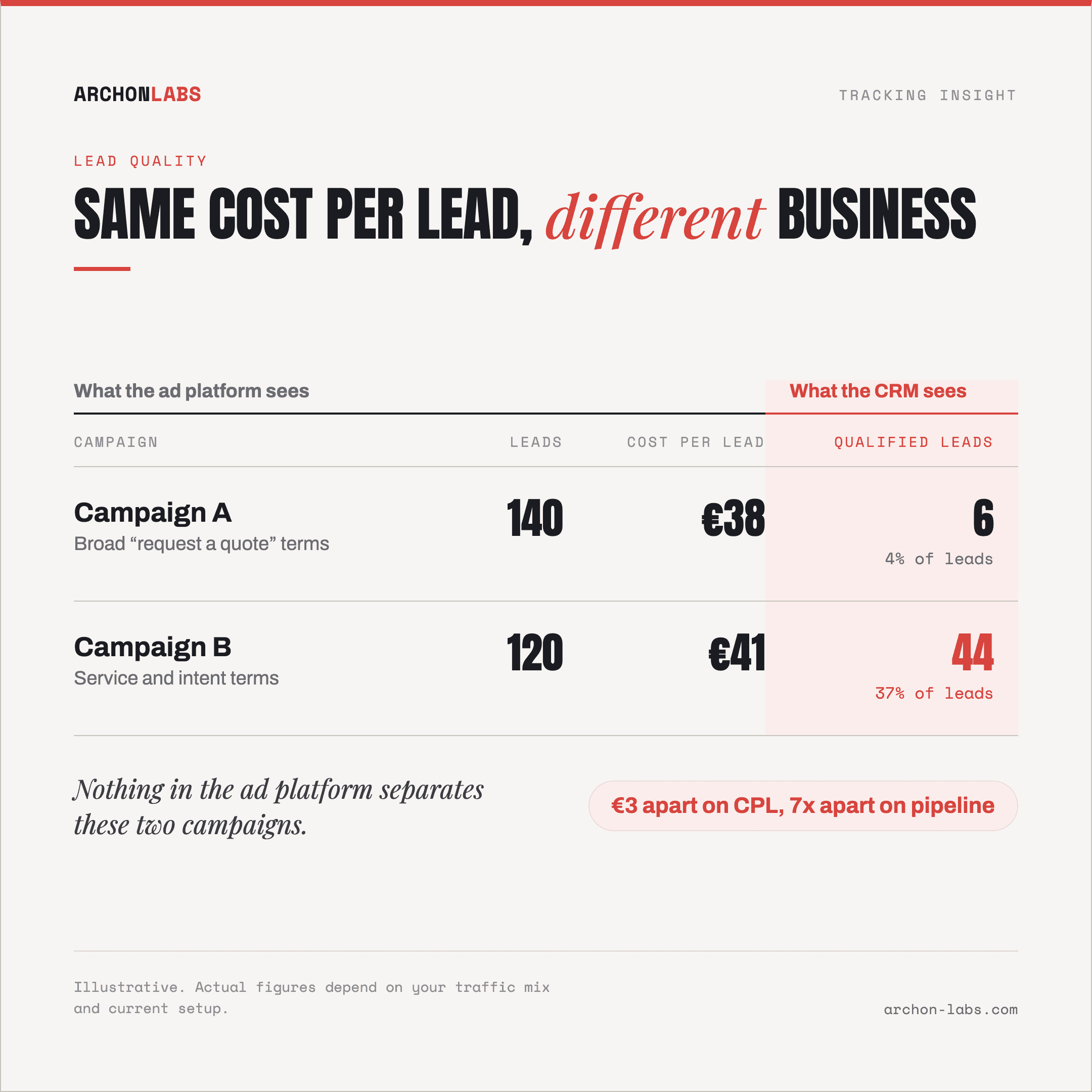
Then the version you cannot argue away on a call: two campaigns, nearly the same cost per lead. One produces deals, the other produces people who wanted a price list or a job. Nothing in the ad platform separates them, so budget drifts toward whichever is cheaper per form fill.
The uncomfortable part: the campaign is doing precisely what it was told to do. It was told a form fill is the goal, so it found the cheapest form fills on the internet.
Why it happens
The bid target is a setting, and someone chose it
In Google Ads, each conversion action is either primary or secondary. Per Google Ads Help, primary actions "are reported in the 'Conversions' column in your reports and used for bidding as long as the standard goal they are part of is used for bidding", while secondary actions "are for observation only" and are "not for bidding, even if the goal they are included in is used for bidding".
That is the whole mechanism. If the only primary action is a form submit, a form submit is the entire definition of success the bidding has to work with. Lead quality is not being ignored by the algorithm, it was never given to it.
One lead is worth the same as the next until you say otherwise
The other half of the target is the value. Google Ads Help sets out the choice: a different value per conversion, which is "more representative of actual values", or the same value for each one, which is "easier to set up" but "may be less representative". Automated bid strategies then "use the conversion values you set up to automatically set bids to optimize for your performance goals".
Most lead-gen accounts run the second option, often without deciding to. When the value is uniform, maximising value is the same as maximising count, and the cheapest count wins. Whether the revenue you can see was created by the ads at all is a different question, and it is the subject of why a healthy ROAS can sit next to a flat business.
Quality is a status in a system the ad platform never sees
A lead becomes good or bad after the click, in a CRM, decided by a person. Google's own documentation is built around that gap: a qualified or "interested" lead is one "further qualified offline (outside of Google Ads) in your customer relations management (CRM) system", and a converted or "closed" lead completed a step you define yourself, per Google Ads Help.
Both depend on that judgement travelling back to the account. Until it does, the platform's opinion of a lead is frozen at the moment the form was submitted, the one moment when all leads look identical.
Nobody has written down what qualified means
This is where the work usually stalls, and it is not a technical problem. Ask three people at the client what makes a lead qualified and you get three answers: the right company size, a budget mentioned on the call, anyone who picked up the phone. A definition that lives in someone's head cannot be sent anywhere, so one person has to own one status in one system and keep it current. Optimizing toward a field updated in bursts is worse than a form fill target: noise with a schedule.
And the form fills you optimized on were already incomplete
On a standard browser-side setup, 15-30% of conversions are consistently never captured, and ad blockers strip 30-40% of events. The count the bidding trusted was already partial, and the leads that went missing are not a random sample of the rest. It is also why an enhancement layer rarely changes much by itself, since enhanced conversions and CAPI inherit whatever the base setup misses.
What good looks like
The fix is a change of objective, not a change of campaign. Four things have to be true.
One stage becomes the target, and it has to pass a feasibility test. Google's own value-based bidding best practices put it in one line: "Select a single stage of your lead-to-sale funnel as your bid optimization goal; choose a goal with a relatively short conversion delay and at least 15 monthly conversions."
The lead carries a value, even a rough one. It does not have to be revenue. Google allows proxy values such as scores, and notes that particular answers on a lead form can indicate a higher quality lead. Three tiers based on company size or service line move the bidding further than a perfect model nobody maintains.
You own the lead-level record. The join between a click and a CRM outcome exists only if both ends were captured, so the event stream has to live in your own dataset, not only inside each platform's reporting. That is what Archon Pixel is for: first-party collection that captures around 25% more events than a standard GA4 setup, so the lead you are scoring was recorded. That is a gain against today's baseline, not a promise. Consent refusals, blockers and network failure make roughly 95% of events a ceiling nobody reaches.
The report changes in the same month the bidding does. If the deck still leads with cost per lead, everyone stays scored on the wrong number, including you. Cost per qualified lead and pipeline per channel survive a conversation with sales.
Treat the connection as a running dependency, not a project. Google Ads Help notes that from June 15, 2026, offline conversion imports and enhanced conversions for leads uploads migrate to the Data Manager API and are blocked in the Google Ads API, so anything built earlier is worth rechecking.
And the honest limit: this is not always worth doing. It depends on the conversion delay, the volume at that stage, whether one person maintains the status, and how much leads differ in size and fit. If a client sells one product at one price to similar buyers, ranking by quality will reproduce the ranking you had.
FAQ
Our client's sales cycle is six months. Should we optimize on closed deals?
Almost certainly not, and that is Google's own position rather than a compromise. The guidance is a stage with a short conversion delay and enough monthly volume, so a deal closing half a year after the click is the wrong bid target even though it is the outcome that matters most. Optimize on the earliest stage that correlates with revenue, usually a qualified lead, and keep the closed deal as the reporting metric you check that against.
We have no revenue per lead. Can we still do this?
Yes. Values do not have to be economic, and proxy values are documented, not a workaround. A qualified lead scoring higher than an unqualified one is already a signal the account lacks today. Start with two or three tiers you can defend in a meeting, then refine once enough deals have closed.
Can we not just remove the junk leads afterwards?
Partly, and it is worth doing. Conversion adjustments let you restate a value or retract a conversion, which "allows you to permanently remove a conversion and change the conversion value to 0.00", per Google Ads Help. Two caveats: online conversions can only be adjusted if a transaction ID was sent with them, and a retracted record cannot be adjusted again. It does not fix the selection problem either, since the budget was already spent.
Are we allowed to send CRM data back to the ad platform?
It depends on the consent the client collected and on what leaves the CRM, and it is a question for their legal counsel, not for us. Two things are documented. Enhanced conversions for leads sends hashed customer data and requires accepting Google's customer data terms, and Google's EU user consent policy requires consent for the collection, sharing and use of personal data for ad personalisation, records of that consent, and clear instructions to withdraw it. The consent state has to travel with the lead, a decision made long before any upload.
Will lead volume drop if we optimize for quality?
Usually yes, and it has to be said before the change, not after. Reported conversions fall, cost per lead rises, and the same budget buys fewer, better-fitting leads. If the only agreed metric is cost per lead, that reads as a regression on the dashboard.
If you want to know which stage a client's data can support today, and whether the leads in the CRM are the ones the campaigns paid for, a free tracking audit answers that.