The symptom
A lead shows up in a pipeline review with the Original Source set to Direct traffic. Nobody remembers running a direct-mail campaign, and the sales rep swears the prospect mentioned a LinkedIn ad. The marketing team pulls up the contact record anyway, because that field is the one everyone reports from. Budget gets allocated on it. QBR slides get built on it.
Then someone checks the ad platform's own numbers for the same period and they do not match. Paid social claims more conversions than HubSpot ever logged against that campaign. The instinct is to blame the ad platform for inflating results, because the CRM feels like the more trustworthy witness. It has the contact record, the timeline, the deal. It looks like ground truth.
It is not ground truth. It is a cookie's best guess, taken once, and never revisited unless a visitor happens to convert again through a session HubSpot can also see.
Why it happens
HubSpot's Original Source and Latest Source properties are set from a combination of the visitor's tracking cookie, the interaction that triggered it (a site visit, a marketing email click, an AI referral), and any UTM parameters present on the landing URL. Original Source records the first known interaction; Latest Source updates on the most recent one. UTM parameters do not create the source category on their own, they drive the drill-down inside it, for example utm_campaign filling Drill-Down 1 on a paid or email source (HubSpot Knowledge Base).
That system depends entirely on one small cookie being present and readable. HubSpot's own documentation states plainly that "if a contact uses an ad-blocker, it may block HubSpot's tracking cookies and affect their values for traffic source properties" (HubSpot Knowledge Base). The identity cookie itself, hubspotutk, is a first-party cookie that lasts six months, sits in the analytics consent category, and is passed to HubSpot on form submission to deduplicate the contact (HubSpot Knowledge Base). No cookie, no link between the anonymous browsing session and the contact record that eventually gets created.
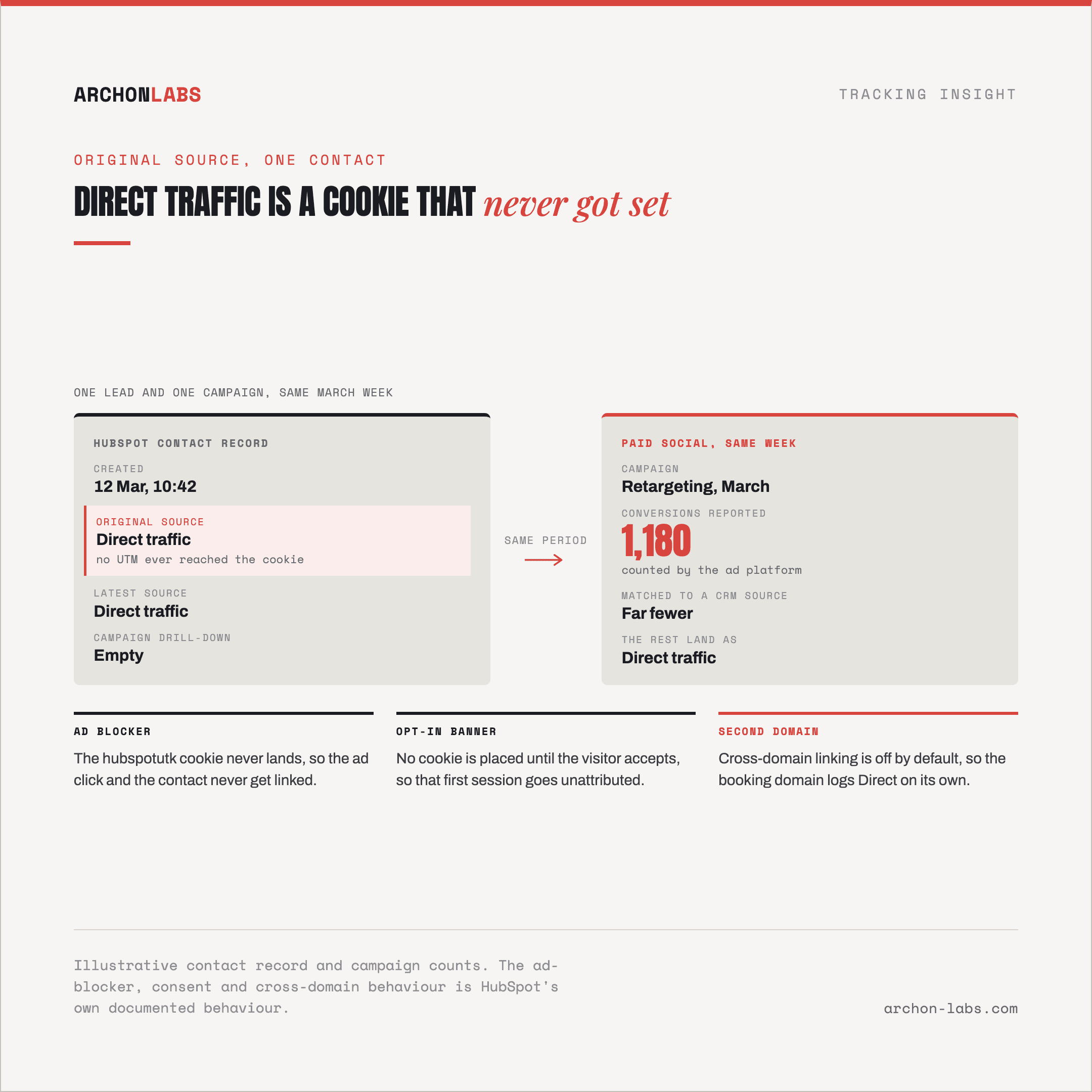
Consent adds a second gate on top of the ad-blocker one. If the opt-in consent banner is switched on for a visitor's region, HubSpot is explicit that "the pixel will not be able to place any cookies until the visitor confirms their consent" (HubSpot Knowledge Base). That is the correct legal behaviour under GDPR, not a HubSpot flaw, but it means every visitor who closes the banner without clicking accept is invisible to the traffic-source system for that entire session, UTM parameters and all.
Cross-domain visits are the third gap, and the one agencies notice least because it looks like a reporting quirk rather than a tracking one. Cross-domain linking is off by default. HubSpot's own worked example describes a visitor who arrives on one tracked domain from organic social, then moves to a second tracked domain: with cross-domain linking switched on, both sessions record organic social; without it, the second domain logs the visit as Direct traffic (HubSpot Knowledge Base). Agencies running a marketing site and a separate booking or portal domain hit this constantly, and the CRM never flags that anything was lost. It just quietly writes Direct.
None of these are bugs. They are the honest limits of a system built around one client-side cookie doing double duty as both an identity token and an attribution record. The problem is not that HubSpot tracks source data badly, it is that a business ends up trusting a single cookie snapshot as if it were the whole picture of how a lead arrived.
What good looks like
The fix is not squeezing more accuracy out of the CRM's own cookie. It is not depending on one first-touch snapshot for a decision that budget gets allocated against. Archon Pixel gives an agency a first-party analytics pixel that streams website events, unsampled, straight into a BigQuery table the agency owns. That raw event stream sits underneath the CRM rather than instead of it: HubSpot still does what it is good at, running the pipeline and the contact record, while the event data that reconstructs how a visitor actually moved through the site lives somewhere that is not limited to one cookie's first successful read.
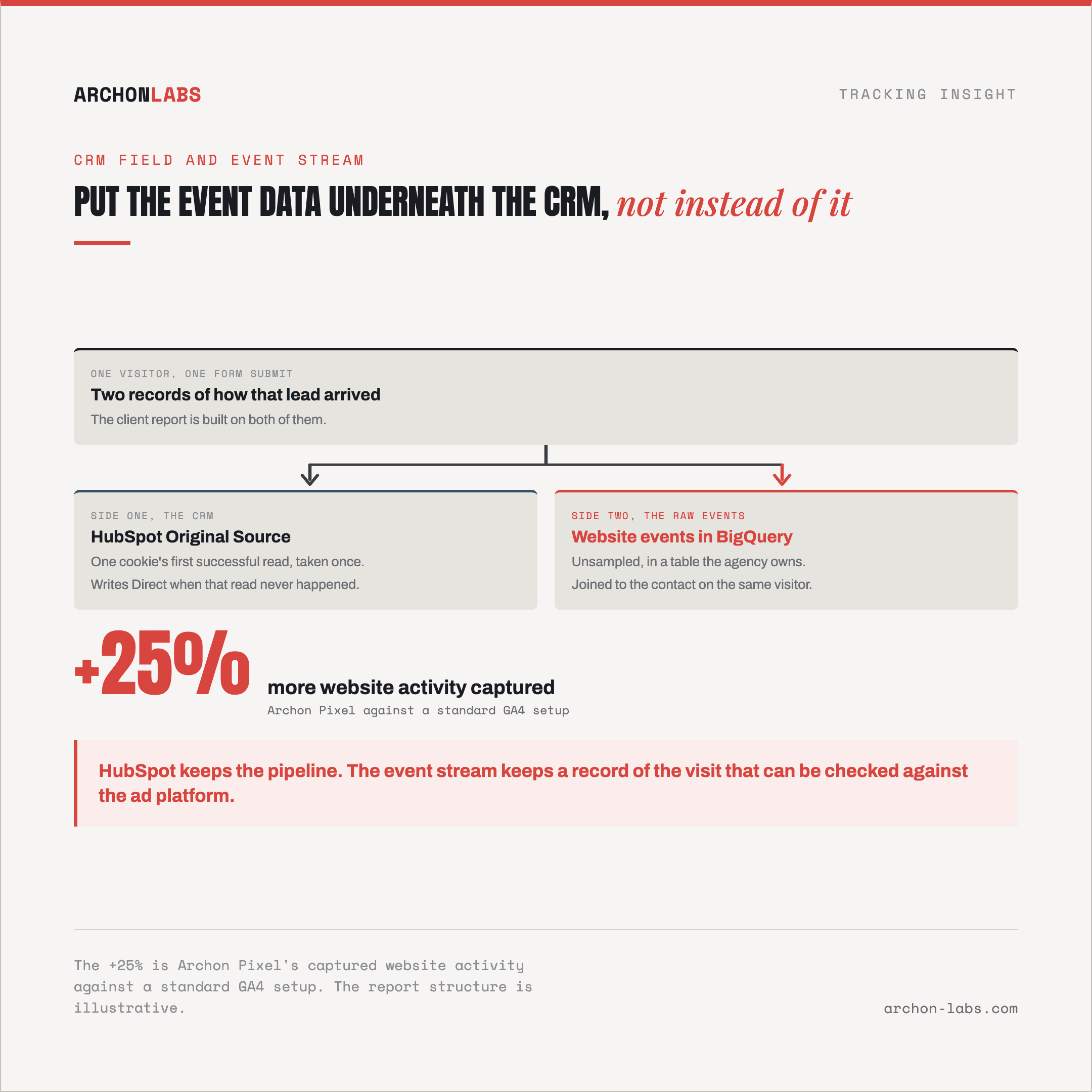
The practical difference shows up at reporting time. Instead of reconciling a Direct-traffic spike with a paid campaign nobody can explain, the raw event data and the CRM record can be joined on the same visitor, and the gap between what the ad platform paid for and what the CRM logged becomes visible instead of assumed. Archon Pixel captures +25% more of a client's website activity than a standard GA4 setup, which is the same category of gap that shows up as unexplained Direct traffic in a HubSpot source report. The goal is not to replace HubSpot's tracking, it is to stop treating a single consent-gated, ad-blocker-exposed cookie as if it were a reliable record of how a lead found the business.
FAQ
Skeptical questions from an agency that already relies on HubSpot's reporting.
Doesn't every visit get a UTM automatically?
No. UTM parameters only appear on a URL if someone built a tracking URL or an ad platform appended them automatically. Organic search, direct navigation and most referrals arrive with no UTM parameters at all, and HubSpot categorizes those through referrer-based heuristics instead, which is a separate and less precise system than UTM matching.
If a lead's browser blocks HubSpot's cookie, does the contact just show up as Direct traffic?
Usually yes, or the source ends up blank until a later session gets through. HubSpot's own documentation confirms ad blockers can block its tracking cookies and change the resulting traffic-source values, so a paid campaign that reached that visitor never gets credit in the CRM.
We run the same brand on two domains. Does HubSpot merge those sessions on its own?
No, cross-domain linking has to be switched on, or the visitor has to submit a form with the same email on both domains. Without either, a visitor who moves from domain one to domain two gets recorded as Direct traffic on the second domain, even if the original source was a paid campaign.
Our consent banner is required under GDPR. Does that mean we lose UTM data for those visitors?
For the session before consent is given, yes. With an opt-in banner enabled, HubSpot does not place its cookies until the visitor accepts, so any UTM parameters present on that first visit are never attached to a cookie HubSpot can later match to the contact.
Can we still trust Original Source for budget decisions?
Treat it as a useful signal, not a verified fact. It is a single cookie's first successful read, not a rebuilt attribution model, so it is worth checking against the raw event data and the ad platform's own numbers before it drives a reallocation.
An audit shows exactly where a client's HubSpot source data and their actual website events disagree, and by how much. Request a free audit.