The symptom
The consent management platform went in, a box that says "Consent Mode v2" got ticked, and the status report moved on. Nobody in that chain was asked whether the account runs the basic implementation or the advanced one, because the distinction reads as a checkbox rather than a choice.
A few weeks later the two outcomes look completely different and nobody connects them back to that tick. One account starts showing modelled conversions in Google Ads that GA4 never recorded, and the team assumes something is broken. Another account, running a similar budget, never gets a single modelled conversion, and the answer everyone reaches for is that the account must not clear the volume, when the real answer is that the mode installed by default never sent Google anything to model from in the first place.
Both modes are lawful. Both stop a tag from firing on cookies a visitor refused. What happens with that refusal afterwards is a separate measurement decision, and it was made by whichever consent platform shipped first, not by anyone at the agency.
Why it happens
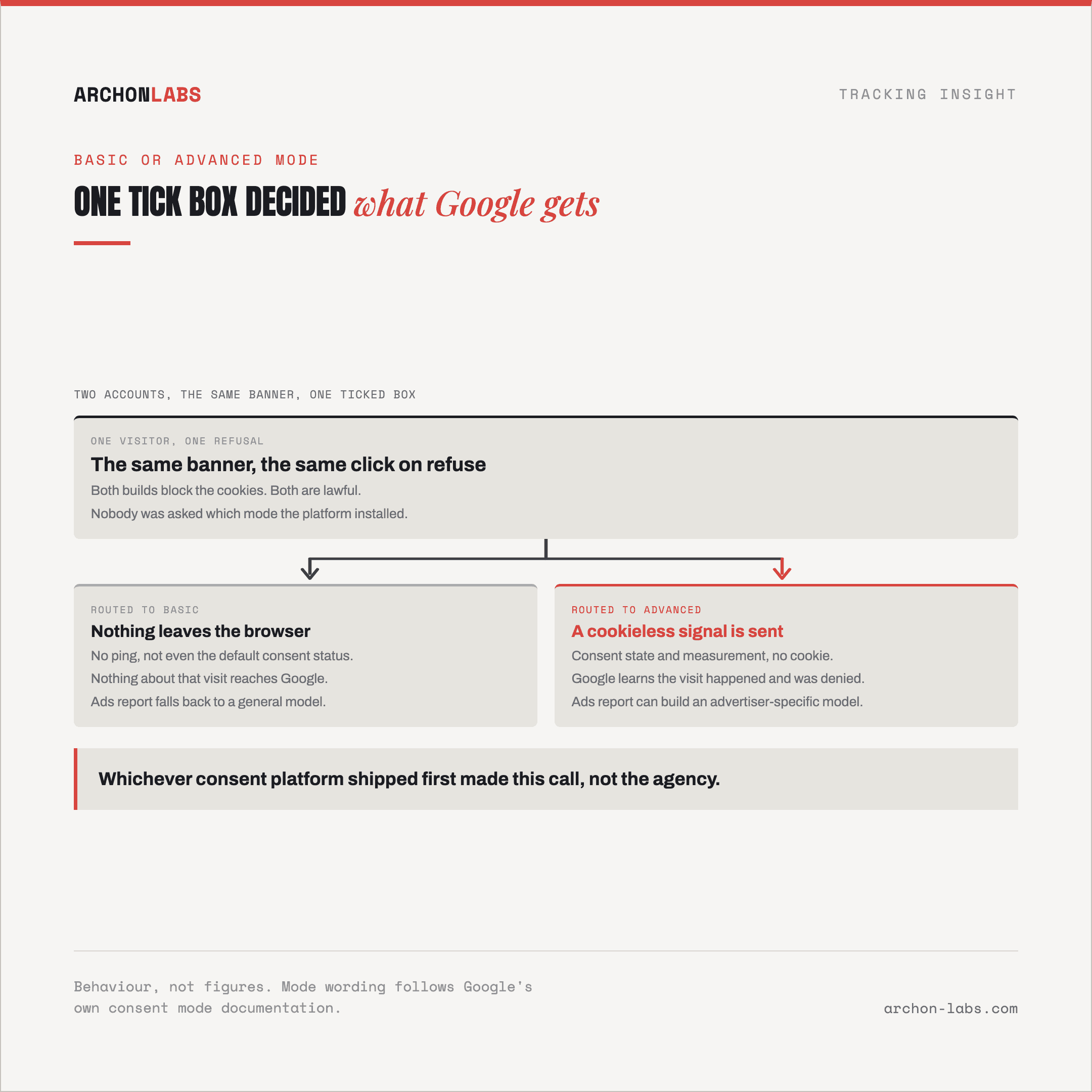
Because the two modes disagree about what a visitor's browser is allowed to say once someone clicks refuse.
Google's own documentation on consent mode lays out the split directly. In basic mode, tag loading is "blocked until user interaction with a consent banner", and once that interaction happens, "no data is sent before a user consents, not even the default consent status". A refusal in basic mode is a closed door. Nothing about that visit reaches Google, not a ping, not a timestamp, not the fact that a banner was shown at all.
Advanced mode opens a narrower door instead of closing it. Tags "load with defaults set to denied, unless configured otherwise", and when a visitor answers no, "consent state and measurements without cookies are sent". No cookie, no identifier, but a signal still leaves the browser: that a visit happened, roughly what it did, and that the visitor said no. Google's documentation is direct about why that signal exists, describing advanced mode as providing "an advertiser-specific model as opposed to a general model", against basic mode's flat description as a "general model (less detailed modeling)".
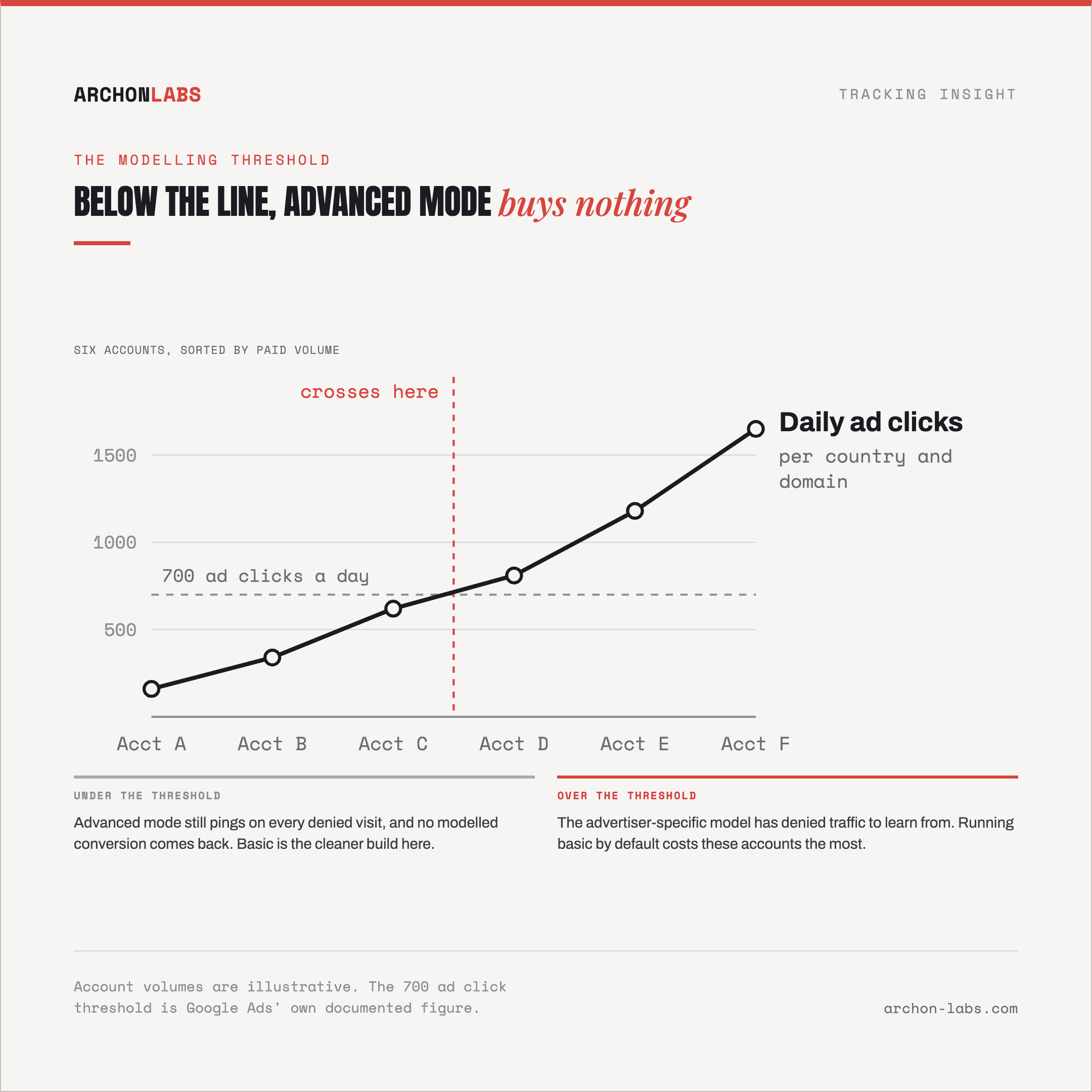
That difference only pays for itself once an account clears a separate bar. Google Ads' own documentation sets modelled conversions at "a daily ad click threshold of 700 ad clicks over a 7 day period, per country and domain grouping", on top of a correct consent mode implementation. Below that threshold, an account can run advanced mode for months, sending a cookieless ping on every denied visit, and never see a single modelled number back for the trouble.
Almost nobody at the agency chooses either side of this on purpose. Consent platforms tend to ship basic as the out-of-the-box setting, because it is the simpler build and the one that looks the most conservative to whoever signs off on the banner. Looking the most conservative and measuring the least are not the same property, and a plugin default quietly answering a measurement question is exactly how this stays invisible until an Ads account and GA4 stop agreeing.
What good looks like
Treat the mode as one measurement decision, not a compliance grade. Both modes are lawful, so the question worth answering per account is narrower: is there enough paid click volume for an advertiser-specific model to be worth building, or is the account better served by sending nothing at all once a visitor says no?
For an account nowhere near 700 daily ad clicks, advanced mode adds a category of outgoing data, a cookieless ping on every denied visit, that legal has to be told about and that never turns into a modelled conversion. Basic mode is the cleaner choice there, not because it is safer, but because there is nothing on the other side of the trade to collect.
For an account that clears the threshold with room to spare, the calculation flips. The general model basic mode falls back to is a coarser estimate built without any signal from the denied share of traffic, while the advertiser-specific model behind advanced mode uses exactly that signal, so the accounts with the most modelling volume to gain are also the ones paying the highest cost for running basic by default.
Neither mode changes what a refusal costs. A visitor who says no is not measured either way, in basic because nothing is sent, in advanced because nothing identifiable is sent. The mode only decides whether Google gets a cookieless signal to estimate from, never whether the refusal itself is recovered.
Mode is one of four configuration decisions behind a Consent Mode v2 setup, alongside how banner categories map onto Google's four consent types, which regions the denied defaults cover, and whether the consent state reaches the server container at all, covered in Consent Mode v2 without throwing data away. This is the audit Archon Consent runs on every account before touching a single toggle: which mode is actually installed, and whether that was ever a real decision.
FAQ
Is advanced mode less compliant than basic, since it still sends something after a refusal?
No. What it sends carries no cookie and no identifier, and the defaults still start at denied. Compliance is decided by whether a visitor's refusal is honoured, not by whether a cookieless ping exists, and both modes honour it. The two differ in what they measure afterwards, not in whether they ask correctly.
If we switch from basic to advanced, do modelled conversions start immediately?
Only if the account already clears Google's threshold, 700 ad clicks over a 7 day period, per country and domain grouping. Under that volume, switching modes changes what leaves the browser without changing what comes back in the report.
Which mode does our current banner run?
Ask, do not assume. Most consent management platforms ship basic as the default because it is the simpler build, and an agency that never revisited the setting is very likely still on it, regardless of what the account could support.
Does advanced mode recover any of the traffic that refuses consent?
No. A refusal removes that visitor from measurement in both modes. Advanced mode gives Google a cookieless signal to model from, which is an estimate standing in for missing measurement, never the measurement itself.
Can different clients reasonably run different modes?
Yes. This is an account-level measurement decision tied to paid click volume, not a house standard, so a large single-market client and a small multi-market client can land on opposite answers without either one being wrong.
If you do not know which mode your clients' banners are actually running, or whether the volume is there to justify it, a free tracking audit checks both.